Loyola and the Art of Beginning Anew
By Cristóbal Jiménez, SJ
In April 1535, Ignatius returned to Loyola from Paris. Seven years of intense study at the University of the Sorbonne had weakened his health, and the doctors advised him to go back to his homeland and breathe its native air. Ignatius obeyed – and Loyola gave him life once more. Loyola and the art of beginning anew. It was not the first time these lands had given him life. He was born here in 1491, and here he was reborn in 1521 when he arrived wounded after the Battle of Pamplona, his dreams and horizons shattered.
Beside the entrance to the Holy House stands a beautiful bronze sculpture depicting the moment Ignatius reaches his birthplace, wounded. It is the work of Joan Flotats, a disciple of Gaudí. In a way, that sculpture represents all of us. We are all wounded people. Our wounds are like an identity card – personal and non-transferable. Sometimes the wound is loneliness, or illness, or the collapse of cherished dreams. Ignatius invites us to discover that our wounds are not our only condition, nor our final one. Beyond them, we are blessed people, always held in the hands of a God who embraces us, sustains us, and contains us. That mystical experience opened infinite possibilities for Ignatius. For him, Loyola was always a place of physical and spiritual healing. And it remains the setting where many discover that it is possible to be reborn, to reset one’s life. Every year more than seventy thousand people come to these lands. Loyola never disappoints. Because of its spirituality, its history, and its overflowing natural beauty.

Art lovers are awed by a monumental complex built between the seventeenth and eighteenth centuries, a Baroque splendour conceived by Carlo Fontana, a disciple of Bernini. At its centre rises a majestic basilica crowned by a 65‑meter dome that dominates the Urola valley and has become an icon for the Ignatian family. Inaugurated in 1738, visitors wander in wonder through its circular floor plan, among carved marbles and Corinthian columns patiently adorned with intarsia. Outside, an imposing Baroque façade is flanked by two wings of seventy‑five meters each. The image is striking, giving visitors the sensation of walking at once through the Vatican and the corridors of El Escorial. The entire complex is conceived as a giant reliquary that shelters within it the jewel that gives meaning to everything: the birthplace of Saint Ignatius – the very place that confirms that here the art of beginning anew is possible. That experience is undoubtedly aided by the natural setting of lush forests, well‑tended gardens of centuries‑old trees, and a spirituality centre devoted to nurturing and promoting Ignatian spirituality.
The Society of Jesus is known worldwide for its schools, universities, and its commitment to faith and justice. Yet for Saint Ignatius, everything has a prior step – and that step begins in Loyola. In a letter written to his confessor in 1536, he said that the Spiritual Exercises were “the best I can in this life think, feel, and understand – both for a person’s own benefit and in order to bear fruit, help, and be of use to many”. Amid generous nature and centuries of art and history, Loyola remains contemporary for the same reason it was for Ignatius: because of that experience of interior silence and encounter with God which makes possible the art of beginning anew.
Related Posts:
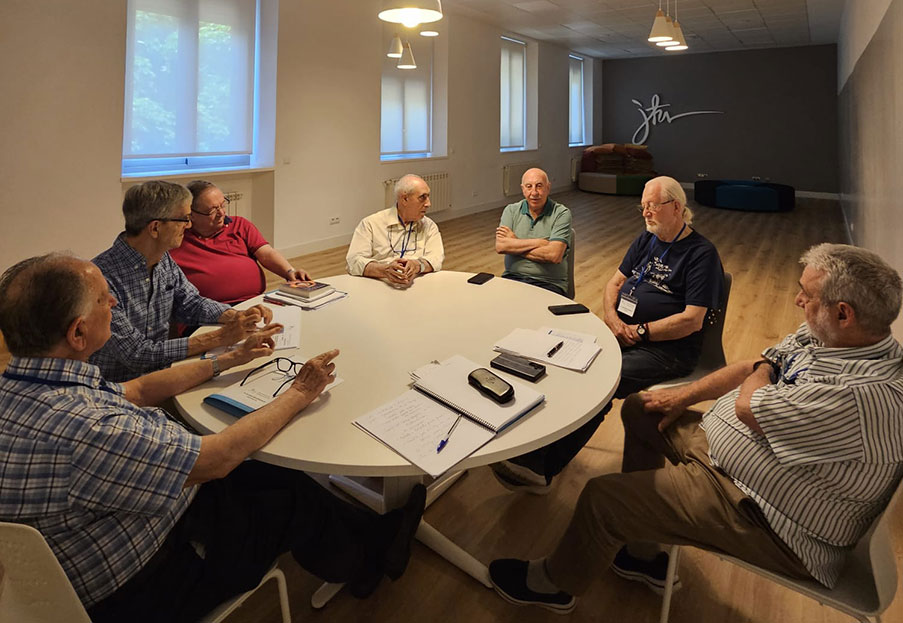
From 23 – 31 May, the Delegation for the Elderly of the Spanish Province organised the third edition of the formation course for elderly Jesuits at the Jesuit House in Salamanca. The program brought together 24 Jesuits aged between 70 and 85, with one or two participants in their 90s...

In April 2026, Pope Leo XIV made the first-ever papal visit to Algeria. Two weeks later, Father Arturo Sosa, SJ, Superior General of the Society of Jesus, travelled to Algeria to visit the small Jesuit community there for the first time since his election in 2016. The land of St Augustine, bishop of Hippo...

Father General Arturo Sosa has appointed Father Bart van Emmerik, as the Regional Superior of the Independent Region of the European Low Countries (ELC). Fr van Emmerik currently serves as the socius of the ELC Region and as delegate for spirituality...
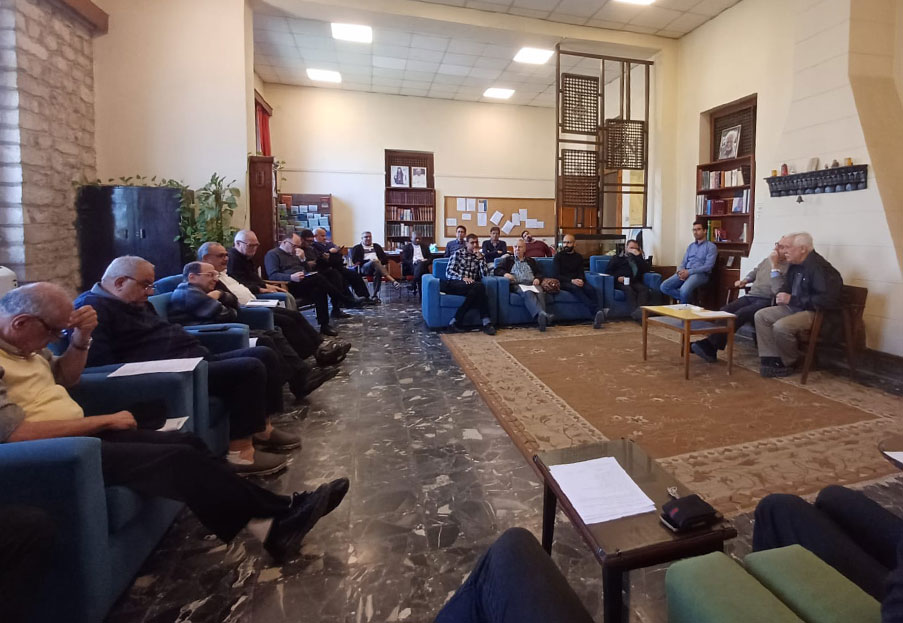
The Superior General of the Society of Jesus, Fr Arturo Sosa, has appointed Fr Marek Cieślik as the new Provincial of the Near East and Maghreb Province (PRO). The Province comprises Algeria, Egypt, the Holy Land, Iraq, Jordan, Lebanon, Morocco, Syria, and Turkey...
Father General Arturo Sosa has appointed Fr Mateusz Janyga as the new Provincial of the Province of Southern Poland of the Society of Jesus. Born in 1978 inWodzisław Śląski, Fr Janyga completed his secondary education in Rybnik before pursuing studies at...
The following article was written with information provided by Fr Michael Zammit Mangion, SJ – the Provincial of the Near East and Maghreb Province since 2020. He provided an on-the-ground testimony of Jesuit relief efforts in Lebanon.