July 1767: Expulsion of the Jesuits from the Paraquarensis Province
By Wenceslao Soto Artuñedo, SJ | Archivum Romanum Societatis Iesu (ARSI)
The Paraquarensis Province was separated from that of Peru in 1604. It comprised the territories of the present-day states of Paraguay, Argentina, Uruguay, part of Bolivia, and, temporarily, Chile. One of the most notable ministries in this Province was the Guaraní reductions, a network of thirty villages, home to 150,000 people, established with special permission from the Superior General, as it contravened the Constitutions of the Society of Jesus. The Jesuits succeeded in keeping them isolated from other influences and carried out exemplary socialisation and evangelisation, with a community-based approach, whilst preserving their language and other elements of their culture. However, this aroused much suspicion and envy that gave rise to the myth of a fabulously wealthy empire independent of the Spanish authorities, and marked the beginning of the (temporary) end for the Jesuits.
In a political climate hostile to the Jesuits, King Charles III of Spain, for reasons he kept ‘in his royal heart’, ‘deported’ the Jesuits, which entailed the loss of their nationality, with the consequent expulsion and seizure of their properties. In Spain, the expulsion was carried out from 1 to 3 April 1767, in a coordinated and surprise operation across all cities. The orders reached Buenos Aires (Argentina) on 7 June 1767 and were carried out throughout the month of July. The usual procedure was to knock at dawn, using some pretext such as the confession of a dying person; once the doors had been flanked, the Jesuits were summoned, the decree was read out to them, and their personal details were recorded, leaving them, from that moment on, as prisoners in their own homes until the time of embarkation. In total, some 450 Jesuits left the Province of Paraguay, out of around 2,500 in South America – a figure similar to that in Spain. Furthermore, the authorities had to expel a newly arrived expedition of 80 Jesuits, which had set sail from Cádiz (Spain) on 11 January 1767.
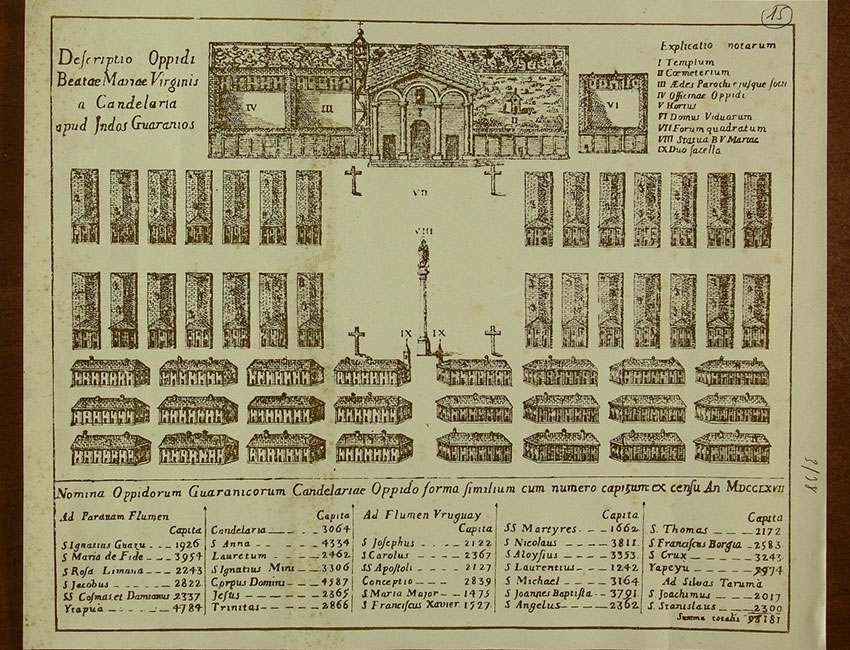
Map of the Candelaria reduction, 1767.
The reductions remained for a further year, as they were more isolated and replacements had to be found. Following royal instructions, the Provincial wrote a letter instructing the Jesuits to comply with the expulsion order, and the governor removed the local chieftains, taking them to Buenos Aires. The governor himself went to the reductions with 1,500 soldiers, accompanied by the replacement missionaries; consequently, by 22 August 1768, not a single Jesuit remained. They were taken down the Paraná and Uruguay rivers to the Casa de Ejercicios in Buenos Aires, to be embarked between 1 November and 8 December 1768. Upon arriving at El Puerto de Santa María (Cádiz, Cádiz) in mid-April 1769, the European Jesuits were able to return to their homeland, whilst the remainder travelled directly to Faenza (Italy), then part of the Papal States. There they suffered the fatal blow of the papal suppression in 1773, which was repealed by Pius VII’s restoration in 1814.
Related Posts:
A series of powerful earthquakes have struck Venezuela on 24 June, causing widespread destruction across affected communities and leaving thousands of people in urgent need of assistance...
On 21 June 1629, the sky above Beijing darkened for a few moments. To astronomers, it was a partial solar eclipse. To the Chinese imperial court, however, the phenomenon had a much deeper significance. For centuries in China, eclipses had been interpreted as messages from Heaven...
For eight decades, the Hogar Virgen de los Dolores (HVD) has served Venezuela’s most vulnerable children, building a legacy rooted in the Jesuit commitment to education and social justice. What began as an apostolic initiative has now evolved into a model of education...
On 5 June 1546, Paul III signed the brief “Exponi nobis”, which addressed how men who did not belong to the original group of highly qualified priests of the Society could nonetheless belong to it and serve its mission. The brief did so by establishing the grade of coadjutor...

On 22 May 1622, Pedro Páez died in Gorgora (Gondar, Ethiopia). He was born in Olmeda de las Fuentes (Madrid, Spain) in 1564 and entered the Society at the age of 20 at the novitiate in Villarejo de Fuentes (Cuenca, Spain), although older biographies state that he entered in Coimbra...

One of the Universal Apostolic Preferences promulgated by Father General in 2019 invites the Apostolic Body of the Society of Jesus to “Walk with the poor, the outcasts of the world, those whose dignity has been violated, in a mission of reconciliation and justice”...