Synodality and Reconciliation with young victims of organised crime
By Elías López, SJ | Province of
Spain – International Coordinator, Peace and Reconciliation of UNIJES
[From “Jesuits 2025 - The Society of Jesus in the world”]
The Spiritual Exercises of St Ignatius as spiritual anchors to help young victims of suburban gangs find reconciliation: a six-step pathway.
Twenty-three-year-old Pedro told us the following story: “One of the criminal gangs in my neighbourhood killed two of my little nephews. I was so angry that I rushed into the street like a madman, clutching a knife. I wanted to kill the assassins. However, thanks to some neighbours who grabbed hold of me and stopped me, I avoided becoming another murderer myself.” As the gang also wanted to kill Pedro for trying to avenge the murders, he had to leave the neighbourhood for over a year until things calmed down. Now, Pedro is back, but so afraid he hardly ever leaves the house. That same terror also preys upon the minds of the 20 young Afro-Colombians we work with in neighbourhoods on the outskirts of the Colombian city of Buenaventura. Fear of catching a bullet confines them to their homes as if they were in prison. Being teenagers and young adults, they need to socialise but simply cannot. For some, the anxiety and depression are chronic, leading them to contemplate suicide repeatedly. To compound their fragile state, the State is absent, failing to offer them the pyscho-social help they so desperately need. Their families, being victims of social exclusion and poverty, cannot afford to pay for private help.
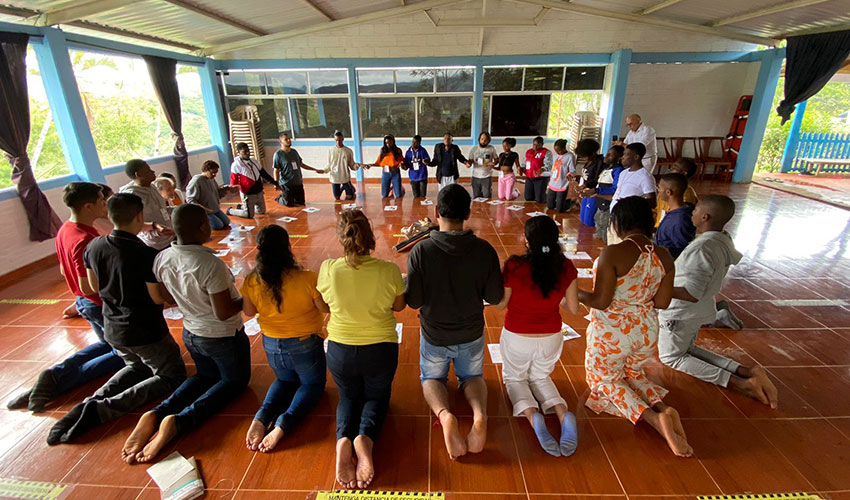
In a workshop we call in Church terms «Synodality and Reconciliation», we work first on creating a safe space where they can name and analyse their personal conflicts. Then, using tools including the spiritual examen, spiritual conversation and discernment and group work, we discern as a group the next possible step towards “re-establishing fair and equal relationships” in the neighbourhood via:
1. Co-existence i.e., ensuring
their physical and emotional safety.
2. Living together i.e., ensuring
there is justice, that people have equal rights.
3. Communion i.e., inviting them to
accept forgiveness, which re-humanises all parties, heals the root of unequal
relationships and reconciles.
We know that healing this amount of pain and death is impossible unless we connect to each individual on a spiritual level – and share that connection. That is why our work is grounded in the Spiritual Exercises through what we call “the six spiritual anchors of Ignatian reconciliation”.
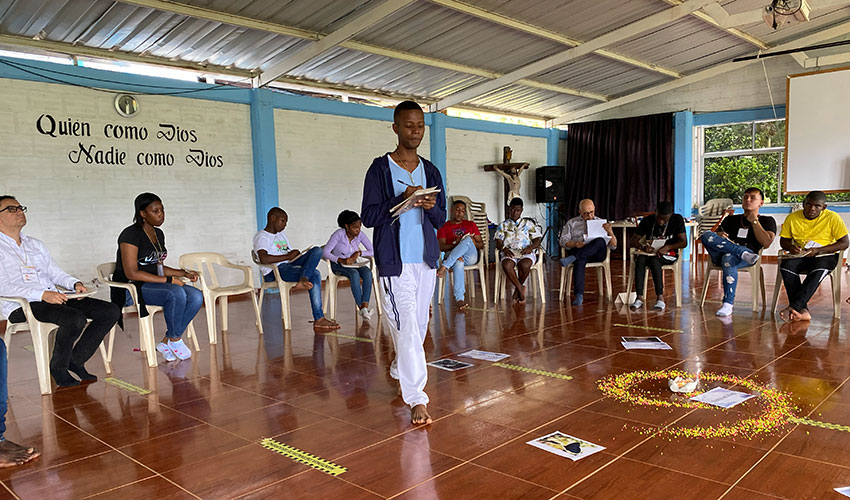
1. What is your personal “Source of Life?” capable of healing this amount of death? The first day is focussed on getting in touch with the Principle and Foundation of each young adult, their Source of Life, where they can find the power of love in the midst of violence. This creates a space for care, trust and tenderness where they feel safe enough to map out their conflicts. This first anchor connects to the first Universal Apostolic Preference – Showing the way to God, or our personal reconciliation with God, as the source of all reconciliation.
2. Will you let your Source of Life forgive you? The first week involves growing in awareness that – albeit to a lesser degree ‒ each individual also causes conflict through their own violent behaviour. Therefore, they also need forgiveness and personal transformation. Starting with themselves, acknowledging their own personal shadows and letting their Source of Life forgive them helps them to empathise with their aggressors. They understand that by sheer good luck, despite their personal weaknesses and living in the same violent setting as the gangs, they have not joined them. That leads to self-forgiveness and gratitude.
3. What choices are you making amidst the violence? In the second week they enter “the school of discernment”, where they learn, with clear-eyed humility, to choose freely. That involves a choice to not only be as gentle as doves (i.e. not reacting to violence with more violence) but also to be as cunning as serpents to prevent the bad spirit from trapping them in the cycle of violence.
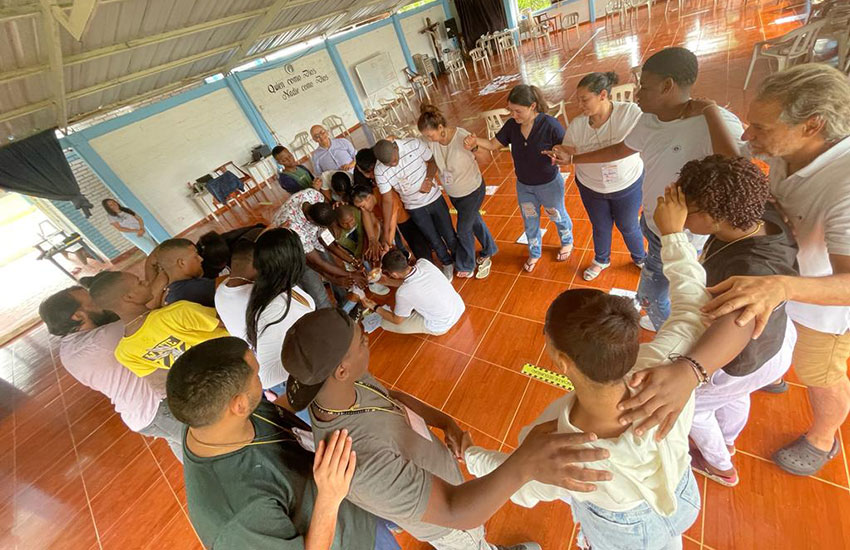
4. Do I forgive others’ violence towards me? After returning to their neighbourhoods, they go through the third week, the passion of the structural violence that preys upon them. What is offered here is Jesus’ “subversive meekness” displayed in his passion. The most radical sign of this is the forgiveness he offers from the cross. This part corresponds to the second Apostolic Preference: walking with the excluded.
5. Is hope possible amid so much violence? That is what we consider during the fourth week, the resurrection. Violence does not have the last word. This connects to the third Apostolic Preference: accompanying young people towards a hopeful future.
6. Do you see God already at work in all things and opening up the path ahead? Finally, in the contemplation to attain love we try to help them learn to live as “co-reconcilers” with the Spirit, i.e., as contemplatives in action who transform neighbourhood conflicts, and sustain their socio-political activities, through their personal support networks and those of other agents of transformation.
There can be no synodality and the Church cannot be a field hospital without, to quote a much-loved phrase of St Ignatius, “discerning reconciliation”, according to various times, places and people.
Related Posts:
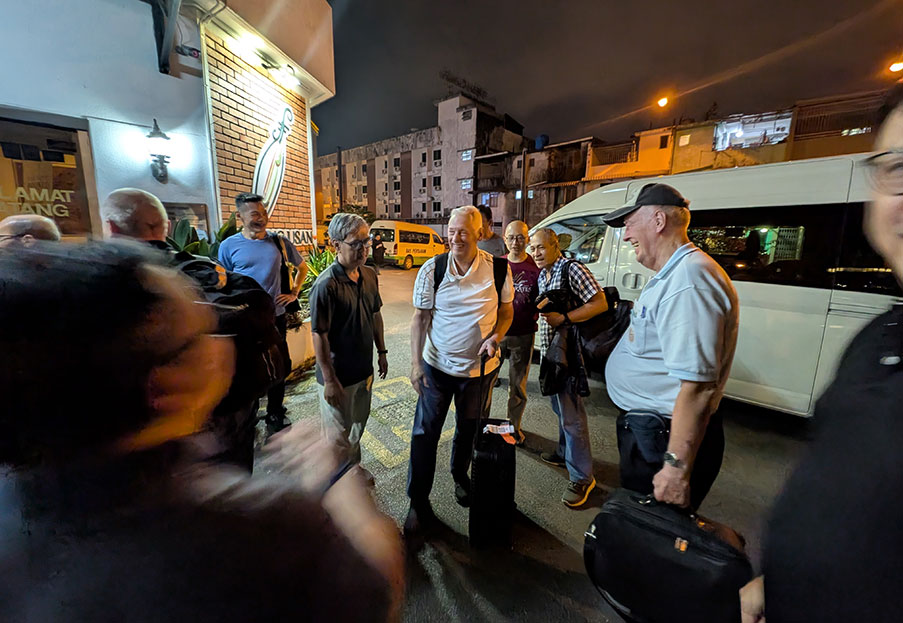
Fr Arturo Sosa, SJ, arrived in Kuching, Malaysia to begin his 5th apostolic visitation of the Jesuit Conference of Asia Pacific (JCAP). With a full schedule of meetings and travel between different Jesuit ministries and communities in Malaysia, Thailand and Indonesia...

The Paraquarensis Province was separated from that of Peru in 1604. It comprised the territories of the present-day states of Paraguay, Argentina, Uruguay, part of Bolivia, and, temporarily, Chile. One of the most notable ministries in this Province was the Guaraní reductions...
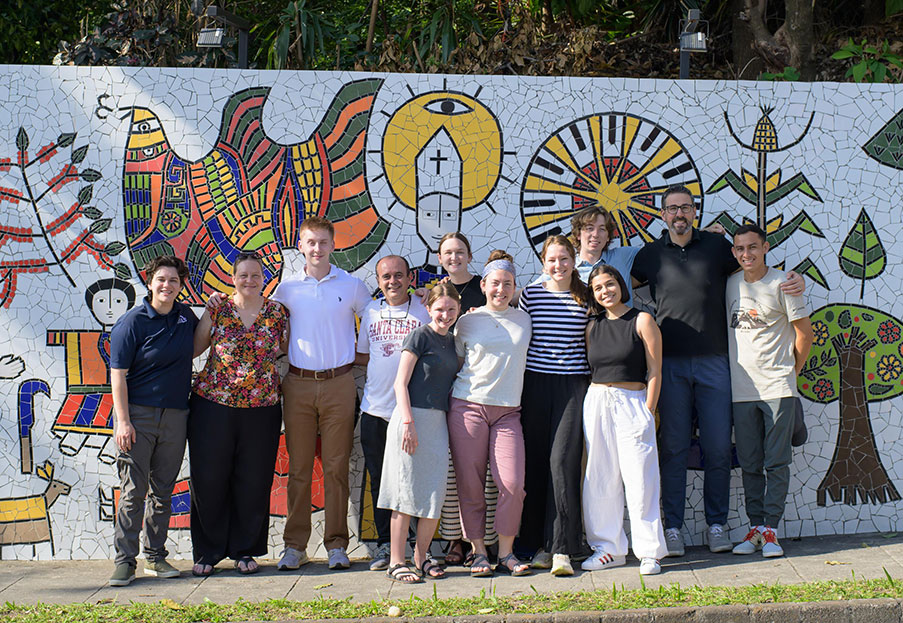
Launched at the 2018 IAJU Assembly, Magis Exchange offers students the chance to study across borders, cultures and academic contexts. It is more than an academic mobility program: it embodies a shared commitment to forming young people ready to engage thoughtfully...
The Society of Jesus has designated Loyola University Chicago as the new home for the Discerning Leadership Program (DLP) which provides leadership formation, accompaniment and resources for senior Church leaders. Loyola University Chicago will henceforth steward...
When nearly one hundred facilitators of discernment gathered in Salamanca in late 2025, something more than a meeting took place. Convened at the desire of Fr Arturo Sosa, Superior General of the Society of Jesus, the Ignite the Way gathering set out to form facilitators for processes of communal discernment...
“On 15 January 2023, after the Angelus – I was travelling to Rome and we watched from the train – Pope Francis announced officially the ecumenical prayer vigil for 30 September of that year. He said that the path to Christian unity and the Church’s synodal conversion are linked...”