“On 15 January 2023, after the Angelus – I was travelling to Rome and we watched from the train – Pope Francis announced officially the ecumenical prayer vigil for 30 September of that year. He said that the path to Christian unity and the Church’s synodal conversion are linked...”
Frédéric Fornos, SJ
Pope Francis: in memoriam
The Invisible Ministry of Pope Francis
Frédéric Fornos, SJHow many times did you hear Pope Francis ask: “Please, pray for me!”? Those words were never a mere courtesy – they expressed a deep conviction: Francis believed wholeheartedly in the fruitfulness of prayer. He was a man of prayer. And one cannot truly understand the consistency of his life and ministry without entering into this invisible yet essential dimension of his existence.
Prayer: the Heart of the Church’s Mission
For Pope Francis, prayer was not simply one practice among many – it was at the very heart of the Church’s mission. In a world that pushes toward fragmentation, conflict and division, he never tired of reminding us of the urgency of prayer. Prayer draws us out of the “globalization of indifference” and leads us into a “culture of encounter”. Through prayer, each person can become open and available to the mission of Christ, at the heart of the world.
This is why he wished to establish a Pontifical Work to express, in his own words, that “prayer is the heart of the Church's mission.”
This conviction is rooted in a long history. In 2010, Fr Adolfo Nicolás, SJ, then Superior General of the Society of Jesus, had initiated a process of re-creation of the Apostleship of Prayer – an ecclesial service born in 1844, with a rich and far-reaching history across the world. In 2014, Pope Francis formally approved it. Then, seeing the fruitfulness of this prayer network, he committed himself to supporting it actively.
As early as 2017, during an Angelus address, he invited the faithful to “join the Pope's Worldwide Prayer Network, which spreads, also through social networks, the prayer intentions I propose for the Church each month. In this way, the Apostleship of Prayer moves forward and communion grows.”
Pope Francis made the point forcefully in 2016, during the Extraordinary Jubilee of Mercy, when he met members of the Prayer Groups of Padre Pio, a movement of lay faithful formed around prayer and works of charity. “[Prayer] is the Church’ greatest strength,” he said, “one which we must never let go of, for the Church bears fruit only if she does as did Our Lady and the Apostles, who ‘with one accord devoted themselves to prayer’” (Acts 1:14). In 2019, addressing the Pope’s Worldwide Prayer Network for its 175th anniversary, he put the same conviction more simply: “The heart of the Church’s mission is prayer. [...] We can do so many things, but without prayer it does not work.”
The Pope’s Prayer Intentions: A Window Open to the World
To give concrete support to his Worldwide Prayer Network, Pope Francis recorded a video message each month: The Pope Video. In it, he explained why the prayer intention he was entrusting to the whole Catholic Church was urgent – both for the Church’s mission and for the life of every person. It was as if, each month, he opened a window so that we might see, hear and feel the challenges of the world – so that we might place ourselves at the service of Christ’s mission, a mission of compassion, through prayer and action.
In January 2019, as young Catholics were preparing to gather in Panama for World Youth Day, Pope Francis launched his personal profile on Click To Pray, the official prayer platform of the Pope’s Worldwide Prayer Network. Speaking at the Angelus on 20 January, he invited young people in particular to download the app and pray with him, saying that he would use it to share “prayer intentions and requests for the mission of the Church”.
Prayer is an invisible dimension of our lives. It can easily be overlooked, because its fruits are not immediately visible. Like a seed planted in the ground, it needs time – but its fruitfulness is immense. As the Gospel tells us: it yields thirty, sixty, even a hundredfold (Mk 4:20).
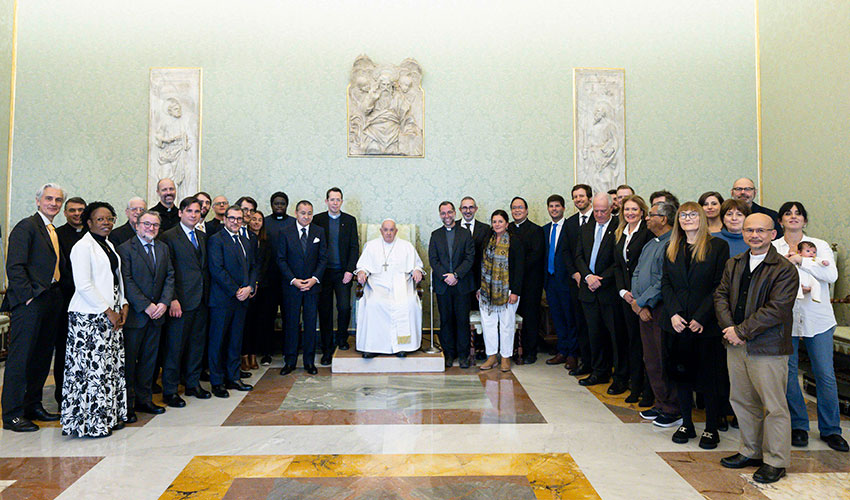
© Vatican Media
Pope Francis: A Man of Prayer
One cannot truly understand Pope Francis – the consistency of his life, the strength of his ministry – without prayer. We only see the tip of the iceberg; the submerged part, the hidden part, is the most important.
Francis prayed the Liturgy of the Hours and the rosary, and spent time in adoration. But he also meditated deeply on the Word of God. To prepare his homilies at Santa Marta, he would begin the evening before, listening to the Word and letting it resonate in his heart throughout the following day, like a quiet melody playing in the background. The Word of God shaped and permeated his entire life.
The Spiritual Exercises of Saint Ignatius give a central place to the Word of God – to see, hear, love and follow Jesus, and to grow each day in docility to the Holy Spirit. This Word resonates with the realities of daily life; it opens us to the world and to one another. To pray is always to seek union with Jesus Christ, and to choose him and walk with him in the service of his mission.
The Holy Father’s prayer intentions call to mind the great challenges facing humanity and the Church’s mission. In a fragmented world marked by tension, Pope Francis – as Pope Leo XIV does today – sought to build bridges between cultures and continents, and to foster dialogue, encounter and communion.
The Pope’s Worldwide Prayer Network, serving these intentions for more than one hundred and eighty years under the name of the Apostleship of Prayer – to which the Eucharistic Youth Movement is linked – helps to mobilize people each month around the challenges of our world and the Church’s mission: a mission of compassion, rooted in union with the Heart of Christ.
Over the eleven years during which I had the joy of working with Francis, at the service of his pontificate, I came to discover in him a true spiritual father: a free man, deeply attentive to others, full of warmth and kindness – and above all, a man with a wonderful sense of humor. In his apostolic exhortation on holiness, Gaudete et Exultate, he noted that humor is indeed one of the hallmarks of sanctity.
[Original in French]
© Jesuit.Media