Towards reducing the carbon impact of a Jesuit Province: the first steps
By Xavier de Bénazé, SJ | French-speaking Western European Province
[From “Jesuits 2024 - The Society of Jesus in the world”]
A Jesuit Province has chosen to respond seriously to the Laudato si’ call - for ecological ... and spiritual reasons.
Since 2021 the EOF Province (South Belgium, France, Greece, Luxemburg and Mauritius) has been more actively engaged on the path of ecological and social transition. We are reviewing here more than two years of a conversion process.
Before starting this assessment, let us recall that:
• This process is rooted in the conversion of the Church and the Society of Jesus, driven by the encyclical Laudato si’, the decrees of the 35th General Congregation and our four Universal Apostolic Preferences [UAP].
• The dynamic commitment of the EOF Province is rooted in God, especially since our Province retreat of 2018, which had chosen the theme: “Integral Ecology”.
• In order to make this conversion concrete, the Province decided to focus on CO2 emissions. That is, to spend time on issues and projects that lead to concrete results (with the support of a layperson employed on a full-time basis and a Jesuit on part-time). From the start, we chose to work within the European network of the “Jesuit European Social Centre”.
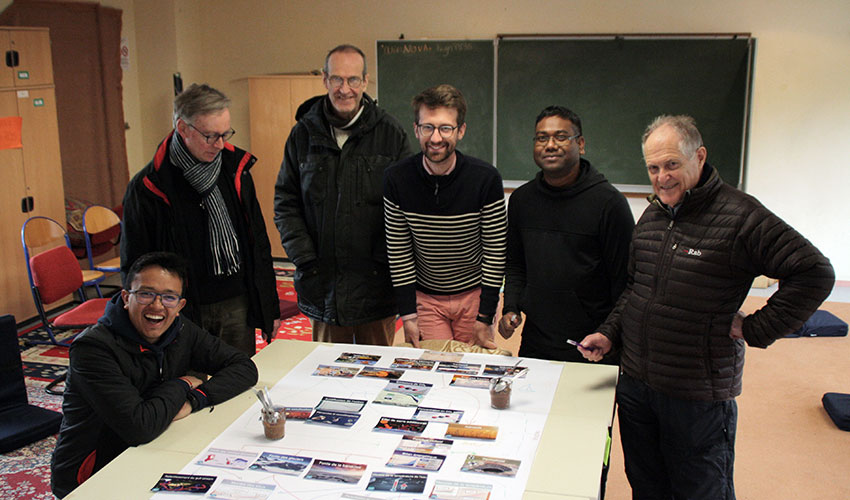
This background work made it possible to know where our Province stands concerning its CO2 emissions (through its communities). Two main observations emerge:
1. There are variations according to the countries, mostly because the national sources of electricity are more or less carbon-intensive. This reminds us that these transition issues require a regional, national and international political vision!
2. All in all, our Jesuits are below their national averages but above the medians. In other words, we belong to the half of the population with the highest CO2 emissions. Therefore, genuine climate and social justice requires us to act.
In addition, with regard to the four usual CO2 emission sources, we notice that:
• “General consumption” is quite moderate. To put it in another way, we are already living a sound kind of happy sobriety. It may well be that this comes from the wisdom of our vow of poverty. The inspiration therefore is to be found in our following of Christ. This is worth pondering, while the other three points will require more effort on our part.
• The first source of CO2 emissions is our buildings. Our houses are generally old, poorly insulated, heated with fossil fuels and too big for us. We will therefore have to work not only on technical changes (insulation, heating), but also on a proper use of our buildings.
• As far as food is concerned, we are within the national average, which is however incompatible with international climate objectives. Since, in this regard, one of the main sources of CO2 emissions is our consumption of meat (especially red meat), we need to work on making our dishes more vegetarian. All the more so since food is also a major source of our impacts on other planetary boundaries, in particular land use change and the ongoing sixth mass extinction of biodiversity.
• With respect to transportation, we are slightly below national averages. Which is not satisfactory. We need to think about reducing our use of carbon-based transportation (planes and cars) and opt for public transportation, especially trains for long distances and bicycles for daily life outings.
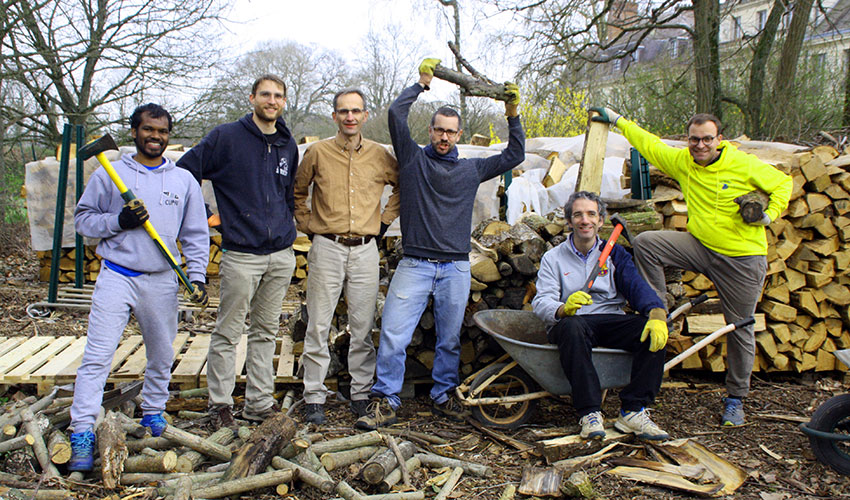
Thanks to these first lessons, we know now where we are starting from: we will have to work at the personal, community and provincial levels to try to halve our CO2 footprint per Jesuit per year by 2030, and move towards 1.5-2tons CO2 per year per person. However, today, if the global economy as a whole does not decarbonise faster than the current rate, we will not be able to achieve these goals on our own. Our first projections show that, so far, by acting ambitiously, 40 % of the effort is in our hands. It is up to us to carry out those acts of justice and love that provide a taste of eternity in God.
But we have also to bring about wider changes.
This is where the networks of universities, social centres and schools of the
universal Society are precious assets. Which is why our Province decided, in
2023, to hire an extra lay person to accompany our 25 schools in ambitious
transition projects. The challenge is huge!
For those who wish to “work with others in the care of our common home”,
the Ignatian maxim of the Hungarian Jesuit Gábor Hevenesi (1656-1715) has a
burning relevance: “The first rule of action is this: so trust in God as if the
success of things depends entirely on you, and nothing on God; yet put all your
labour into it as if God alone would do everything (and) you nothing”.



Related Posts:
From 23 – 31 May, the Delegation for the Elderly of the Spanish Province organised the third edition of the formation course for elderly Jesuits at the Jesuit House in Salamanca. The program brought together 24 Jesuits aged between 70 and 85, with one or two participants in their 90s...

Pope Francis raised climate change to global consciousness as the defining moral issue of our time. As a result, the Church has become a global voice urging political accountability and personal responsibility for healing the planet. Building on his legacy, Pope Leo vigorously calls for urgent climate action...

The annual meeting of Eco-Jesuit delegates in South Asia, held at Inigo Bhawan in Matigara, Darjeeling, became much more than a routine gathering. Set against the fragile ecology of the Eastern Himalayas, the meeting turned into a moment of discernment on the future...

In April 2026, Pope Leo XIV made the first-ever papal visit to Algeria. Two weeks later, Father Arturo Sosa, SJ, Superior General of the Society of Jesus, travelled to Algeria to visit the small Jesuit community there for the first time since his election in 2016. The land of St Augustine, bishop of Hippo...

Father General Arturo Sosa has appointed Father Bart van Emmerik, as the Regional Superior of the Independent Region of the European Low Countries (ELC). Fr van Emmerik currently serves as the socius of the ELC Region and as delegate for spirituality...

The Social Justice and Ecology Secretariat (SJES) of the Society of Jesus has released its 2025 Annual Report, “The Promotion of Justice is Fueled by Hope”. The report details regional milestones at the conference level, the results of global advocacy, and its commitment to the mission of...