Reimagining Eco-Justice: South Asian Jesuits Move Toward Advocacy
By Fr Lumnesh S. Kumar, SJ, Ecology Commission Coordinator of the Karnataka Jesuit Province and Assistant Professor in the Department of Environmental Science at St. Joseph’s University, Bengaluru.
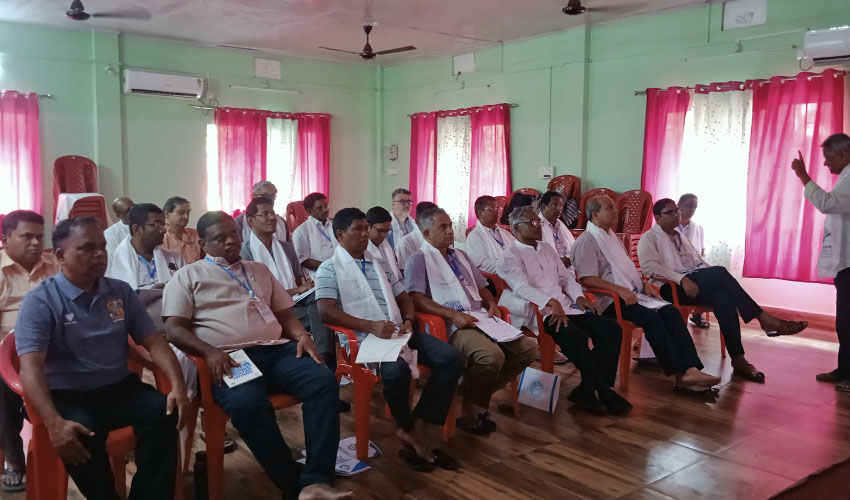
The annual meeting of Eco-Jesuit delegates in South Asia, held from 17-19 April 2026 at Inigo Bhawan in Matigara, Darjeeling, became much more than a routine gathering. Set against the fragile ecology of the Eastern Himalayas, the meeting turned into a moment of discernment on the future of Jesuit ecological engagement in the region. Representatives from across the Jesuit Conference of South Asia (JCSA) gathered to reflect on one pressing question: how can Jesuit ecological efforts move beyond awareness toward meaningful advocacy and systemic change?
A Context of Urgency and Hope
Held during the Easter season, the gathering carried a spirit of hope rooted in action. Participants recognised that the ecological crisis is no longer distant or abstract. It is immediate, complex, and deeply unjust, disproportionately affecting the poor and vulnerable.
In his keynote address, Fr Stanislaus D’Souza reflected on the Jesuit ecological journey through the lenses of past, present, and future. He acknowledged the many initiatives already undertaken across the Conference, including environmental education, grassroots engagement, and sustainability efforts within Jesuit institutions. At the same time, he pointed out important shortcomings.
“Our efforts are often fragmented”, he observed. “Ecology is still treated as secondary in many places, rather than as something central to our mission.”
Understanding the Wider Crisis
Environmentalist Dr Sunita Narain, Director of the Centre for Science and Environment in New Delhi, situated the ecological crisis within a broader global reality. She spoke about three major forces shaping the present world: climate disruption, political and economic instability, and the rapid rise of artificial intelligence.
“These crises are interconnected,” she said, “and together they increase vulnerability, especially among the poor.” Her message was direct and uncompromising:“Sustainability without justice is impossible.”
She challenged approaches that rely solely on technology and called instead for development models that are inclusive, people-centred, and attentive to livelihoods, equity, and access to resources.
Advocacy and Collaboration as Integral to Mission
“Advocacy is more than creating awareness”, said Fr Frazer Mascarenhas. “It means engaging systems, influencing policies, and amplifying the voices of the marginalized.”
He noted that such engagement requires collaboration, competence, courage, and long-term commitment. Advocacy, he insisted, is a natural extension of the Jesuit call to faith and justice.
Offering a global perspective, Fr Roberto Jaramillo reflected on the gradual process through which Jesuits are learning the language and practice of advocacy. “We are still learning advocacy”, he admitted. “It requires humility, openness, and the willingness to work with others.”
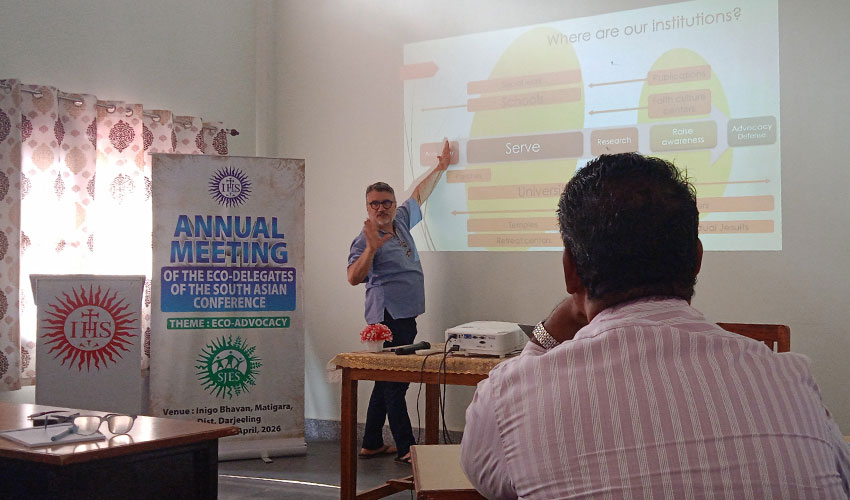
He highlighted the importance of networking across sectors and referred to international climate conferences as examples of how sustained collaboration can influence public discourse and policy. At the same time, he raised a concern that many ecological initiatives remain inward-looking.
“Energy saving and waste management are important”, he noted, “but they are not enough. We must also engage the wider systems that shape ecological destruction.”
Experiences from Across Provinces
Delegates shared ecological initiatives from their respective Provinces, including eco-education programmes, sustainable campus practices, renewable energy projects, community outreach, and environmental research. Jesuit schools and higher education institutions were recognised as particularly important spaces for nurturing ecological awareness and responsibility.
At the same time, recurring challenges emerged across the discussions: weak coordination, limited networking, insufficient policy engagement, lack of trained personnel, and difficulty in translating awareness into measurable action.
Participants acknowledged the need for stronger institutional policies, dedicated ecological centres, improved formation and training, and greater collaboration across Jesuit sectors. Many also stressed the importance of integrating indigenous and traditional ecological knowledge with modern scientific approaches.


Emerging Directions
The meeting concluded with several concrete proposals, including the possibility of a coordinated climate justice campaign across South Asia and preparation for future global ecological processes. Delegates also discussed a large-scale mobilisation planned for 4 October, the Feast of St Francis of Assisi.
More significantly, the gathering revealed a noticeable shift in mindset. The focus is gradually moving from isolated activities to measurable outcomes, from institutional inwardness to collaboration, and from awareness-building to advocacy.
Looking Ahead
The path ahead remains demanding. Advocacy requires time, formation, patience, and courage. The Darjeeling meeting did not offer easy solutions, but it clarified an important direction for Jesuit ecological engagement in South Asia.
The deeper challenge now is not only how to care for creation, but how to help transform the systems that continue to threaten it.

Related Posts:

Pope Francis raised climate change to global consciousness as the defining moral issue of our time. As a result, the Church has become a global voice urging political accountability and personal responsibility for healing the planet. Building on his legacy, Pope Leo vigorously calls for urgent climate action...
A Croatian Jesuit who crossed half the world to serve the poorest communities of Bengal, Fr Ante Gabrić spent five extraordinary decades building up the Church in the Sundarbans – one school, one clinic, one family at a time. His cause for beatification is now before the Church...

The Social Justice and Ecology Secretariat (SJES) of the Society of Jesus has released its 2025 Annual Report, “The Promotion of Justice is Fueled by Hope”. The report details regional milestones at the conference level, the results of global advocacy, and its commitment to the mission of...

On the morning of 24 March 1964, Fr Herman Rasschaert celebrated Mass in his remote parish of Kutungia, 240 kilometres from Ranchi on the Orissa border. He knew what was happening in nearby Gerda village. Word had spread: a frenzied mob was attacking Muslims trapped...

What began as a simple encounter between urban students and forgotten hamlets has evolved into a profound Jesuit mission of accompaniment. For eight years, St. Xavier’s University Kolkata has answered the Society of Jesus’ call to “walk with the excluded” through its transformative...

In the context of the First Conference on Transitioning Away from Fossil Fuels, which will be held in Santa Marta, Colombia, from 24 to 29 April 2026, the Jesuits for Climate Justice Campaign is presenting its Statement for COP31...