One year with Leo XIV: polarisation, the heart and the world
By Miguel Pedro Melo, SJ
The centrality of the heart
The first year of a pontificate is measured not only by the decisions taken or the documents published, but by the underlying orientation that begins to become visible. In the case of Leo XIV, this orientation can be expressed with disarming simplicity: peace as a gift that is born in the heart, becomes communion and translates into the transformation of the world.
From the very first moment, this intuition was clear. On the Vatican balcony, Leo XIV inaugurated his pontificate with simple words: “Peace be with you” (Jn 20:19). He did not offer a political programme for the Church nor an admonition to the world, but a Gospel key to open the times to another possibility. Peace, in his perspective, is not the result of external balances nor does it reduce to a product of effective negotiations. It is something that springs from the heart transformed by encounter.
Let us recall his words at the Jubilee of the Eastern Churches:
“For my part, I will make every effort so that this peace may prevail. The Holy See is always ready to help bring enemies together, face to face, to talk to one another, so that peoples everywhere may once more find hope and recover the dignity they deserve, the dignity of peace. The peoples of our world desire peace, and to their leaders I appeal with all my heart: Let us meet, let us talk, let us negotiate!”
This
shift to the primacy of the heart and of encounter is decisive. In a time that
tends to seek solutions only at the level of structures, Leo XIV places the
centre back in the human heart. Not out of spiritual naivety or clerical
obsession, but out of fidelity to the realism that springs from the Gospel. As
the Second Vatican Council reminds us, the disorders of the world are linked to
the disorder of the human heart. (Cf. Gaudium et Spes, 10) Where the
heart is divided, society fragments; where the heart is reconciled, paths of
unity open up.

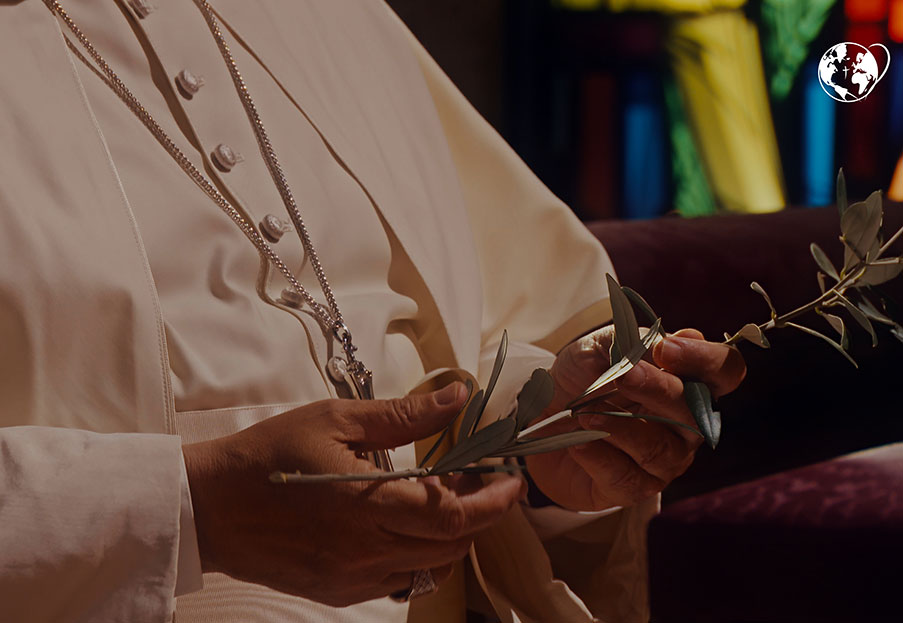
© Jesuit.Media, Communications Office of the General Curia, 2026. Photo by Vivian Richard, SJ.
Christ as the centre of the Church (Evangelisation, synodality and the poor)
A heart touched by the Gospel thus becomes capable of a new form of relationship: with God, with others and with oneself. In this sense, the proclamation of the Gospel and the social promotion of peace are not separate aspects, one in the realm of evangelisation and the other in that of the Church’s social teaching. Both are the irradiation of the same light upon the personal, social and political event. It is from this transformation, discreet but real, that a peace is born which does not impose itself, but radiates.
For this reason, Leo XIV insists on a Church that does not place itself at the centre, but allows itself to be constantly re-centred in Christ. As he recalls, in his address to the College of Cardinals at the Extraordinary Consistory of 7 January 2026, taking up his predecessors Benedict XVI and Francis: “The Church does not engage in proselytism. Instead, she grows by ‘attraction’”. And he specifies: “it is not the Church that attracts, but Christ”. When a community attracts, it is because through it flows “the lifeblood of Charity that cascades from the Heart of the Savior”. This awareness frees the mission from the anxiety of effectiveness and restores its source: the experience of being reached by a Love that precedes, transforms and surpasses us.
From this also arises a renewed understanding of the Church. “The Church”, he reminds us in his homily for the Jubilee of the Synodal Teams and Participatory Bodies (26 October 2025), “is not merely a religious institution, nor is she simply identified with hierarchies and structures”, but is “the visible sign of the union between God and humanity”, called to become “one family of brothers and sisters”. This vision takes shape in a Church that lives from communion and, for this very reason, becomes a sign of unity in a polarised world. “Unity attracts, division scatters”: not only as a theological principle, but as existential evidence.
In this horizon, synodality is not, for Pope Leo, merely a method but a way of life: walking together because one has truly listened to others and because, together, we experience that there is a meaning that attracts us. However, it is not only a question of listening ad intra, to those of the Church, to our own. It is a question of a listening that includes all without being trapped by conveniences but aligning ourselves with the heart of God. So that this purity of intention is present in the way of living synodality, the Pontiff highlights the role of the poorest. As he writes in his apostolic exhortation Dilexi Te (4 October 2025): “As the Body of Christ, the Church experiences the lives of the poor as her very ‘flesh,’ for theirs is a privileged place within the pilgrim people of God [in syn-odos]. Consequently, love for the poor – whatever the form their poverty may take – is the evangelical hallmark of a Church faithful to the heart of God”.
City of God and City of Man
The peace that is born in the heart and becomes communion cannot remain enclosed in the ecclesial space. It has its own force of expansion to which the Church must be faithful, beyond all whims and the calm of previously navigated seas. The Gospel, when truly welcomed, generates history. The Christian tradition has expressed this profoundly through the Augustinian image of the two cities. They are not two separate spaces, but two forms of loving that traverse the same history. “Two loves have built two cities” (City of God XIV, 28). Unjust structures are born of disordered loves; just structures require converted hearts.
The City of God is not a parallel utopia, but a spiritual dynamic that traverses the city of man and orientates it from within. As Leo XIV expressed in his address to members of the diplomatic corps accredited to the Holy See on 9 January 2026, these cities have an external and internal dimension: they are also “the internal attitudes of each human being”. Therefore, “each of us is a protagonist and responsible for history”.

© Jesuit.Media, Communications Office of the General Curia, 2026. Photo by Vivian Richard, SJ.
Beyond the daily responsibility of each person in the construction of peace, the transformation of the world does not dispense with political, economic and social mediations. But even this is only decided in the depth of the heart that chooses dialogue instead of unacceptable arrogance. An example of this decisive place of the heart, even at the highest levels of government, is found in his address at the Prince's Palace during his visit to Monaco (28 March 2026, where he appeals to a deeper awareness of the responsibility associated with privileges: “To dwell here is a privilege for some, and a particular call for everyone to reflect on their place in the world. In God’s eyes, nothing is received in vain! [...] what has been entrusted to us must not be buried in the ground, but placed at the service of others [...] within the perspective of the Kingdom of God [...] which shakes up the unjust configurations of power [...] those structures of sin that create chasms between the poor and the rich [...] Every talent, every opportunity and every good placed in our hands has a universal destination [...] not to be held back, but to be shared”.
Leo XIV does not propose a political programme, but he equally refuses a disembodied spirituality. For this reason, he affirmed that “everyone in society, through non-governmental organisations and advocacy groups, must put pressure on governments to develop and apply more rigorous regulations, procedures and controls. Citizens need to take an active role in political decision-making at national, regional and local levels”.
The crescendo of Leo’s voice, evangelising through the appeal to peace
Let us now look at some examples from the few but significant international visits and other addresses to the international community by Pope Leo XIV. In his journey to Turkey and Lebanon, the Pope gave body to his vision. In Turkey, he emphasised that “a society is alive if it has a plurality, for what makes it a civil society are the bridges that link its people together”. In a context marked by religious and cultural tensions, he affirmed with clarity: “We are all children of God, and this has personal, social and political implications”. And he launched a demanding criterion: “Justice and mercy challenge the mentality of “might is right,” and dare to ask that compassion and solidarity be considered as the authentic criteria for development”.
In Lebanon, the tone became even more existential. Peace, he said in a poetic tone, “is a desire and a vocation, it is a gift and a work in progress”. It is not an abstract idea, but a daily work, marked by perseverance: “It takes tenacity to build peace.” In a country wounded by successive crises [and today again ravaged by war], the Pope proposed a cordial language as a way of integrating such great diversity: “May you speak just one language, namely the language of hope.”
Moreover, in a world where religion is so often instrumentalised to justify conflicts, Leo XIV has been progressively unequivocal. At the ecumenical service in İznik on 28 November 2025, he declared: “We must strongly reject the use of religion for justifying war.” This appeal runs through, in crescendo, his first year of pontificate and gains particular density in the current context, marked by multiple armed conflicts.
In his words in the Palm Sunday liturgy, he affirmed with force: "Brothers and sisters, this is our God: Jesus, King of peace, who rejects war; whom no one can use to justify war.He does not listen to the prayers of those who wage war, but rejects them, saying: ‘Even though you make many prayers, I will not listen: your hands are full of blood’ (Is 1:15)”.

© Jesuit.Media, Communications Office of the General Curia, 2026. Photo by Vivian Richard, SJ.
“The times are ourselves”
In conclusion, it seems to me that Pope Leo XIV's insistence on the word “peace” is not merely a moral appeal directed to contexts of conflict, but an invitation to a broader conversion and, at the same time, closer than we imagine: to return to the heart as a condition for peace. Perhaps here lies the most silent and most demanding contribution of his first year of pontificate: to recall that unity is not built only from without, nor is peace guaranteed by decree. Both are born of a transformation that begins in the heart, recognises itself in communion and is verified in history.
It is at this point that the originality of his proposal is better understood. Rooted in the Augustinian tradition, Leo XIV seems to deepen the classic binomial of the Second Vatican Council: Church ad intra (inward) and Church ad extra (outward). It is a distinction that, over time, risked generating unhealthy separations: between worship and proclamation, between catechesis and service to the poorest, between interiority and commitment.
In this context, and reinforcing the primacy of evangelisation in the life of the Church, Pope Francis spoke of an "outward-bound Church", in contrast to a self-referential Church. Without abandoning this conciliar horizon, from which he starts, Leo XIV introduces a new accent, more explicitly anthropological. His emphasis does not fall so much on a Church turned inward or outward, but on the human being in its unity.
Thus, the ad intra comes to designate the heart, as a place of listening, unification and transformation; and the ad extra refers to sociability, that is, to the way in which this interior transformation translates into relationships, practices and structures. The ecclesial dynamism thus also becomes an existential dynamism: it does not begin in the institution, but in the person. It is precisely this displacement that gives his discourse on peace a truly universal force. Because it does not depend on institutional belongings, but touches the deepest fibre of the human: the relationship between interiority and life in common.
In the horizon that opens with Leo XIV, peace does not appear as an abstract ideal nor as a programme to be imposed, but as life that springs from a transformed heart. When the Gospel returns to inhabit the centre, the Church can be a humble sign of unity and a leaven of reconciliation. Perhaps this is the most discreet and most decisive light of his pontificate: to recall that a wounded world can only be healed from within. As he recalled, at the beginning of his pontificate, on 12 May 2025, to representatives of the media: “Let us live well, and the times will be good. We are the times” (Augustine, Discourse 80,8).
Related Posts:
Pope Leo XIV’s July prayer intention is for respect for human life in all its states
Pope Leo XIV dedicates his June prayer intention to the values of sports, “to build communion and fraternity in history”. He invites us to pray that sports might be a path of peace, encounter, and dialogue between cultures, promoting respect, solidarity, and the spirit of overcoming limits.

If we believe that human dignity for all is the greatest common good, then how shall we guide the development of technologies that may ignore or discard that dignity? This is the question that forms the foundation of Magnifica Humanitas (“Magnificent Humanity”), the first encyclical...

The Holy Father’s intention for the month of May, “That everyone might have food,, focuses on the most urgent challenges of our time: hunger and wasted food.

The Holy Father’s prayer intention for the month of April focuses on the human and spiritual accompaniment of priests going through difficult moments.
The Holy Father’s prayer intention for the month of March invites nations to opt for dialogue, diplomacy, and disarmament.