“On 15 January 2023, after the Angelus – I was travelling to Rome and we watched from the train – Pope Francis announced officially the ecumenical prayer vigil for 30 September of that year. He said that the path to Christian unity and the Church’s synodal conversion are linked...”
Arturo Sosa, SJ
Pope Francis: in memoriam
Thinking with the Church: Pope Francis and the Jesuit Vocation
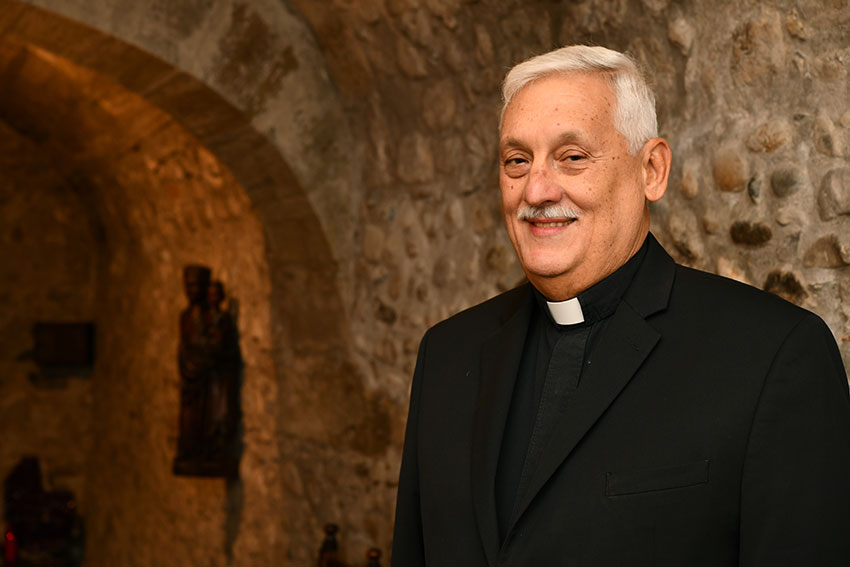
Arturo Sosa, SJ | Superior General of the Society of JesusA year after the death of Pope Francis, the Church continues to feel the impact of his ministry. With grateful hearts for the self-giving and ministry of Jorge Mario Bergoglio, SJ, Pope Francis, we wish to remember and to name what he has left us as the People of God gathered in the Church, and in a particular way for those of us who belong to the Society of Jesus, together with those who share its apostolic commitments throughout the world.
Before the election of Jorge Mario Bergoglio, the idea of a Jesuit Pope was considered improbable. Indeed, a distinctive characteristic of the Society of Jesus, established by Ignatius of Loyola and the first companions, is to see itself as a body at the service of the Church from positions other than hierarchical offices or places of honour. Its members are cautioned against the ambition to occupy such positions and against every form of seeking personal advancement.
In other words, the Jesuit vocation requires interior freedom as a condition for complete availability to the service of the Lord’s mission in whatever the Church, through the Supreme Pontiff, considers necessary. Part of Jesuit identity is sentire cum Ecclesia: to think and to feel with the whole Body of Christ, and to do the will of God by receiving one’s mission through the Supreme Pontiff.
A Jesuit, upon final incorporation into the Society of Jesus, promises not to seek or pursue, directly or indirectly, any office or dignity, within or outside the Society, including explicitly the episcopate, unless the Holy Father requires it for specific needs of the Church’s mission. In this sense, throughout history, at the will of the Supreme Pontiffs, there have been Jesuit bishops, with the tension this entails. There are still such bishops today. Therefore, from the perspective of the Jesuit vocation, the possibility of being elected to the papacy lies outside consideration.
© Jesuit.media
Jorge Mario Bergoglio, following his Jesuit vocation, was formed in the Spiritual Exercises and remained throughout his life faithful to the manner of proceeding that flows from them within the Society of Jesus. He lived fully what the charism of Ignatius embodied in the Constitutions of the Society of Jesus: that the Jesuit vocation is always ordered to the service of the mission of Jesus Christ entrusted to the Church. It can be affirmed that he understood his call to the episcopate in Buenos Aires, Argentina, and later his election as Bishop of Rome, as arising from his Jesuit vocation, and never as personal advancement or as a privilege for the Society of Jesus.
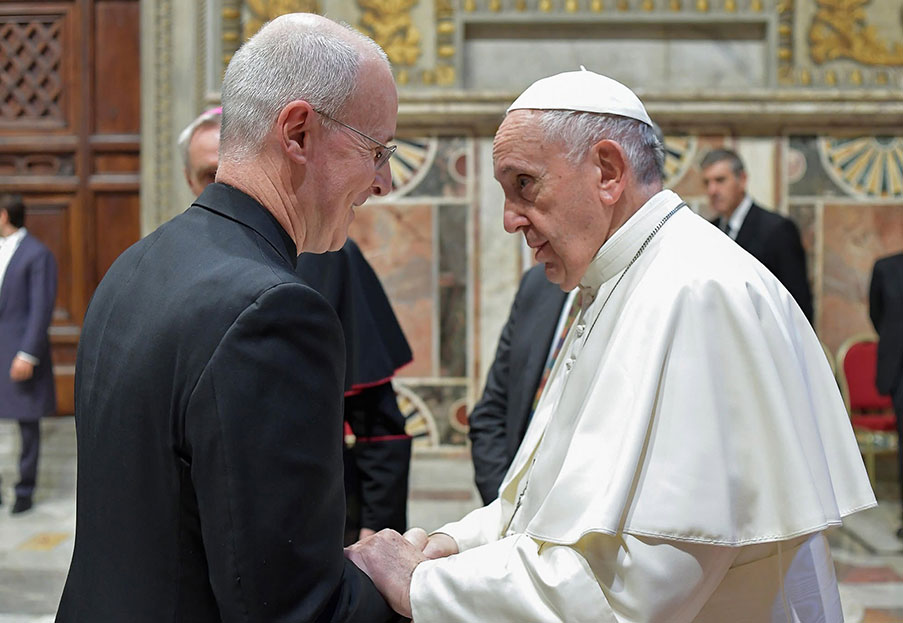
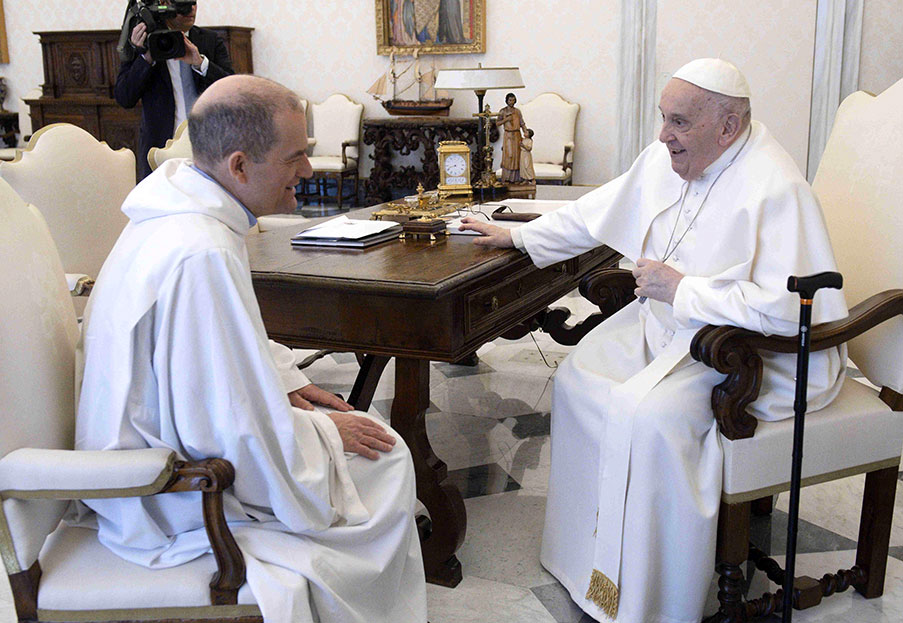
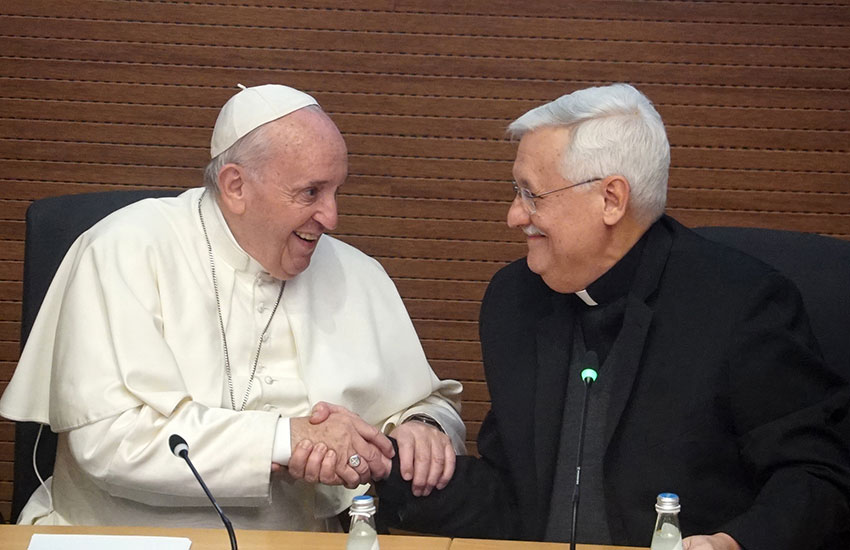
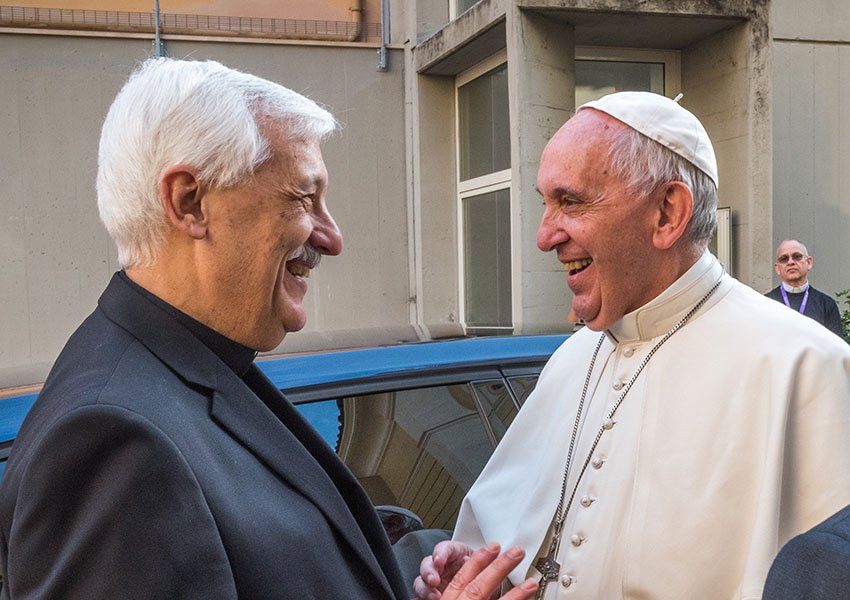
This was my experience in my personal relationship with Pope Francis as Superior General of the Society of Jesus. On the one hand, sharing in the experience of the Society’s charism – the Jesuit vocation – fostered between us a sense of being in tune with one another as brothers who felt ourselves profoundly united. On the other hand, we always met as the Holy Father, responsible for the mission entrusted to the Church, and the Superior General of a Society of Jesus eager to place itself at her service.
This was evident in his fraternal presence at the 36th General Congregation. Pope Francis addressed the Congregation in keeping with the tradition of the Supreme Pontiffs: “As my Predecessors have said to you on various occasions, the Church needs you, relies on you and continues to turn to you with trust, particularly to reach those physical and spiritual places which others do not reach or have difficulty in reaching.” In that context, he recalled the words of Paul VI, spoken more than 40 years earlier, which described the Jesuit vocation at “the crossroads of ideologies” and in “the front line of social conflict”, where the demands of human life encounter the enduring message of the Gospel (Paul VI, Address to the 32nd General Congregation, 3 December 1974).
In addressing the Society, Francis consistently grounded himself in what Ignatius considered essential: prayerful attention to the action of the Holy Spirit, without which apostolates come to be driven by urgency, restlessness, or self-assertion, rather than by obedience to the promptings of the Spirit or to the guidance of the Church through the Holy Father.
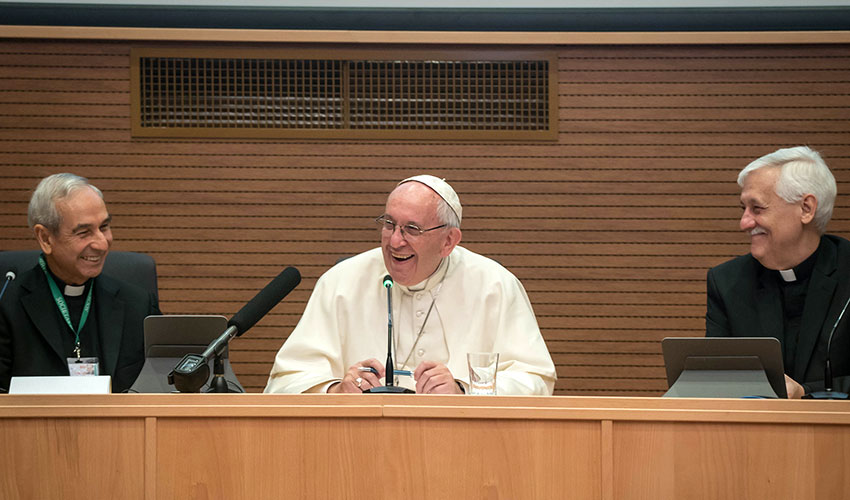
Pope Francis at the 36th General Congregation. © Jesuit.media
When, in 2019, Francis confirmed the Universal Apostolic Preferences (UAPs) for 2019-2029 – the four orientations for carrying forward the Society of Jesus’s mission of reconciliation and justice – he pointed to the foundations of the Jesuit vocation. He emphasised that the first preference – showing the way to God through the Spiritual Exercises and discernment – constitutes the foundation of all the others. This preference, his letter of 6 February 2019 states, “presupposes as a basic condition the Jesuit’s relationship with the Lord in a personal and communal life of prayer and discernment.” Without that foundation, the other three preferences – walking with the excluded, accompanying young people, and contributing to the care of our common home – he said plainly, “will not bear fruit”.
Moreover, Francis did not idealise the Society of Jesus. At the 36th General Congregation, he warned against what he called “all kinds of paralysis and vain ambition” – temptations that accompany any apostolic body, including our own, and from which we are not exempt – and he concluded his address with a prayer that the Society’s manner of proceeding might remain “free of all worldly ambition” (Address to the 36th General Congregation, 24 October 2016).
In subsequent conversations with Jesuits, including his conversation with Jesuits during World Youth Day in Lisbon, he insisted on this warning. He spoke of the danger of rigidity, self-referentiality, and ideological bias – attitudes that seek security rather than discernment and which can be present even in those who are sincerely convinced of their own fidelity. He named these not as external threats but as interior temptations that corrode apostolic freedom from within. He spoke in this way not as an external observer, but as one who knew these dynamics from experience, as one who had learned, slowly and with difficulty, to recognise them without illusions (cf. Francis, conversation with Jesuits in Portugal during World Youth Day 2023, published in La Civiltà Cattolica).
© Jesuit.media
The Church lives with enduring tensions related to questions of authority and trust. Personal ambition or the pursuit of privileges – what Ignatius called vanagloria – are manifested in ways both blatant and subtle. Francis did not offer a programmatic solution to these tensions. But he did make visible the ways in which our habitual lack of self-awareness, our attachment to the privileges of office, and our tendency toward self-protection can silently undermine what we profess in following the vocation to which we have been called. His way of living the Jesuit vocation was not marked by concern for the prestige or influence of the Society, but by a different pattern: choosing what serves the mission rather than what secures the institution; remaining close to those who are on the margins; and resisting the attraction of prestige, even within the Church.
In accepting the episcopate that led him to be Bishop of Rome, Jorge Mario Bergoglio did not yield to the temptation of ambition that Ignatius so feared. On the contrary, consistent with the charism that shaped his Jesuit vocation, he made himself available to receive as mission what he had not sought, to carry a responsibility he had not chosen, and to do so by putting in place the means to ensure that the office would not become a form of personal prestige.
The surrender of one’s own freedom for the good of the Church is what Francis lived in following his Jesuit vocation. This is what he leaves us as a responsibility: to remain faithful to the charism that inspires the vocation to which we have been called in this least (mínima) Society of Jesus.
[Original in Spanish]
© Jesuit.media