“On 15 January 2023, after the Angelus – I was travelling to Rome and we watched from the train – Pope Francis announced officially the ecumenical prayer vigil for 30 September of that year. He said that the path to Christian unity and the Church’s synodal conversion are linked...”
Cardinal Michael Czerny, SJ
Pope Francis: in memoriam
With gratitude, Pope Francis on the first anniversary of his death
Cardinal Michael Czerny, SJ | Prefect of the Dicastery for Promoting Integral Human DevelopmentIt was just a year ago on Easter Monday, here known as the Monday of the Angel, when the world received the sad news: Pope Francis had died. Bewilderment and loss slowly gave way to gratitude. The day before, he had imparted the Easter blessing, nearly inaudibly from the balcony of St Peter’s Basilica, and toured the square in the popemobile to bless the faithful for the last time. Just a few hours later, “with the smell of the sheep!” he was gone. A farewell in “Bergoglian” style, for he was first of all a shepherd.
Now, one year without him, the memories are in full bloom. As a priest, a Jesuit, a Cardinal and Prefect of a Dicastery (Department) of the Roman Curia, I give thanks for him and for so much we had shared, both explicit and implicit, spoken and silent, facing so many challenges together.
From the beginning of his pontificate, Francis longed for an “outgoing” Church that makes every effort to go out and embrace and accompany people – not waiting to be approached, but ever striving to be welcoming, like a parent and a friend, with a special eye for the least, the vulnerable and the forgotten. These were Christ-like givens for working at his side.

© Vatican Media
My first more direct collaboration with Pope Francis was to help discreetly with several meetings of the Popular Movements (in Rome, Bolivia and again Rome). Then came a much greater “assignment”: to help finalise the new encyclical Laudato si’ and prepare for its launch in mid-2015. A year-and-a-half later, Francis named me one of the two priests responsible for setting up the new Migrants and Refugees (M&R) Section which he personally guided until the end.
The M&R Section was dedicated to the person at the centre, no one excluded, doing everything possible to welcome, protect, promote and integrate all those newly arrived in communities, especially those forced to flee. With Francis, one did not speak of migration but of migrants: real men, women and children, each with their own stories, wounds and hopes.
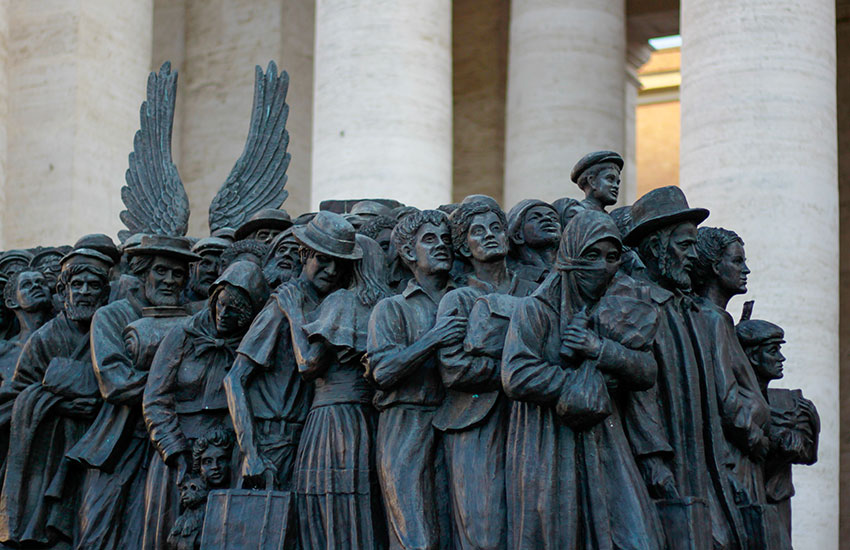
What helped to inspire Francis’s decision to establish a dedicated M&R Section was probably his first dramatic journey as pope in July 2013, less than four months after his election. On the island of Lampedusa, he bore as his own the pain of survivors of treacherous crossings of deserts, mountains and seas, and joined in mourning those who had not made it. He suffered greatly on that journey. An emblem of this suffering is an orange life jacket given to him during an audience by a rescuer who had not succeeded in saving a baby girl who was drowning in the sea. Francis in turn gave it to the very new M&R Section and said, “This is your mission”. Later he supported the installation of Timothy Schmalz’s “Angels Unawares” in St Peter’s Square, a monument depicting the human family as migrants of all times and places.
© Jesuit.media
Then in 2022, he entrusted me with my current role as Prefect of the Dicastery for Promoting Integral Human Development, and so with the other dicastery Superiors, we were involved in addressing many urgent challenges of our time, most of them blatant violations of human dignity and human rights: poverty, injustice, violence and war, hunger and disease, the degradation of the environment, etc. where “etc.” includes so many obstacles to everyone’s integral human development. Francis’s heart, like the Heart of Jesus, always turned toward the human in need. He never took his distance.
Listening, journey, care, forgiveness, joy and service: these were key words of his magisterium, a magisterium set on renewal. He was not afraid of change; rather, he promoted it vigorously in the light of the mandate given him by his fellow cardinals when they elected him to succeed Pope Benedict XVI. So, so often, he urged us to have the courage to address what was really needed. He would never accept, “But this is how it has always been done”, and he incarnated this commitment to renewal for mission in the reform of the Roman Curia.
In 2022, with the promulgation of the new constitution Praedicate Evangelium (PE), Pope Francis gave life to a thorough evangelical, theological, structural, cultural and spiritual transformation, with the intention of making all the entities of the Holy See more missionary as well as more effective and efficient.
Earlier, he created the Dicastery that I am now guiding. In 2016, with the Apostolic Letter Humanam Progressionem, he united four Pontifical Councils that had something fundamental in common: the good of the human person. Thus, the previous Pontifical Councils for Justice and Peace, for the Pastoral Care of Migrants and Itinerants, for the Pastoral Care of Health Care Workers, and Cor Unumfor humanitarian response, joined together to become one Dicastery for promoting integral human development.

© DSSUI - Dicastery for Promoting Integral Human Development
Now with Praedicate Evangelium, Pope Francis endowed the Curia with a more evangelical and missionary role, namely, to always be at the service, not only of the Successor of Peter, but equally of the successors of the Apostles, that is, the Bishops and all the particular Churches. Evangelization, missionary conversion and synodality were the principal orientations of PE and synthesize much of his magisterium.
Yet this orientation, singular and striking as it was, was far from made of whole cloth, ex novo. Rather, Pope Francis was always implementing the Second Vatican Council. It is with a post-conciliar view that his entire pontificate should be read, within the Vatican walls and outside them. Included are his appeals for collegiality and the invitations to synodality as preferred ways for the life of the Church going forward in history, always recalling that every Christian is a missionary disciple, therefore the involvement of every person is indispensable.
Pope Francis wanted the people of God to become protagonists of the Church’s mission, and so he convoked a multi-year Synod on Synodality. The first step is listening to all the callings in the Church: clergy, consecrated, laity. This helps the Church to recognize and address the challenges of the present as daily experienced by God’s people. This vision begins from the base, which Francis places at the top in his image of the inverted pyramid, and goes all the way to the Pope himself. In our hierarchical Church, those in authority are at the service of all, especially the least. The inverted pyramid symbolizes a synodal Church. Francis reminds us that those who exercise authority are called “minister” because they are the servants of all, which is consistent with a traditional title of Peter’s successor, “servus servorum Dei”, the “servant of the servants of God”.

© DSSUI - Dicastery for Promoting Integral Human Development
Along these lines, our Dicastery initiates its service by listening, through the Bishop and his co-workers, to “the joys and the hopes, the griefs and the anxieties of the people of this age, especially those who are poor or in any way afflicted” (Gaudium et spes, 1). In response, we help, if we can, to deepen the understanding of these cries of the poor and cries of the earth, and then propose how the local Church can pastorally accompany its people in overcoming the obstacles to their integral human development.
In conformity with the teachings of the Council, Pope Francis always sought to read the “signs of the times”. Examples include the role of women, fighting every form of abuse, overcoming clericalism, embracing the popular movements, supporting the digital mission, and most recently facing artificial intelligence: these are among the many concrete signs of his magisterium proclaimed in words, gestures and deeds.
I am sure that Francis succeeded in being the Pope for everyone. As a Jesuit, I see Ignatian spirituality suffusing his pontificate, beginning with seeking God in all things, governing with discernment and invoking the Mercy of God at every opportunity. He coined the term “mercifying” to express God’s constant attitude and action towards us, and in 2015, he proclaimed the Extraordinary Jubilee of Mercy specifically to open wide the doors of the Church so that everyone, even those who feel most distant, might discover a loving and fatherly God who “never tires of pardoning”, as Francis constantly repeated.
On the first anniversary of his passing to the Father, Pope Francis’s magisterium is alive in Pope Leo XIV, who constantly recalls his “beloved predecessor”. I am most grateful for the enormous trust Pope Francis showed me, for his great example of inner freedom, for the humour we shared and for so thoroughly living Jesus’s (and St Ignatius’s) unlimited missionary spirit: “Go into all the world and preach the Gospel to the whole creation” (Mark 16:15).
[Original in English]

© Lorenzo Moscia