“On 15 January 2023, after the Angelus – I was travelling to Rome and we watched from the train – Pope Francis announced officially the ecumenical prayer vigil for 30 September of that year. He said that the path to Christian unity and the Church’s synodal conversion are linked...”
Federico Lombardi, SJ
Pope Francis: in memoriam
Encounters with Pope Francis
Federico Lombardi, SJMy first encounter with the future Pope Francis had taken place many years earlier, in 1983, during the 33rd General Congregation – the one convened by Father Paolo Dezza, then delegate of Pope John Paul II, to accept the resignation of Father Pedro Arrupe and elect his successor. They were intense days, a crucial turning point in the recent history of the Society; days that were also deeply moving, above all the “farewell” of Father Arrupe.
Father Jorge Mario Bergoglio was an elected representative of the Province of Argentina, very closely connected to Father Arrupe, for whom he had great respect. “Years earlier, Arrupe had appointed him provincial and had accompanied him on a very significant visit to the province and to Bishop Enrique Angelelli, later beatified as a martyr for faith and justice.”
At that congregation, the youngest was the current superior general, Arturo Sosa, and I too was among the ‘younger members’. There were more than 200 of us, and I had no particular contact with Bergoglio. Yet those days came vividly back to me the first time Pope Francis came to the Gesù in Rome, on 31 July 2013, for the feast of Saint Ignatius, when, to our surprise, he expressed a strong desire to remain for a time in the chapel where Father Arrupe is buried.
The superior general, Adolfo Nicolás, informed all the Jesuits: “The Holy Father prayed, laid a bouquet of flowers, and gently touched the tombstone and the portrait medallion twice. It was an intense moment of deep prayer and gratitude, with a visible desire not to leave.” And each time he returned to the Gesù, Francis wished to stop at Arrupe’s chapel. It is no coincidence that, during his pontificate, the cause for beatification was formally opened.
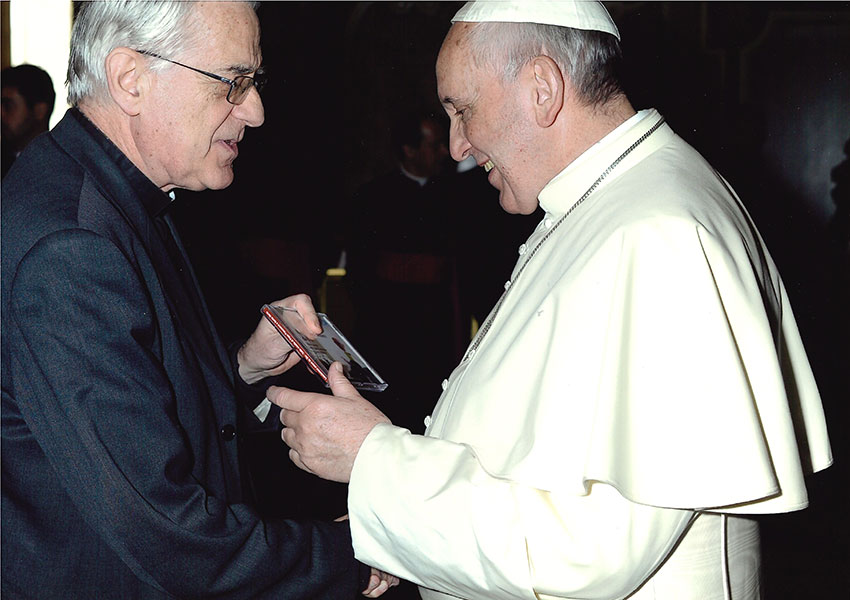
I had caught a brief glimpse of him in the corridors during the general congregations of cardinals held in preparation for the conclave that would later elect him. For reasons connected with my office, I was authorised to follow the proceedings without drawing attention to myself. Since we had not seen each other for many years, he himself approached me very kindly: “Good morning, Father, I am Cardinal Bergoglio.”
I then heard his well-known, very brief intervention in the assembly, on a Church that “goes out” and against “self-referentiality”, and I was taken aback when his election was announced. For me, it was impossible to imagine a Jesuit as pope. It took me several minutes to recover, but I had to do so quickly, because the journalists were buzzing with excitement in the Holy See Press Office, which adjoined my office, and I could not remain frozen in my chair any longer.
Early the next morning, we were in the deserted Basilica of Santa Maria Maggiore, before the Madonna Salus Populi Romani, for the first of more than a hundred times Francis would lay a bouquet of flowers there, and where he would later choose to be buried. As usual, I tried to remain unnoticed, but the group was too small and he spotted me easily. Naturally, I cannot forget that warm and gracious greeting before the Madonna.
And so began the adventure of three years in his service at the Holy See Press Office. There was no chance of getting bored, especially in the early days. He was a free man and rightly wanted to be a “free” pope in his relationships and in the way he communicated, even over the telephone.
One morning he found me waiting for him at the entrance as he came down from his room at Santa Marta to ask him for an explanation of what he had said to a group he had met the day before, who were enthusiastically spreading the news of the wonderful conversation they had had with the pope on many topics, including the gay lobby in the Vatican...
A few days later, he saw me rushing breathlessly into his private library, where he was drinking a glass of water after a president had left and an archbishop was about to enter, and he exclaimed anxiously: “What have I done?” I explained that news was spreading very rapidly that he had had a telephone call that morning with President Assad. We were in the midst of the Syrian crisis. He was dumbfounded: “Me? Assad?” I apologised, thanked him and ran off – I really was running – to deny it. It had taken just two or three minutes. With him, you could do that. He grasped situations immediately and was not caught off guard.
But he had very clear ideas about the messages he wanted to convey right from the start of his pontificate. On the first morning he was to meet a group of ambassadors, not resident in Rome, for the presentation of credentials, he called me very early to urge me to give adequate coverage to the brief speech he would deliver to them, stressing the welcome of migrants and the demands of justice. On the famous visit to Lampedusa, as we were making our way around the island by boat to cast a wreath into the sea in memory of the victims, he called me to his side to speak about the significance of that visit and his desire for it to be properly understood.
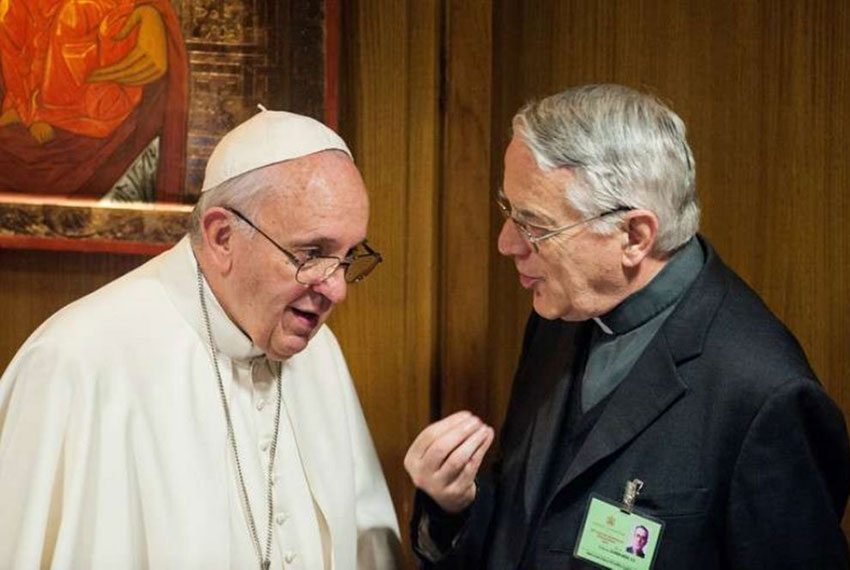
One type of meeting I often and fondly recall is the – always very brief – one that followed every audience with some prominent politician (president or prime minister...) in view of the press release or information to be issued subsequently. Since a similar meeting also took place with his predecessor, Benedict XVI, it was easy to observe the difference.
Benedict would have me sit beside him and, in three or four minutes, would give a perfectly ordered and crystal-clear summary of the contents of the conversation; first, second, third... a question... an answer... I would take a few notes, thank him, and off I went. Francis, on the other hand, remaining standing and as if chatting, would say to me: “You know, this man is very honest, he cares about migrants, he loves his family, you’ll be able to talk to him...” or: “He doesn’t strike me as very trustworthy...” and so on. In short: Benedict, the contents; Francis, the approach to the person – to begin a journey, to seek an encounter.
When I told him – more than once, I think – that I was of course entirely willing to be replaced whenever he wished, he was very kind and replied candidly that for the time being he was happy for me to continue, because since he himself sometimes did not worry too much about being prudent, it was appropriate to have a collaborator who tried to be prudent.
When the time came for a replacement, he told me he did not want me to leave the Vatican, and that I should therefore take on the responsibility of the Ratzinger Foundation. I told him I did not feel particularly suited to a predominantly cultural role, but he stuck to that idea and proposed it to my Jesuit superiors. And so the last ten years have passed.
I have always thought that Francis had great respect and love for Benedict, and that for this reason, while they were living together in the Vatican, it was fitting that someone who knew them both well and cared for them both should still be around.
From then on, every year I asked him to present the Ratzinger Prize in person to those proposed by our Foundation and approved by him. He did so until 1 December 2022.On that occasion, sensing that it was almost certainly the last – as Benedict was by then very frail – I suggested a draft speech that was a little longer than usual, with some fine words for his predecessor. He accepted it with his usual kindness, making just one very brief addition of his own.
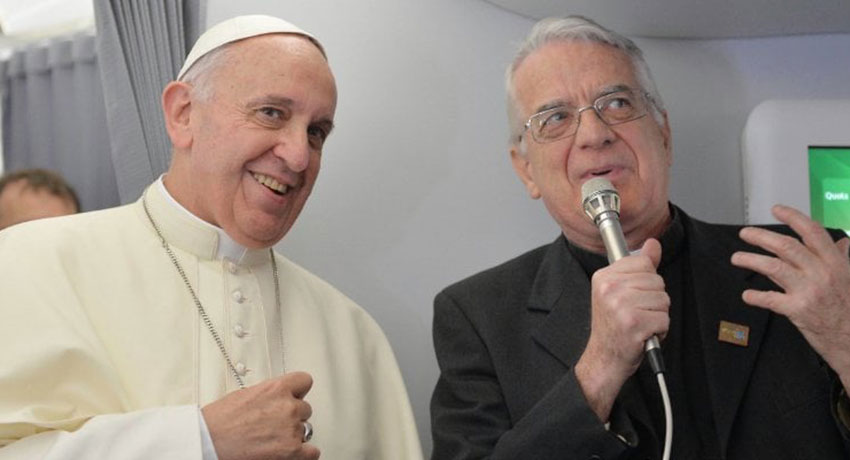
He said of him: “those contemplative eyes he always shows.” Those were certainly the most noted words of that speech. And rightly so. They were enough to convey how Francis and Benedict looked into each other’s eyes with sincerity, esteem and affection.
The last occasion of close collaboration I had with Pope Francis was for the meeting he convened at the Vatican in February 2019 on “The Protection of Minors in the Church”, attended by the presidents of the episcopal conferences and various other Church leaders. The Pope entrusted me with the role of “moderator” of that gathering. It was an issue that had left a profound mark on the life of the Church and the ministry of the popes in recent decades, above all Benedict XVI and Francis.
During those days, our exchanges were frequent, particularly regarding meetings with victims of abuse, the texts of the pope’s own speeches, and so on. Benedict had carried a very heavy cross, with humility and truth, and had left his successor a wise and sound legacy: to face the crisis by listening to the victims, ensuring rigorous justice, the purification of the Church and the prevention of abuse.
But there was still a long way to go. Francis had to come to terms with this, becoming deeply and personally involved in this affair, particularly in the “Chilean crisis.” Yet during his pontificate the Church has made great strides, both in understanding and in defining norms, as well as in converting and acting as the “People of God”.
As was the case during Benedict’s pontificate, so too in Francis’, this probably remains for me the most profound experience of participating in the pope’s service on the Church’s journey along the path of the Cross and the Resurrection of Jesus.
[Original in Italian]
© Jesuit.media