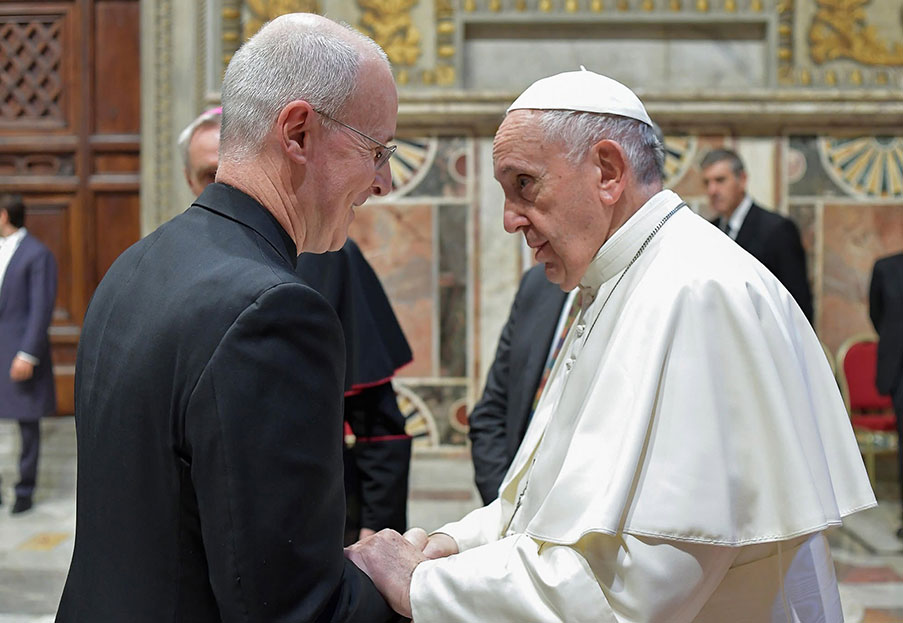
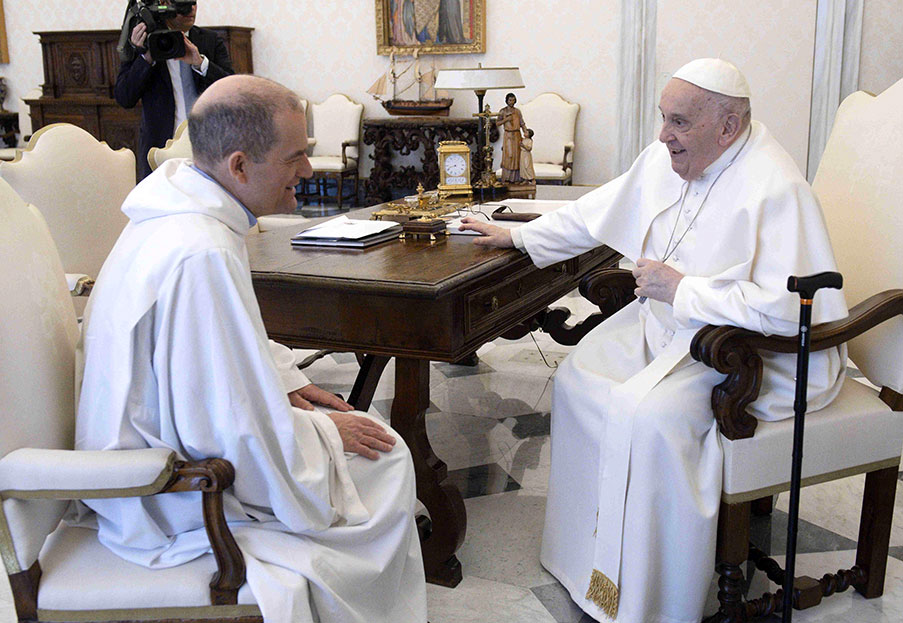
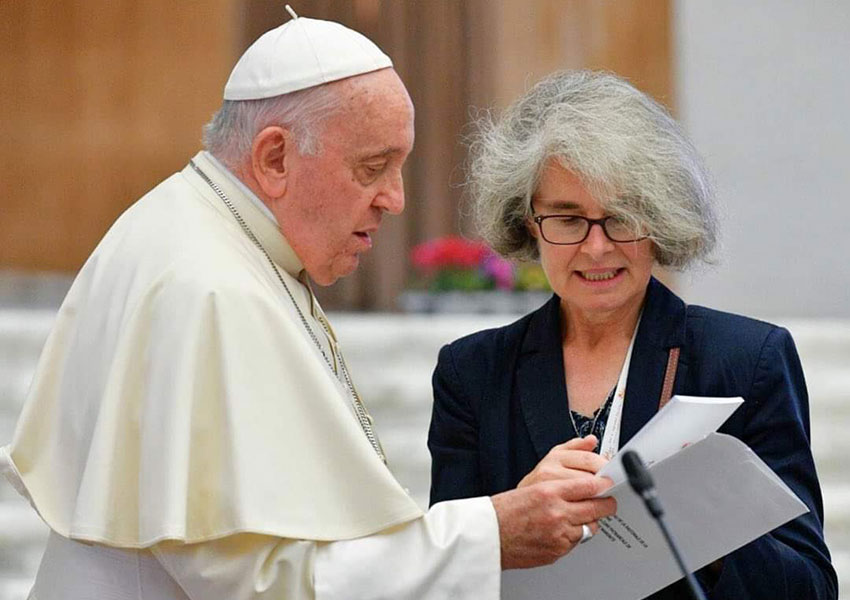
“On 15 January 2023, after the Angelus – I was travelling to Rome and we watched from the train – Pope Francis announced officially the ecumenical prayer vigil for 30 September of that year. He said that the path to Christian unity and the Church’s synodal conversion are linked...”
Nathalie Becquart, XMCJ
Pope Francis: in memoriam
Pope Francis – and my synodal journey with him
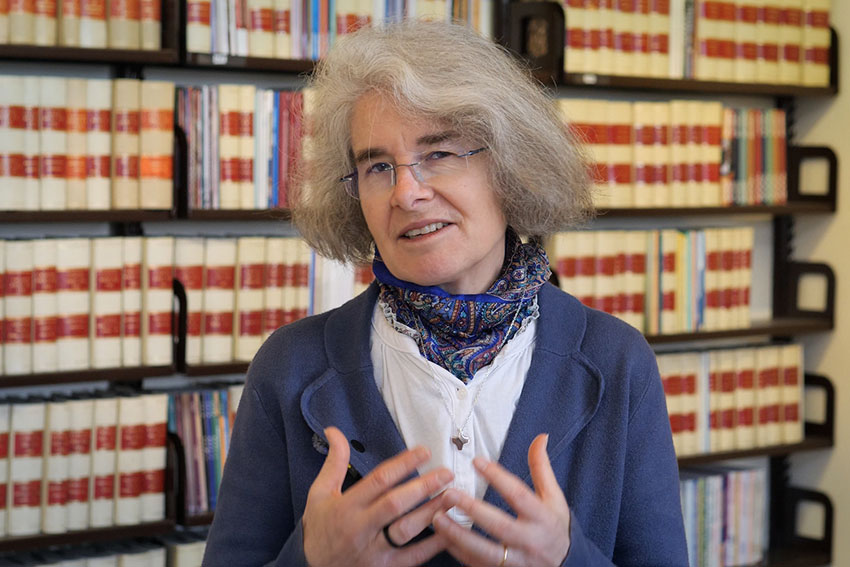
Nathalie Becquart, XMCJ | Under-Secretary of the General Secretariat of the Synod of BishopsOn 13 March 2013, while working late at the French Bishops' Conference, I was following the wait for the white smoke online. At the very moment it appeared, my phone rang: one of my brothers was calling to announce the birth of his fourth child, Céleste. Since then, I have linked these two events – the arrival of this pope as a new birth for the Church. I was far from imagining what it would come to mean for me.
Back in my Xavière community to watch the Habemus Papam [We have a pope] announcement, I discovered the name Jorge Bergoglio – a Jesuit. I was immediately struck by the way he related to the crowd, asking them to pray for him: “And now, we take up this journey: Bishop and People.” A profoundly synodal gesture that I have returned to again and again as an expression of his unbreakable bond as a pastor with his people.
I saw him for the first time at World Youth Day in Rio in July 2013. As director of the National Service for the Evangelisation of Youth, my team and I coordinated the participation of 5,500 young French people. During the diocesan phase, we had gone through the ordeal of a bus accident involving a group from Paris, in which a young woman died. These three days with the pope felt like an Easter Triduum, culminating in Paschal joy at the final Mass under the Brazilian sun at Copacabana.
His message to young people – “Don’t stay sitting on your couch; go out and make ‘a mess’ in your dioceses” – already embodied his synodal approach: encouraging all the baptised to become agents of mission, protagonists in the Church and in society.
In November 2013, I received his first programmatic exhortation, Evangelii Gaudium, as a true “missionary bomb” that resonated deeply with my vocation as a Xavière sister, a missionary of Christ Jesus, and with our way of living mission, rooted in the Spiritual Exercises of Saint Ignatius. During my first brief personal encounter with him at the Vatican, at a colloquium on Vocations Ministry, I was particularly struck by the way he was fully present to the person before him, attentive to each one – embodying the very “culture of encounter” he championed.
In October 2016, Pope Francis announced – unexpectedly – a Synod on “faith, young people and vocational discernment” for 2018. We received the news with great joy in our Youth and Vocations Service. We were soon involved in coordinating and accompanying the synodal consultation process in France, and I quickly found myself involved in international preparation meetings at the Vatican.
In March 2018, at the Youth Pre-Synod, I discovered that I had been named coordinator alongside two priests. Drawing on my Ignatian experience of communal discernment and leading retreats for young people, I helped these 300 young people from around the world engage in the process opened by Pope Francis and produce a final document as the fruit of a week of listening and dialogue.
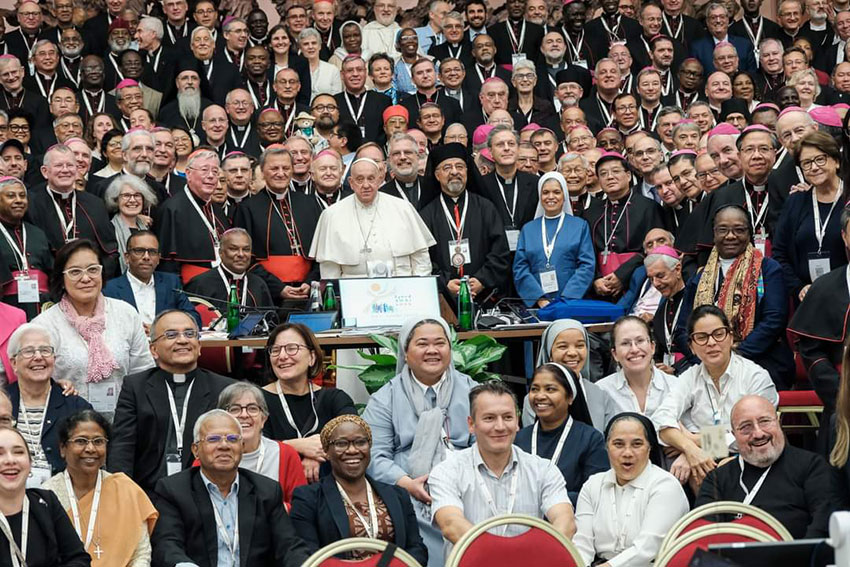
Pope Francis then appointed me an auditor for the October 2018 Assembly. For a month in the Synod Hall, at his side with all the participants, I lived an extraordinary experience of Church that transformed me deeply. In the voices of bishops and young people, I heard everything I had been listening to and carrying for nearly 30 years in my journey with young people – from whom, in the end, I had learned synodality. I also came to see the importance of the more informal dimensions of a synodal process, including during breaks with the pope.
I remember, for example, one day when, going down in the lift with other religious sisters, the doors opened and the pope stepped in. We were so surprised to find ourselves with him like this that we spontaneously said, “Come stai?” [How are you?] And he replied with humour: “Ancora vivo!” [Still alive!]
After the Youth Synod and the end of my mandate at the Episcopal Conference, I took a sabbatical in Toronto and then Chicago to rest, renew myself, and write articles and a book. I then discerned with my superior general what the next step might be. Without having planned it, the idea emerged to return to theological studies, specialising in ecclesiology and undertaking research on synodality – a fruit of the Youth Synod that had profoundly marked me and deepened a vocation to serve synodality.
In April 2019, just as everything was finalised for my arrival at Boston College, I learned, to my surprise, that Pope Francis had appointed me consultor to the General Secretariat of the Synod. This call from the pope confirmed the ecclesial dimension of my commitment to synodality.
In February 2021 came another surprise: just as I was about to begin a new mission, Pope Francis appointed me Under-Secretary of the General Secretariat of the Synod of Bishops. The adventure of synodality then continued at the Vatican, building on everything I had received and worked on during my research in Boston.
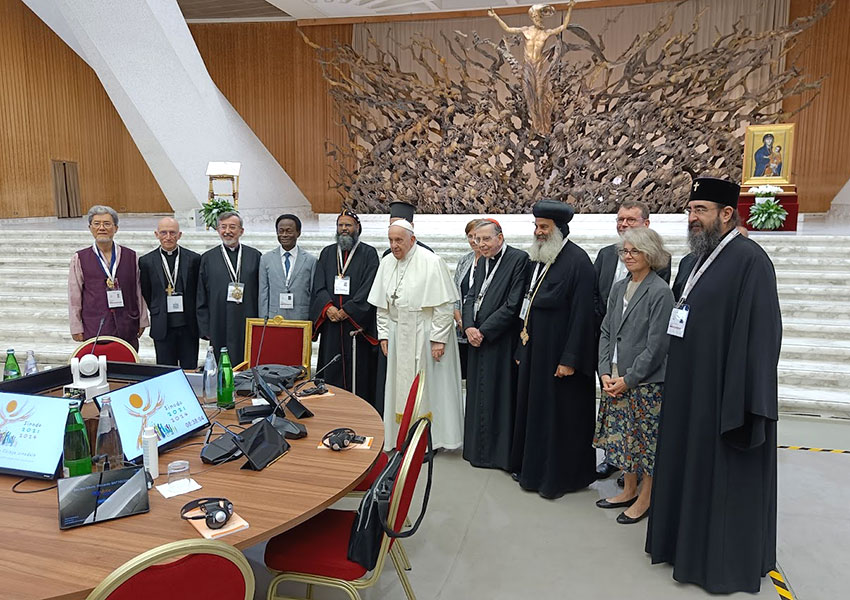
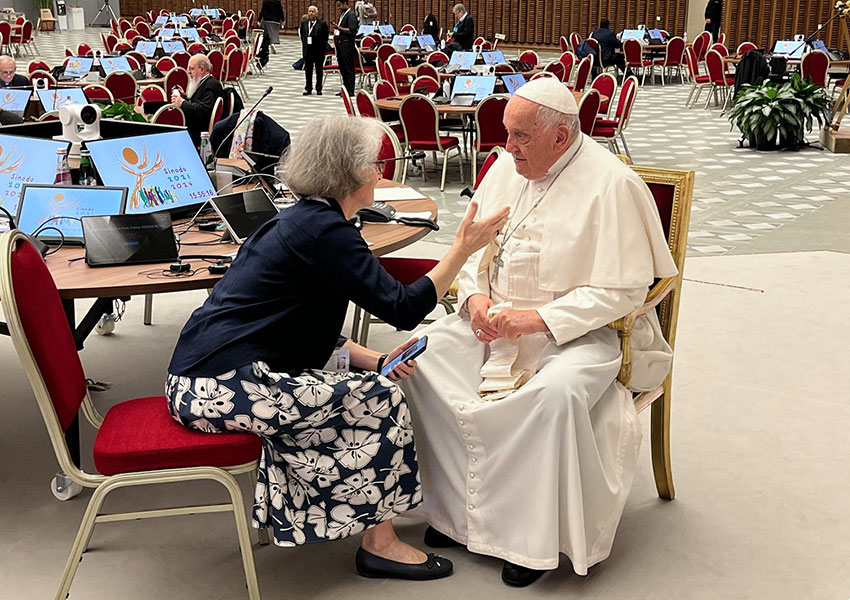
Over the years, the synodal journey – marked by meetings and key stages with the pope – was also woven into celebrations with him at St Peter’s, as well as through his interventions, travels, and publications. The two Roman assemblies of the synod in October 2023 and October 2024, in particular, gave me the opportunity to sit regularly at the same round table as him. This proximity allowed me to see his synodal style, marked by welcome and attentive listening to all participants.
I particularly remember certain more personal exchanges, and especially his final address of thanks: “I too, as pope, need to listen to you.” This prophetic humility redefined primacy within a synodal perspective. Throughout this process from 2021 to 2024, I witnessed his patience, his trust in the Spirit, and his closeness, making each person feel they were a brother or sister in Christ. He called us to carry the Church’s mission together in service of the women and men of our time. He profoundly encouraged the laity and women, also entrusting them with greater responsibilities at the Vatican. He helped us understand throughout the synods that synodality is truly the path for the Church of the third millennium, inviting us to commit ourselves to it without fear.
To the very end, he wanted to remain with his people. On Easter Sunday 2025, I had the grace to participate in the Mass in St Peter’s Square. At the end, already very weak, he came to the balcony to give his blessing and greet the crowd from the popemobile. The next day, when news of his death reached us, people immediately began to gather in St Peter’s Square.
I will always remember the procession transferring his body from Santa Marta to St Peter’s, in which I took part, walking behind his coffin with others, alongside a crowd that spontaneously applauded in an atmosphere of peace. I carried in my prayer all the poorest and those who suffer on the peripheries, towards whom he had never ceased to turn – and to turn the Church towards them. I remembered that first evening of 13 March 2013: “We take up this journey: Bishop and People.” He had kept his promise. He had walked with us and remained among us in another way. In his face, now taken into the light of God, we saw reflected the face of this diverse people who came to pray before his coffin.
At his funeral, all humanity in its diversity was gathered in that square, silently manifesting the Church’s profound vocation which the Synod had helped us to deepen: “the sign and instrument both of a very closely knit union with God and of the unity of the whole human race” (Lumen Gentium, 1). In the pain of his loss, like that of a grandfather in a family, I also felt deep gratitude: he had given us far more than documents or reforms. He had made us live synodality – in our flesh, in our relationships, in our way of being Church. One year after his death, we can continue to give thanks and walk forward without fear with Pope Leo XIV on the synodal path he opened.
[Original in French]
© Jesuit.media