The Diaconate: Service, personal growth and resilience
During the Jubilee Year 2025, the Church has set aside a number of days to celebrate different groups of people and various ministries. 21 -23 February has been designated as the Jubilee of Deacons. In this article, Serge Kasiama, SJ, shares his experience of diaconate ministry, highlighting it as an experience of profound growth and fulfilment which has allowed him to connect with God’s people through service.
By Serge Kasiama, SJ
The diaconate is one of the holy orders of the Christian Church, along with the presbyterate (priesthood) and the episcopate. The diaconate is certainly an ancient vocation that dates back to the early days of the Church and has evolved over time to meet the needs of the Christian community. The term “deacon” comes from the Greek “diakonos”, which means “servant” or “minister”. This is to say that deacons play an essential role in the life of the Church as servants of the community. Their responsibilities generally include:
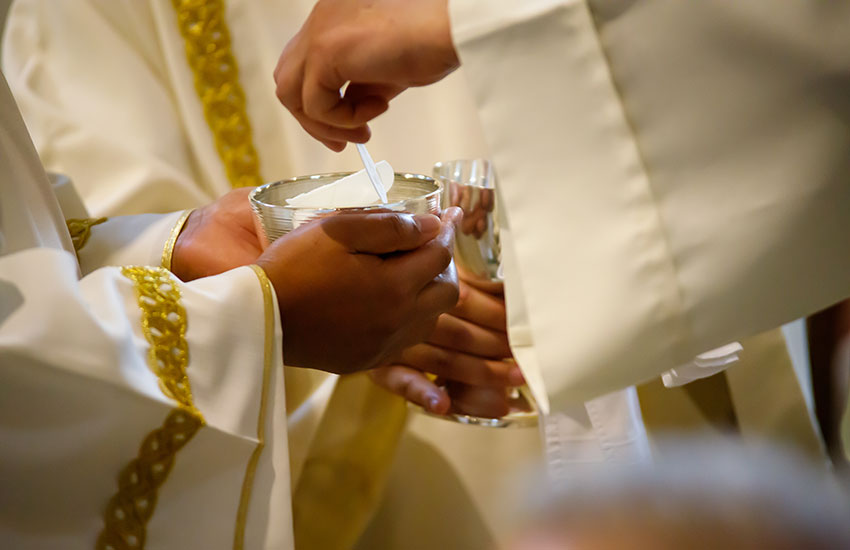
• Assistance during liturgical celebrations, such as mass.
• Preaching and teaching the faith.
• Charitable service, including support for the poor and needy.
• Management of certain administrative matters of the church.
• Visiting the sick and elderly.
My experience of the diaconate is marked by various aspects, namely, spiritual aspect, emotional aspect, experiential aspect, etc.
1. Spiritual development
My experience of the diaconate has not only prompted me to deep and continuous reflection on my relationship with God, but also to engage deeply in my faith. This spiritual commitment has fostered solid personal development in me and led me to deepen my understanding of the Scriptures and the teachings of the Church. This constant search for knowledge and wisdom has strengthened my personal faith and enriched my spiritual life, in the sense that, day by day, I allow myself to be imbued with the word of the Lord, through the texts of the Holy Scriptures and the sermons. This is what testifies to the undeniable spiritual richness of the life of the deacon, that is to say, the sincere attachment to the ministry of the diaconate, for a solid rooting in the spiritual life and in Christ his Master.
2. Service and compassion
The main role of a deacon is not only to serve at the altar during the Eucharistic celebration, but also to serve others outside of the Eucharistic celebration, following the example of our Lord Jesus. This is evidenced by this powerful statement that recalls humility and service, central values in Christian teachings: “For the Son of Man came not to be served but to serve and to give his life as a ransom for many” (Mt 20:28). This calling to help and support those in need has developed in me not only qualities of compassion, empathy and altruism, but has also led me to put the needs of others before my own and to grow in humility and understanding of human challenges. This experience has also helped me develop communication, organizational and management skills, as well as the ability to work with diverse people, resolve conflicts and promote unity and collaboration. By serving others with love and humility, I gain experience and personal maturity.
3. Emotional fulfilment
Helping others and seeing the positive impact of their service gives me a great sense of personal and emotional fulfilment. The feeling of contributing to something greater than myself. This brings me deep satisfaction and a sense of accomplishment and inner peace. An invitation for me to build more strong relationships with positive and caring people, within the community and outside the community, with a view to support and to share my sorrows and joys authentically.
4. Resilience in the face of challenges
The diaconate not only brings inner peace, but also exposes one to various difficult situations, including suffering and injustice, embarrassment, humiliation, moments of consolation and desolation, etc. The service rendered in and outside of Eucharistic celebrations is sometimes minimized by other ministers (elders) or celebrants, and why not by other participants in the celebration. By facing these challenges with faith and determination, I have developed emotional and psychological resilience. What helps me overcome the difficulties encountered in this essential stage that leads directly to the priesthood is, above all, active listening. By listening carefully to the criticism, you can understand the concerns and points of view of others. It also shows respect and empathy. In addition, by responding to criticism in a constructive way while proposing solutions or possible improvements, you can transform negative criticism into an opportunity for growth.
In short, the diaconate offers a path to rich and complete personal growth, cultivating the heart, mind and soul of the deacon. This journey of service and faith transforms and fulfils him in a significant way if, and only if, he allows himself to be accompanied by deep prayer, listening and total abandonment to the Lord.
Related Posts:

The Holy Father’s prayer intention for the month of April focuses on the human and spiritual accompaniment of priests going through difficult moments.
When Jharna Spirituality Centre in Ranchi Province opened on 13 September 2008, it answered a deep longing. Thousands have since crossed its threshold seeking spiritual renewal – Jesuits primarily, but also priests, religious sisters and brothers, and laypeople...
The establishment of the first novitiate in Bangladesh in 2022 marked a milestone for the Society of Jesus in the region, responding to growing pastoral needs and reflecting confidence that more men in Bangladesh are responding to the call to Jesuit life...
Father General Arturo Sosa’s visit to the UCS (USA Central and Southern Province) novitiate came at a most opportune time for our 1st year novices. The first-year had just completed their 30-day silent retreat, their first in-depth experience of Jesuit prayer and Ignatian Spirituality...
“The Mes Arrupe (Arrupe Month) has been a deeply enriching and transformative moment in my formation as a Jesuit scholastic. It offered many consoling and enriching experiences that helped me to integrate the theology I am studying with lived experiences...”

When Fr Mark Ravizza, SJ, Counsellor for Formation at the General Curia, addressed the MAGIS Think In gathering in Rome, he posed a question that cuts to the heart of the meeting: Is vocational discernment an “add-on” to young adult ministry, or is it integrated into...