“Not an Issue, but a Way of Life: Jesuits and Ecumenism in the 21st Century”
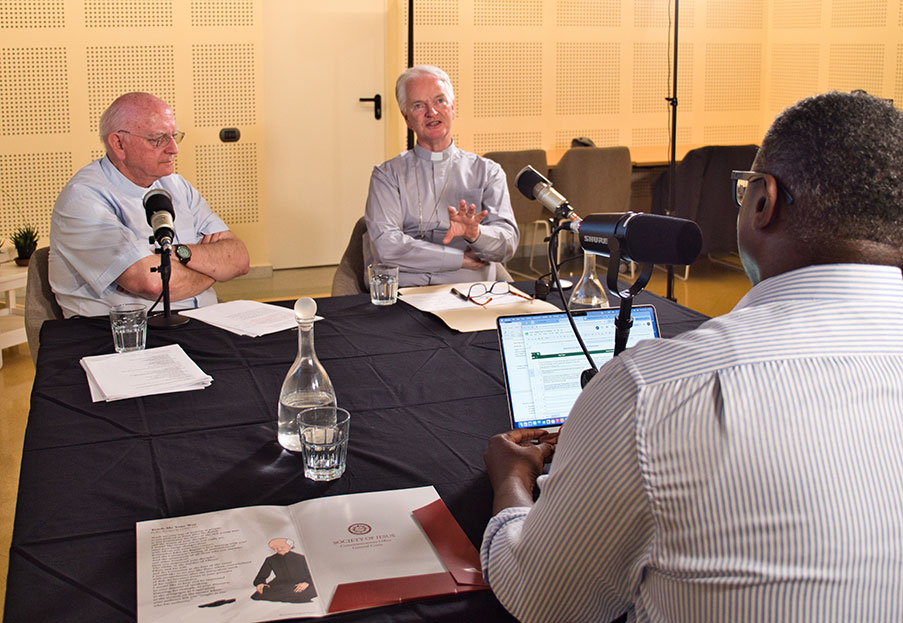
The leadership team of the International Society of Jesuit Ecumenists recently came to Rome to consult with Father General and his counsellors about the place of ecumenism in the Society of Jesus. Fr Dorian Llywelyn, SJ, gives us his reflections following those meetings.
The Society’s contribution to the Church’s approach to ecumenism
Since the Second Vatican Council, Jesuits have played a distinctive role in the Church’s ecumenical journey. Jesuit scholars have helped interpret Unitatis redintegratio, the Council’s landmark Decree on Ecumenism, and contributed to official dialogues with Protestants and Orthodox Christians.
Often, the Jesuit contribution has been to make ecumenism an everyday dimension of mission – sometimes so much so that it risks being taken for granted. In some places Christians live in harmony; in others they are indifferent to one another, or even rivals. Jesuits have worked side by side with Christians of other churches, forming friendships across confessional lines. Ecumenism looks different depending on context: where believers are persecuted or where poverty and marginalization unite people, Christian unity takes on a practical shape – whether opening a school at the request of Orthodox neighbours or providing trauma care in war zones.
The Spiritual Exercises have also become an important ecumenical tool. In retreat centres and 19th annotation retreats (Spiritual Exercises in Daily Life), it is now common for Christians of other traditions both to participate and to serve as spiritual directors.

Cleaning up the misconceptions
Yet, even after 60 years of effort, ecumenism still suffers from misconceptions. It is not about diluting Catholic identity or finding the lowest common denominator. True encounter requires honesty and respect in difference. Nor is the goal to persuade other Christians simply to “become like us”. Popes since Vatican II have emphasized that unity is not absorption. Real ecumenism recognizes the communion already shared in Christ and seeks to deepen it patiently – the magis in action.
Finally, ecumenism is not a niche activity for a handful of European or North American specialists. Most progress happens in ordinary encounters – friendship, prayer, and shared discipleship. For Catholics, it is not an optional extra but part of fidelity to Christ’s prayer “that they may all be one” (Jn 17).
Shared Prayer versus Shared Action
Debates sometimes ask whether ecumenism should emphasize shared worship or joint action. In practice, the two belong together. Prayer without action easily slips into sentimentality; action without prayer risks becoming purely pragmatic or ideological. Both are essential. Prayer roots us in God’s gift of unity; action embodies that unity in service of the poor, in reconciliation, and in justice. Jesuits often describe themselves as contemplatives in action; ecumenism, too, must be prayerful in its activity and active in its prayer.
When Dialogue Feels Stuck
Official dialogue sometimes reaches an impasse – over jurisdiction, sacraments, or ecclesial titles. After decades of discussion, results can seem limited. The “ecumenical springtime” of Vatican II has cooled. Some major accords have been reached, particularly with mainline Protestants, though mutual suspicion often lingers in relations with the Orthodox.
In these moments, the Spiritual Exercises are a resource: they cultivate deep listening and openness, helping us to recognize God’s work even in slow growth or setbacks. The long view is essential. Two pastoral attitudes are especially helpful:
• Patience and honesty: acknowledging difficulties without minimizing them, and continuing dialogue at the grassroots even when official talks stall.
• Acceptance: progress comes when Christians feel respected as they are, not pressured to conform.
Insights from the meeting with Father General
In our recent conversation, Father General underlined five key insights. First, ecumenism is no longer an “issue” in many places; this undramatic normality may be one of its greatest successes. Secondly, a new impetus to ecumenism comes from the recent Synod on Synodality. By its nature, synodality invites other Christians to walk together with Catholics. Thirdly, we live in a world that is experiencing both authoritarian repression and liberal fragmentation of societies. Ecumenism can model fraternal dialogue and reconciliation – in the process becoming a witness to prophetic resistance. Fourth, unity needs to take generational differences into account. On the whole, younger generations are less tied to old divisions, though they need formation to avoid superficiality. And finally, context matters: it must always be embedded in local culture and history. If it is going to be effective, it will look different in Gaza and Ukraine, Kerala and Egypt, Sweden, or Brazil. The demographic centre of the universal Church and the membership of the Society of Jesus to the global South means that a new ecumenical path has to emerge.
These insights affirmed that ecumenism is as integral – not peripheral – to our Jesuit mission today as in previous generations.
Conclusion
The main takeaway from our conversations at the Curia, the Gregorian University, and the Orientale is that today’s ecumenism is about deepening friendships not out of mere politeness but for the sake of mission, and because of that, the ongoing task of ecumenism is always urgent, in every place. As Jesuits we bring to this task our characteristic way of proceeding. Ecumenism, in this sense, is not a program but a way of being Church together – a way that is deeply Jesuit and deeply needed today.

Related Posts:
The General Curia of the Society of Jesus launches its brand-new Webinars’ Calendar. After being in pilot mode for the last two years, these meetings have proved to be incredibly useful, with sometimes up to 600 people taking part from all around the globe. The idea is to provide ongoing formation...
The General Curia concluded its social year with a gathering in the Aula on 19 June that brought together the Jesuit members of the Curia community and the lay collaborators that jointly sustain its administrative operations...

The Enlarged Council brought together the Secretaries of the Apostolic Sectors, General Counsellors, General Treasurer, Presidents of Conferences, and other officials at the Curia to examine a central question: How to increase and deepen collaboration across apostolic...
On 5 June 1546, Paul III signed the brief “Exponi nobis”, which addressed how men who did not belong to the original group of highly qualified priests of the Society could nonetheless belong to it and serve its mission. The brief did so by establishing the grade of coadjutor...

Four hundred and eighty-four years ago, the Apostle of Asia stepped ashore in Portuguese India – marking both the end of a long formation and the beginning of a ministry that would span a continent. The arrival of St Francis Xavier (1506–1552) in Goa, India, on 6 May 1542 was at once a...

Superior General Arturo Sosa has convoked the 72nd Congregation of Procurators, bringing representatives from across the Society of Jesus to Indonesia in October 2027. The gathering will examine how the Society’s structures must be reshaped to carry its mission forward...