Who counts as a Jesuit? A 1546 papal brief answered one question and raised others
By Wenceslao Soto Artuñedo, SJ | Archivum Romanum Societatis Iesu (ARSI)
On 5 June 1546, Paul III signed the brief “Exponi nobis”, which addressed how men who did not belong to the original group of highly qualified priests of the Society could nonetheless belong to it and serve its mission. The brief did so by establishing the grade of coadjutor – those who assist, whether in the spiritual or temporal sphere – in its two forms: priests to help in spiritual ministries such as preaching, confession and teaching, and laymen for material and administrative matters. The Society’s secretary, Juan Alfonso de Polanco, noted, however, that the spiritual coadjutor should not be equated exclusively with the priest, nor the temporal with the layman, as this depended on the mission they carried out.
This brief resolved the problem of “undocumented Jesuits”: those priests who lacked the academic qualifications of the founding Parisian group, or laymen who had no priestly vocation but felt drawn to the Society. The first two were relatives of Francis Xavier: the brothers Eguía and Jassu, Diego (a priest) and Esteban (a layman), who had been incorporated in 1536, before the founding of the Society. They are taken as prototypes of the spiritual and temporal coadjutor respectively.
Ten years later, Ignatius offered the Pope three possibilities for incorporating them: 1) by means of three simple vows of poverty, chastity and obedience, binding for as long as the Superior General or his successors deemed appropriate; 2) two perpetual vows of poverty and chastity; 3) living in poverty, chastity and obedience for the duration of their time in the Society, without vow, and free to leave.
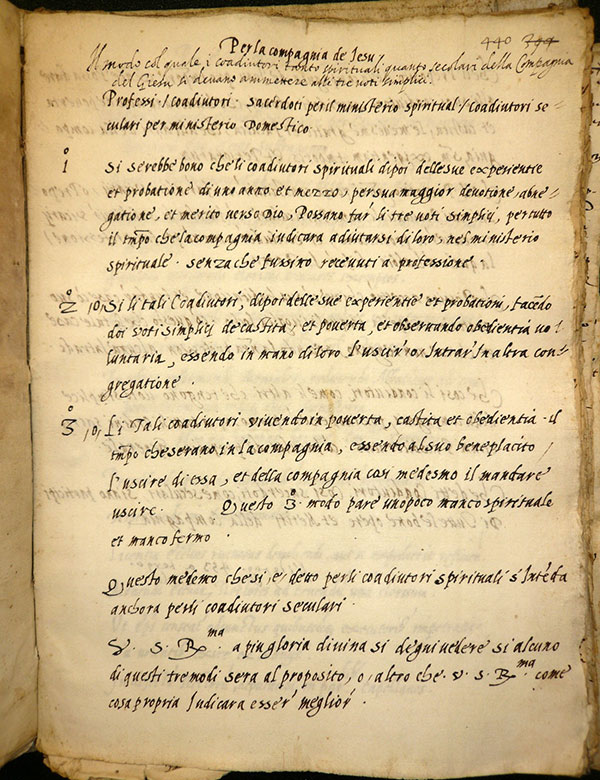
First page of the options for regulating coadjutors, presented by Ignatius to the Pope in 1546, Capitular Library of Toledo, Spain.
The brief chose the first option, so coadjutors were to be admitted if needed, and dismissed if not. From the outset, some interpreted this temporariness as applying both to the individuals and to the institution of coadjutor itself.
The grade of spiritual coadjutor was later applied to Jesuits who did not attain the expected academic excellence during formation; for temporal coadjutors, the Constitutions assigned only domestic services, meaning they could not pursue further studies beyond what they had on entry. In practice, those tasks were soon exceeded, particularly with the admission of the first architect, Giovanni Tristani, in 1552.
The Pope also granted that temporal coadjutors could be promoted to the priesthood. This was the case of Bernardino Descalcio, admitted in 1542 and ordained twenty years later, in 1562. The Father General was likewise permitted to appoint spiritual coadjutors who might later make their profession – a practice described by Polanco in 1547.
Ignatius and his collaborators drew very few distinctions between spiritual and temporal coadjutors, but the question of grades eventually became a problem, particularly that of the spiritual coadjutor, since creating hierarchies among priests was, and remains, an innovation unique to the Society.
In the twentieth century, the integration of temporal coadjutors into the life and mission of the Society, and their formation within it, changed significantly in practice. A new profile of Jesuit brother has emerged – a richness for the Society, and a question that still awaits full expression in the Society’s own law.
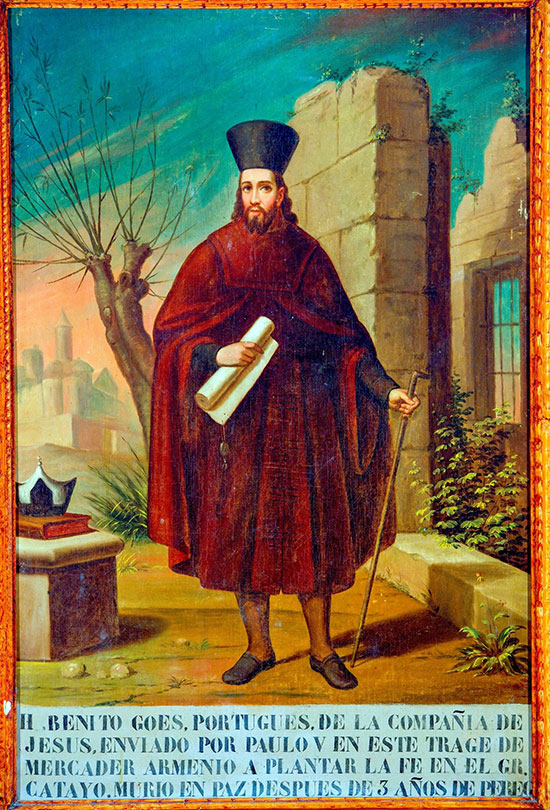
Br Bento de Goes, one of the coadjutor brothers who served the Society’s mission, Sanctuary of Loyola, Spain.
Related Posts:
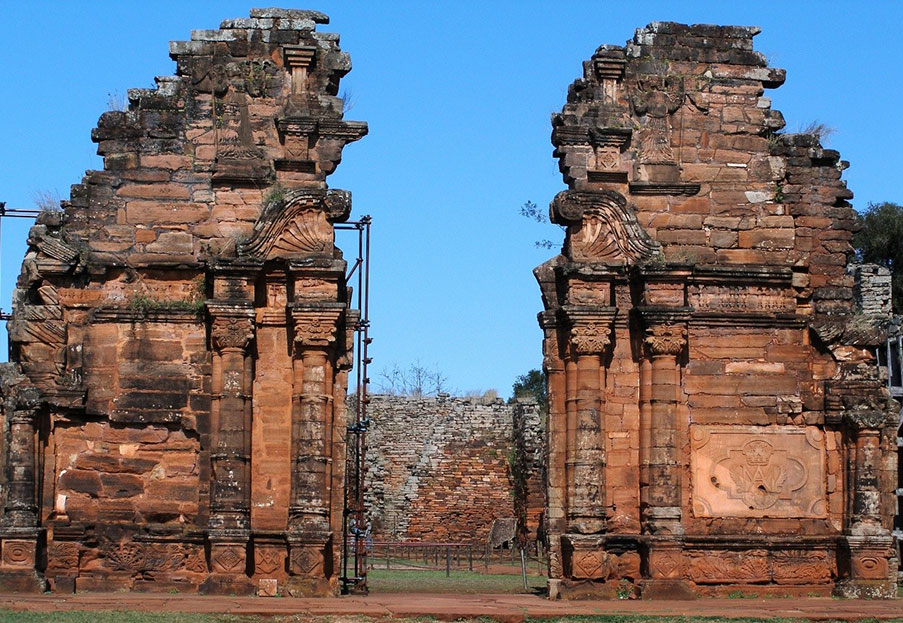
The Paraquarensis Province was separated from that of Peru in 1604. It comprised the territories of the present-day states of Paraguay, Argentina, Uruguay, part of Bolivia, and, temporarily, Chile. One of the most notable ministries in this Province was the Guaraní reductions...
The General Curia of the Society of Jesus launches its brand-new Webinars’ Calendar. After being in pilot mode for the last two years, these meetings have proved to be incredibly useful, with sometimes up to 600 people taking part from all around the globe. The idea is to provide ongoing formation...
The General Curia concluded its social year with a gathering in the Aula on 19 June that brought together the Jesuit members of the Curia community and the lay collaborators that jointly sustain its administrative operations...
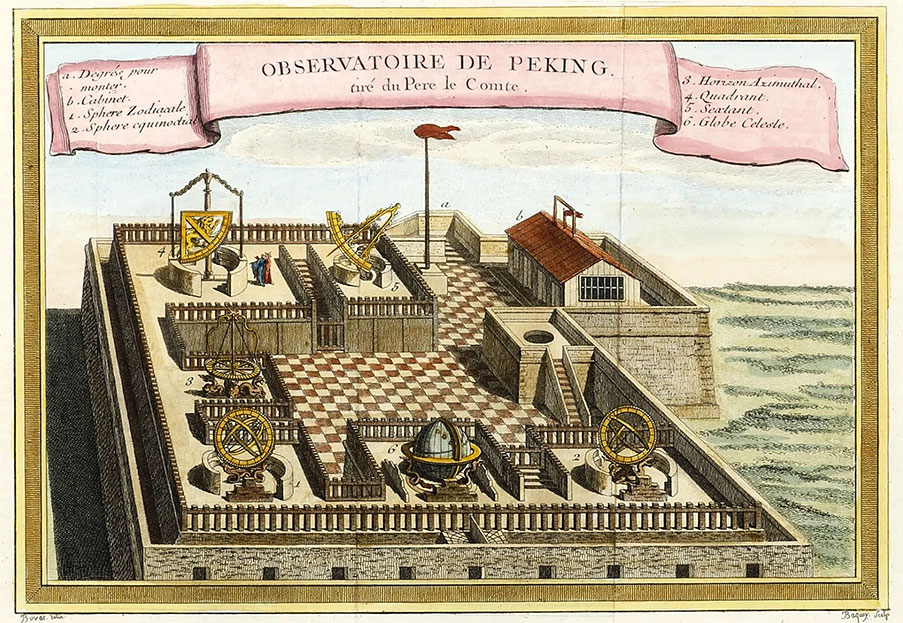
On 21 June 1629, the sky above Beijing darkened for a few moments. To astronomers, it was a partial solar eclipse. To the Chinese imperial court, however, the phenomenon had a much deeper significance. For centuries in China, eclipses had been interpreted as messages from Heaven...

The Enlarged Council brought together the Secretaries of the Apostolic Sectors, General Counsellors, General Treasurer, Presidents of Conferences, and other officials at the Curia to examine a central question: How to increase and deepen collaboration across apostolic...

On 22 May 1622, Pedro Páez died in Gorgora (Gondar, Ethiopia). He was born in Olmeda de las Fuentes (Madrid, Spain) in 1564 and entered the Society at the age of 20 at the novitiate in Villarejo de Fuentes (Cuenca, Spain), although older biographies state that he entered in Coimbra...