Seeds of Hope: Young Yezidis in Iraq rebuild from the rubble through culture of peace
The Yezidi religion is an ancient northern Mesopotamian tradition deeply connected to nature and grounded in a unique spiritual heritage. Because of misinterpretations of their beliefs and practices, the Yezidi community, indigenous to the Sinjar region of northern Iraq, has faced repeated cycles of persecution throughout its history – most recently and devastatingly in 2014, when ISIS launched a targeted attack against Yezidis in Sinjar, resulting in mass killings, the abduction of women and children, and the displacement of an entire population.
More than a decade later, many Yezidis remain displaced in camps or temporary housing, while Sinjar remains marked by significant destruction, limited services, and ongoing political and security tensions that hinder large-scale return and recovery. The nearest university is a 3-hour drive away, and financial and security concerns mean most youth – especially young women – cannot travel.
Still, some Jesuit Worldwide Learning (JWL) students and graduates from learning centres across the Kurdistan Region of Iraq (where JWL has worked since 2017) gradually decided to return to their hometowns, determined to rebuild their homes and forge a peaceful and sustainable future for their community. Among them was Sahira, who returned in 2020: “Now, we are slowly rebuilding our lives, holding onto hope and working toward a future where we can live in peace and safety once again.”

Hizrat (left) and fellow graduate, Bafreen (right), at Lalish temple, holiest Yezidi site. (© JWL)
In 2021, JWL responded to students’ and graduates’ numerous requests for higher education in the Sinjar region and, in collaboration with Nadia’s Initiative, opened a learning centre in Sinuni, followed by a second one in Sinjar City in 2022. JWL’s Peace Leader programme, accredited by Hekima University College, is the most popular programme offered in the region. Over the course of six months, it brings together young Yezidis who are eager to contribute positively to their communities despite ongoing challenges, focusing on the role of a peace leader, the value of inner peace, and practical skills for communication, dialogue, and conflict resolution.
For many participants like Sahira, the Peace Leader programme (which she graduated from in Sinuni) provides a space to reflect on their experiences and aspirations: “I joined this course because I come from a society that has endured numerous genocides and continues to struggle with a deep need for peace and security. As a member of this community, I wanted to develop skills in effective communication and conflict resolution. My goal is to use what I learn to support others and contribute to building a more peaceful and united society.”
Participants engage with concepts such as nonviolent communication, empathy, identity, and servant leadership. They explore how peacebuilding can begin at the individual level and extend outward to families, neighbourhoods, and wider social networks. For some, like Khansi (a graduate from Sinjar), this internal dimension of peacebuilding becomes especially meaningful: “Through the Peace Leader course, I started to feel inner peace again.”
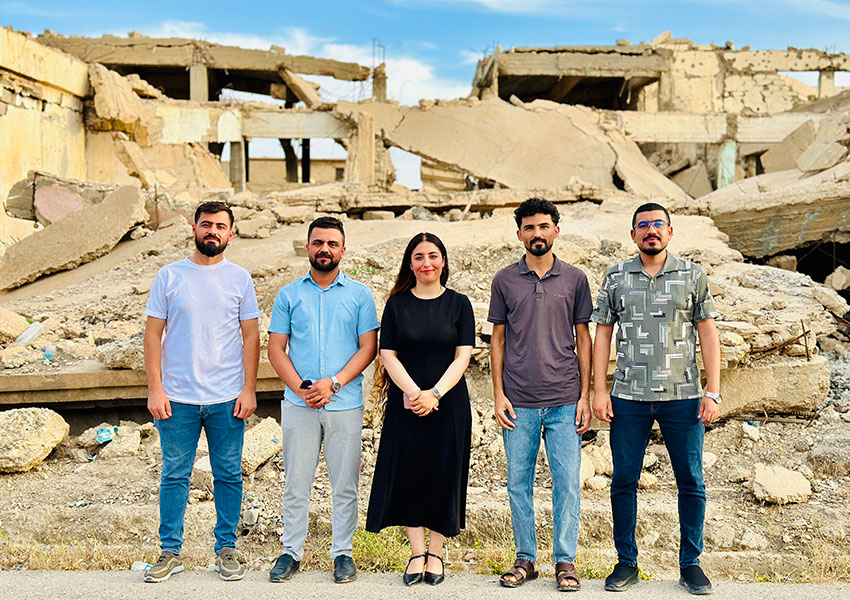
Peace Leaders in Sinjar, Iraq, determined to rebuild from the rubble through culture of peace. (© JWL)
Sinjar’s complex post-conflict environment means that young people frequently encounter divisions, misunderstandings, and frustration about the slow pace of reconstruction. Through the Peace Leader course, students reflect on how peaceful engagement can be practised in everyday situations. Marwan (graduate, Sinuni), for instance, emphasises that peace begins with respect for others: “To me, peace is letting others live with dignity and safety, no matter their faith or identity. God created us different so we can learn from each other, not fight each other.”
For others, the programme offers an opportunity to regain personal stability after years of trauma and displacement. Hizrat, for example, shared how the programme helped her reconnect with a sense of purpose: “Personally, I was going through a lot of depression [...] and I kind of lost the meaning of peace in my life. I wanted to discover that. That’s why I decided to study the Peace Leader course of JWL. And after studying, I felt like the course and sessions were almost like a therapy for me [...].”
No matter the challenge, Peace Leader students and graduates in Sinjar cultivate peace within and without, steadfast in their determination to rebuild from the rubble, leading and inspiring others on a daily basis for, as Marwan believes: “Every day, in small ways – through kindness, respect, and support – we can plant the seeds of peace and grow closer as one human family.”
Related Posts:
Launched at the 2018 IAJU Assembly, Magis Exchange offers students the chance to study across borders, cultures and academic contexts. It is more than an academic mobility program: it embodies a shared commitment to forming young people ready to engage thoughtfully...
Excitement is building for MAGIS Korea 2027, the international gathering that will bring young people from across the Ignatian family to Korea ahead of World Youth Day in Seoul. A recent online information session, led by Fr Hakjoon Lorenzo, SJ, General coordinator of MAGIS Korea...

“Since the third Universal Apostolic Preference was given to us, I have spent time discerning how the General Curia can help to move it forward. I didn’t want to set up a heavy structure. I didn’t think a Secretariat here in the Curia was needed. In the end, I opted for a light network structure...”

Pope Francis raised climate change to global consciousness as the defining moral issue of our time. As a result, the Church has become a global voice urging political accountability and personal responsibility for healing the planet. Building on his legacy, Pope Leo vigorously calls for urgent climate action...

Leading a retreat for young people should be easy. It’s usually just two or three days. But... where should I start? What should the theme be? Where do I get help? The good news is that help is at hand with a new platform called Magisresources.org...
For ten years, MAG+S Timor-Leste has been quietly accompanying young people. In our small community shaped by friendship, prayer, and service, many young people have encountered the richness of Ignatian spirituality and discovered a deeper relationship with God...