“How will the faithful respond to suffering?” | Father General’s letter to the Society of Jesus
Returning from the Holy Land:
How will the faithful respond to suffering?
TO THE WHOLE SOCIETY
Dear companions,
As we approach the light at the end of Advent, we are called to moments of solemn reflection: times when we acknowledge not only the grace and blessings we have received this past year, but also the shadows and challenges – not just for us alone as individuals, but as a worldwide family. In my reflections I cannot help but think of the shadows of the conflicts that have taken the lives of hundreds of thousands. From Ukraine to Myanmar & Haiti, Gaza & the West Bank to Sudan & D.R. Congo, the Americas to Syria & Afghanistan, we have seen families torn apart and displaced, children denied the chance to grow in peace, and entire populations wounded in ways that will not heal for generations.
For far too many, the sounds of the weapons of war have become part of the rhythm of daily life. Losing friends and loved ones to violence has become normal. The hatred that fuels these conflicts has become the only language spoken: yelling without understanding. We have become more invested in being proven right than trying to build a better world. And because of that, the specter of war and death hangs over even our most sacred moments.
And yet there are lights among the darkness. We are surrounded by those who stand with the poor and the powerless. Those who remind us that every human being is a brother or a sister, deserving of respect, hope and a future. We are invited to be People of Good Will who choose compassion over hatred, empathy over indifference, trust over the cynicism that poisons all that it touches. These ministers, humanitarian workers, teachers, community leaders, and ordinary individuals who stand against injustice – they demonstrate that dialogue is not weakness, reconciliation is not naïve, and that forgiveness is the only way to prevent hatred from deciding our future. In them, we hear the call to respond to the suffering around us.
At the end of November, I travelled to the Holy Land. The world watched in horror as they saw the images from Gaza,the October 7th attacks and their aftermath, the boiling rage that turned into devastation. In a better time, I believe that we – the world – would have cried out in one voice to stop the killing, to halt the revenge, to do everything we could to protect those in danger, comfort those in grieving, help those in need. But in today’s world, it seems as if everything is polarized and politicized. Empathy has become collusion. Reconciliation has become treason. A desire for understanding has become the mark of evil, fodder for purveyors of doom who write headlines that serve only to stoke the fires of hatred.
My pilgrimage to Jerusalem and Bethlehem was not a response to those headlines, but a desire to hear the voices of the suffering. I was moved by personal accounts from Palestinian Muslims and Christians who described living in the land of their ancestors, even as they are treated as invaders. Some spoke of how checkpoints are used as a form of revenge against Palestinians in Bethlehem and the West Bank. Others described how their lands and olive trees, sacred to the people, have been systematically stripped away and given to strangers. Still others voiced their refusal to be driven from their homes, to abandon the land for which they feel personally responsible, land that symbolizes their roots, a land which – if they leave – they will never again see. As I listened, I heard stories of those lost: a mother, a father, a brother, cousins, friends – all gone without any hope of justice – the “normal abnormal life”.
That normality of suffering spreads indiscriminately. Fr. Francesco Ielpo, the Custos of the Holy Land, shared with me the story of an Israeli who lost his wife in the October 7 attacks. Murdered in front of his eyes, the last moments of his loved one haunt him and to this day he cannot bring himself to reenter their home. These stories, found everywhere, bring with them a sense of inevitable violence and of hopelessness.One Palestinian Christian, trying to explain his feeling of helplessness, told me:
I read George Orwell’s book: 1984. “Orwellian”, this is what we’re living in. They can see all of our movements, and we, we see nothing. They know they have complete control of us. We only know that we can die at any time. You could be walking in the street and you’re shot dead. And that is just how it ends. This is how we live.
These testimonies were repeated over and over by so many living in Jerusalem and Bethlehem. These aren’t isolated incidents or rare tragedies, but common moments of suffering that have blanketed the land, infecting all they touch and spreading like a poison.
It is exceedingly difficult to hear so many testimonies of suffering without being paralyzed by despair or radicalized by anger, but we are moved by our faith to respond differently. Not with despair or rage, but with an openness to forgiveness and healing. This is the primary mission we have been given by the Church: to bring reconciliation to the people. To bridge divisions as Christ did. But how does that openness come to the Holy Land?
I started my visit by speaking with Cardinal Pizzaballa, the Latin Patriarch of Jerusalem, who tried to prepare me for the complexity of what I was about to experience in Jerusalem and Bethlehem. Offering wisdom from his years as Patriarch, he told me: “none are willing to engage because everyone believes that they alone are suffering.” Two days later, a Palestinian Muslim told me, “Everything is made so that we cannot meet each other, cannot know each other. When I left Palestine to study, one of the first things I did was to watch a Zionist lecture at the hospital. That was the first time I heard what the other side thought they knew about me, and saw how they were different from the narrative I was taught in Palestine.”
So much suffering comes from the belief that the “other” isn’t human or deserving of human respect. That belief comes about when people are only able to see the other as the enemy. A young Palestinian told me, “I only see Jews at the checkpoints when I tell them my name, where am I going, here is my ID. That’s the only time we share with Jews.” Another described summer camps that once existed for young Palestinian and Jewish children to learn with one another. The camps were extremely effective at dispelling misinformation and forming relationships between Arabs and Jews. Because of rising tensions, and perhaps because of their effectiveness at introducing people to the “other”, they were discontinued.
Two decades ago, in August 2003, Cardinal Carlo Martini returned from the Holy Land and wrote a letter about his experience in Jerusalem.
Certainly, the hatred that has accumulated is great and weighs on hearts. There are individuals and groups who feed on it like a poison that keeps them alive even as it kills them. To overcome the idol of hatred and violence, it is vital to listen and understand the pain of others. [...]
If we look only at our own pain, then resentment, retaliation, and vengeance will always prevail. But if the memory of pain is also the memory of the suffering of others, of strangers, and even of enemies, then it can represent the beginning of a process of understanding. Giving voice to the pain of others is the premise of any future policy of peace.
Across decades and generations, it is our inability to see the “other” that has prevented us from responding to suffering as we should. Removing the obstacles that prevent us from experiencing life with the other is difficult, but necessary – not just so that we can respond to the suffering of others, but so that we can attend to our own. Seeing the others for what they are – brothers, sisters, friends, fellow humans – is the only way for us to move forward.
To all People of Good Will, I offer an invitation to raise our voices together and insist that violence is a choice, never inevitable. The world needs not more weapons, but builders of bridges. We need hearts willing to understand before judging, to heal before condemning, to welcome rather than exclude. When we look upon those who suffer, we cannot remain indifferent or distant. Their pain is a call to our responsibility for our faith and our world.
To my brother Jesuits, I must confess that I have been moved by this pilgrimage and I pray that hearing about it moves you as well. Pope Leo, Pope Francis and Pope Benedict, each missioned us to the edges of the Church. Each told us that where the Church most needs the Society of Jesus is at the frontiers. The mission in the Holy Land is a frontier. This frontier needs Jesuits who are willing to learn the languages and cultures of the people so that we may fulfill our mission of reconciliation and justice.
May this Advent, be an opportunity for solemn reflection, be a time for our global family to step away from the temptation to resolve differences through force and denigration. May we instead choose a path of peace that includes reconciliation and freedom. May the coming light of Advent bring us perseverance, humility, and an unwavering commitment to true peace.
Fraternally yours in Christ,
Arturo Sosa, SJ
Superior General
Rome, 12 December 2025
Feast of Our Lady of Guadalupe
Related Posts:
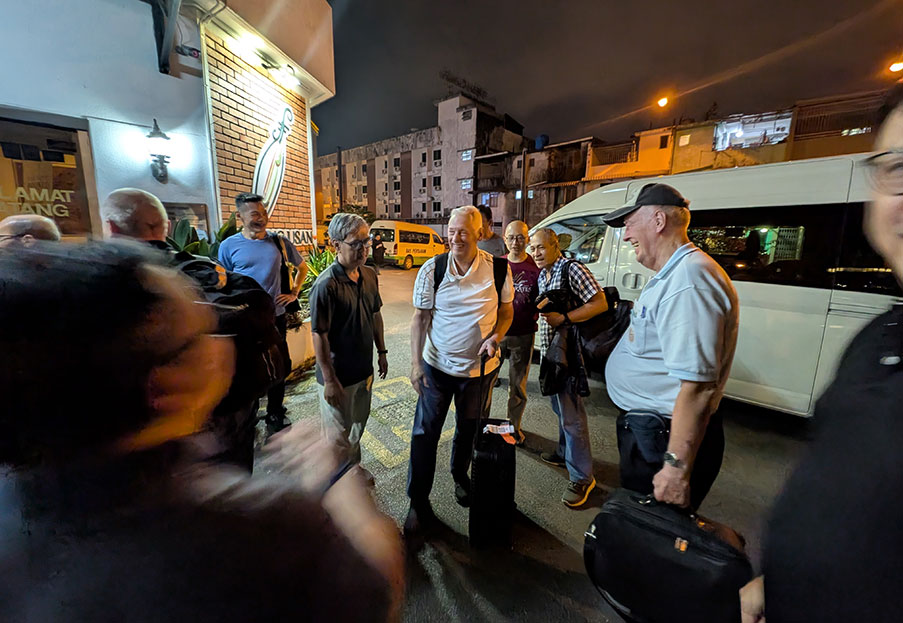
Fr Arturo Sosa, SJ, arrived in Kuching, Malaysia to begin his 5th apostolic visitation of the Jesuit Conference of Asia Pacific (JCAP). With a full schedule of meetings and travel between different Jesuit ministries and communities in Malaysia, Thailand and Indonesia...
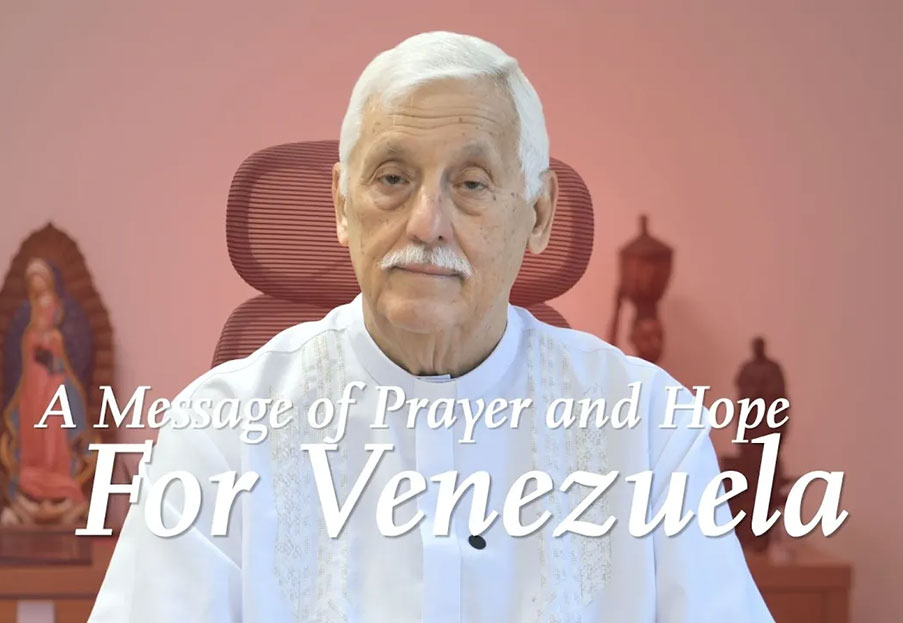
As Venezuela begins the difficult task of recovering after two strong earthquakes that claimed lives, left many missing and caused widespread destruction, Father General Arturo Sosa has sent a message of closeness and hope to the Venezuelan people.
As the Society of Jesus prepares for the II Congress JESEDU-Montreal 2027, a global process of review, discernment, and foresight is now underway. This initiative seeks to evaluate how the shared vision for Jesuit education has been implemented across the worldwide network of...

“Since the third Universal Apostolic Preference was given to us, I have spent time discerning how the General Curia can help to move it forward. I didn’t want to set up a heavy structure. I didn’t think a Secretariat here in the Curia was needed. In the end, I opted for a light network structure...”

The Enlarged Council brought together the Secretaries of the Apostolic Sectors, General Counsellors, General Treasurer, Presidents of Conferences, and other officials at the Curia to examine a central question: How to increase and deepen collaboration across apostolic...
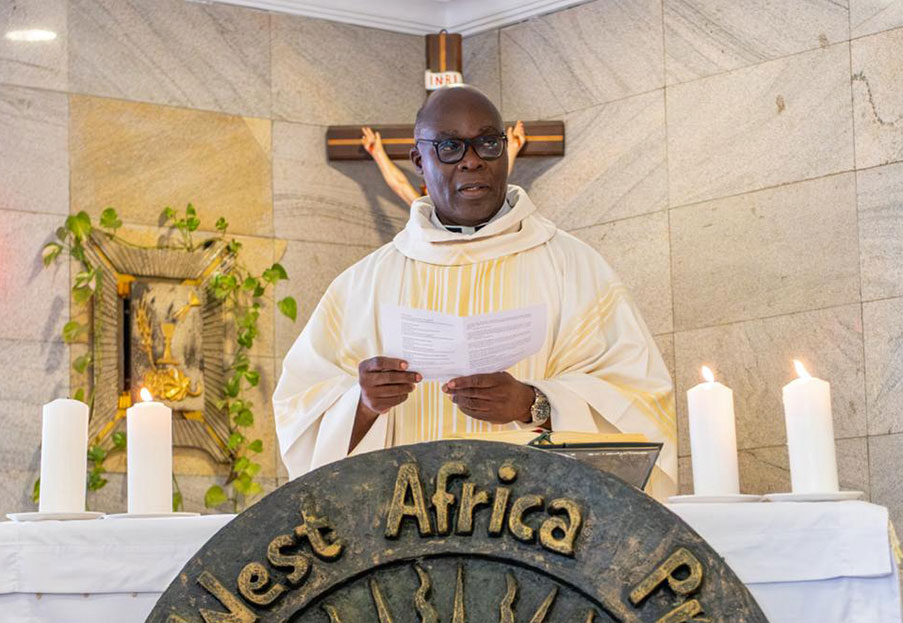
Father General Arturo Sosa has appointed Fr John Kobina Ghansah as the new Regional Assistant for Africa and Madagascar and General Counsellor. Fr Ghansah, currently Provincial of the North-West Africa Province (ANW), will assume his new role on 6 January 2027...