Investing in Futures: When Students Become Educators
École Fondamentale Saint Louis de Gonzague was built to give every child space to be included, to live and learn alongside others, and to recognize their dignity as human beings. When the Jesuits founded the school in September 2004, in a region greatly affected by the Burundi Civil War, their goal was to contribute to the education of children from marginalized communities who were at risk of joining armed groups. From the beginning, students have been able to study free of charge, ensuring access to education for the most vulnerable.
Today, the school has grown to serve 1,130 students (578 girls and 542 boys). Given these numbers, the ongoing need to expand classrooms, and the desire to improve the quality of education, one might overlook the deeper impact of this institution. Yet, a conversation with Didier Dusabe reveals something more: this is not just a school; it is a Jesuit school, and that makes a profound difference.
Didier is not merely a teacher; he is a former student of the same school, and today, his own son studies there as well. He teaches basic computer skills to students in grades 7 through 9. Beyond the classroom, he is engaged in photography and creative design, producing items such as key tags, practical expressions of the creativity nurtured during his formation.
He recalls that he first saw and touched a computer at Saint Louis de Gonzague when a Jesuit scholastic encouraged him to try it. Although there were no formal computer classes at the time, what stood out most was the relationship between Jesuits and students. Learners were free to express themselves, ask questions, and explore their curiosity without fear. It was an environment that nurtured confidence and discovery.
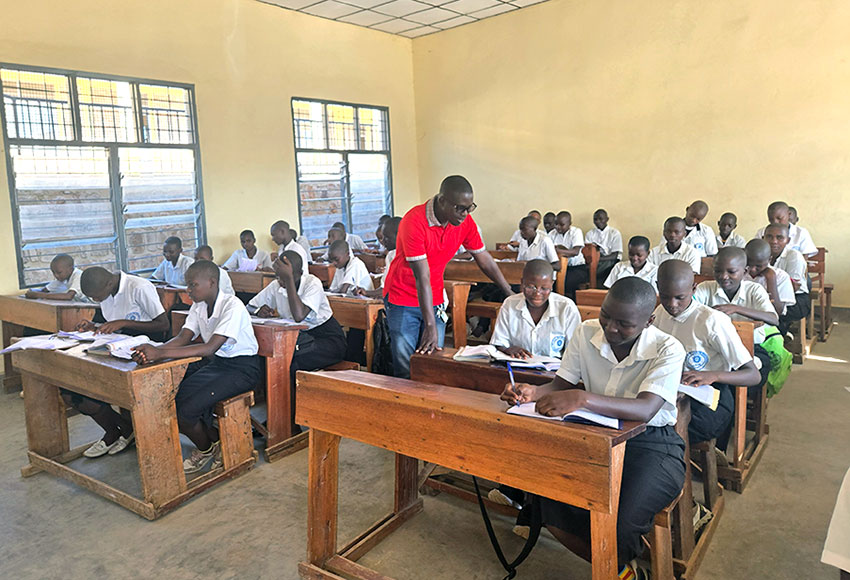
When Didier later continued his studies in another public school, he realized that not all learning environments offer the same sense of support and encouragement. Reflecting on his journey, he says: “École Fondamentale Saint Louis de Gonzague was the first step in my intellectual development. Beyond the usual teaching, the Jesuits ensured the quality of our studies. Here, I developed a love for technology. Today, I am overjoyed to be part of the institution that shaped who I am.”
Didier’s story is not unique. Several former students remain closely connected to the school, actively supporting its mission by leading clubs such as French, English, Swahili, environmental, and computer clubs. Their continued engagement shows that they have internalized the Jesuit spirit of service and are committed to giving back to their community.
This ongoing connection between former students and the school highlights a sustainable and transformative model of education. École Fondamentale Saint Louis de Gonzague does not only provide access to learning; it forms individuals who grow, return, and invest in others.
In this way, the school continues to equip young people with the skills, confidence, and values needed to build a better future. As former students like Didier testify, Jesuit education forms not only learners, but individuals committed to service, what Pedro Arrupe described as “men and women for others”.


Related Posts:
On a sunny mid-week day in Kuching, Fr General Sosa visited St. Joseph’s Private Secondary School (SJPS) where the Jesuits of the Malaysia-Singapore Region work as teachers and administrators. Currently, Fr Stanley Goh is the Rector, while Fr Francis Lim served as the first...
Service Yezu Mwiza (SYM) is a Christian, socio-medical organization dedicated to fighting HIV/AIDS, tuberculosis, and malaria, while promoting holistic healthcare and social justice. Founded in 2008, it operates as a prominent reference centre under the care of the Jesuits in Burundi...

As the Society of Jesus prepares for the II Congress JESEDU-Montreal 2027, a global process of review, discernment, and foresight is now underway. This initiative seeks to evaluate how the shared vision for Jesuit education has been implemented across the worldwide network of...

The Secretary for Secondary and Pre-secondary Education, with great joy and gratitude, announces that Fr Hugo Gómez Sevilla, SJ, a Jesuit leader with a wealth of valuable international leadership experience building networks, pastoral sensitivity, and a deep commitment to Jesuit education...

Rwanda’s youthful population holds great potential, yet nearly one in four young people are not in employment, education, or training, according to the 2025 Labour Force Survey. In response to this situation, the Jesuit Urumuri Centre (JUC), a social initiative of the Jesuit Rwanda-Burundi Province...
The ICAJE (International Commission on the Apostolate of Jesuit Education) and JGNS (Jesuit Global Network of Schools) Board meeting took place from 26 May to 29 May 2026, bringing together leaders of the global Jesuit educational apostolate to reflect on shared priorities...