“On 15 January 2023, after the Angelus – I was travelling to Rome and we watched from the train – Pope Francis announced officially the ecumenical prayer vigil for 30 September of that year. He said that the path to Christian unity and the Church’s synodal conversion are linked...”
Antonio Spadaro, SJ
Pope Francis: in memoriam
My travels with Pope Francis
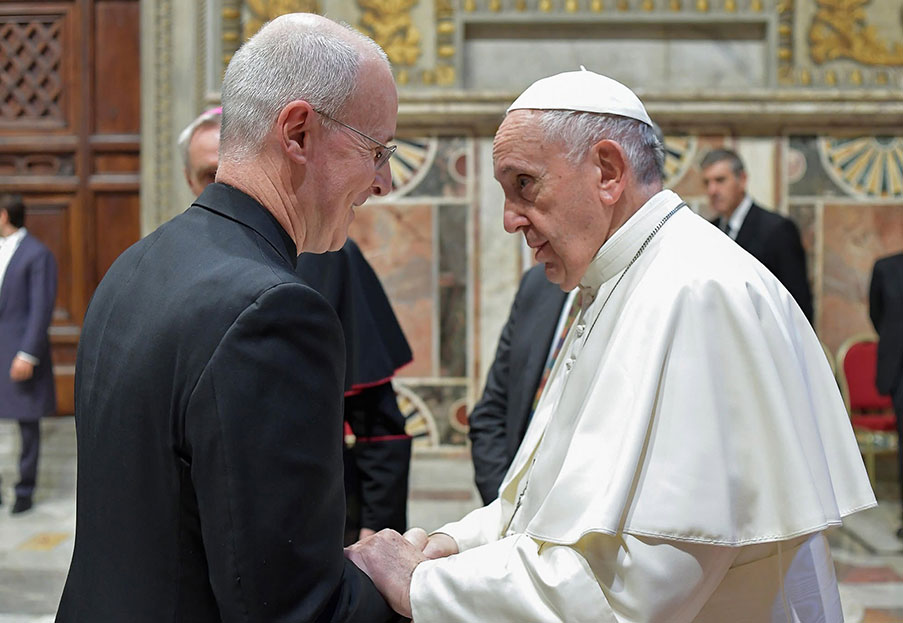
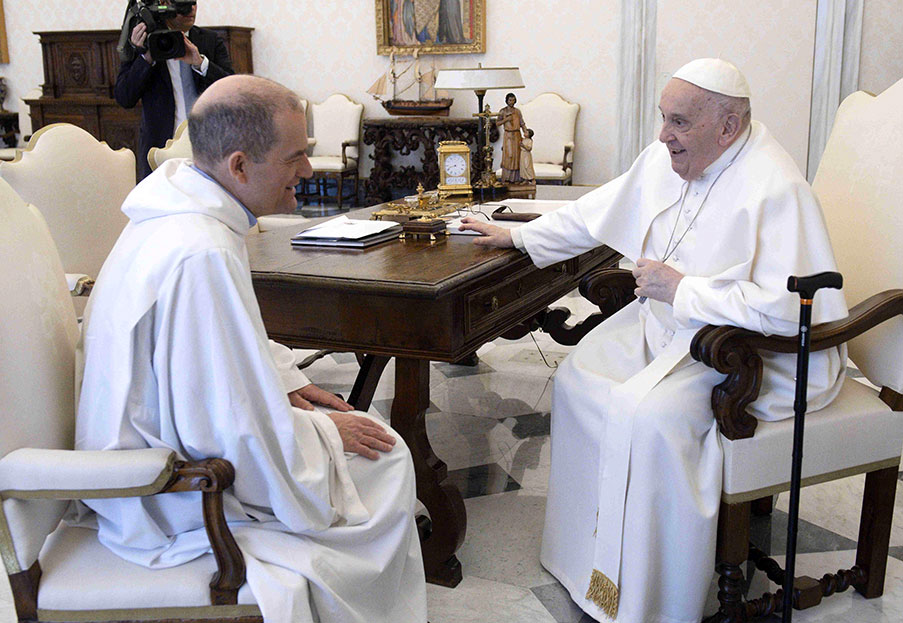
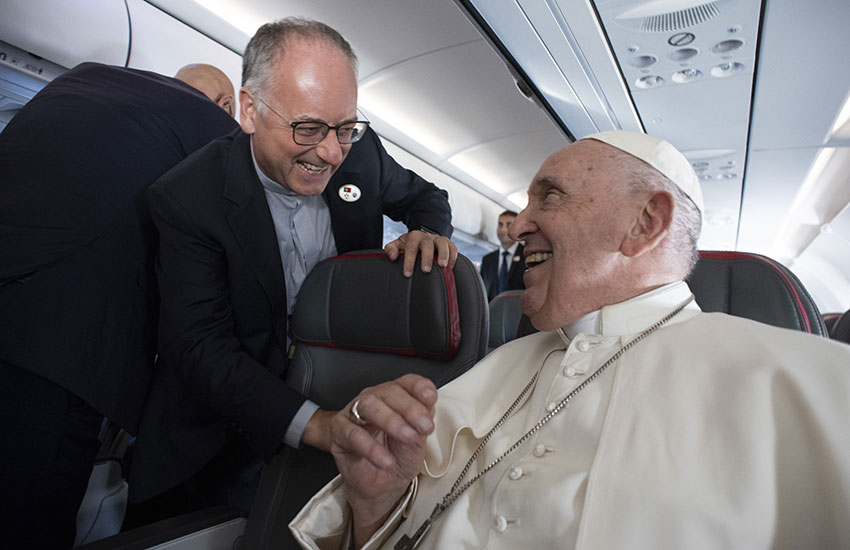
Antonio Spadaro, SJWe were in Korea, August 2014. I had just finished a live commentary for RAI on the closing Mass of Asian Youth Day, at Haemi Castle, when Alberto Gasbarri – the Vatican official best known for organizing papal trips around the world – came up to me and said, “As soon as you’re done, get on the helicopter waiting for you”. He didn’t say where. He didn’t say why. I got on. Mid-air, I learned we were headed for Sogang University in Seoul, the Jesuit university. Once we landed, we hurried to the community residence. There I found Francis already speaking, surrounded by a group of fellow Jesuits. He was speaking in Spanish, translated into Korean. I stood still, struck. Instinctively, I pulled out my iPhone and began to record. I did not yet know that that improvised gesture would mark the beginning of ten years of conversations gathered at the margins of apostolic journeys – material that would eventually become the book Be Tender, Be Brave.
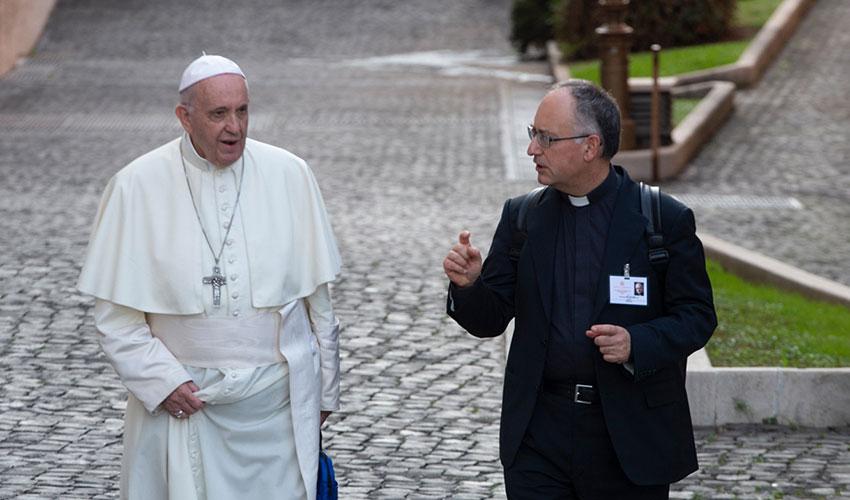
There is no complete transcript of that first encounter. But from the partial recording, one word stood out, clearly dear to the Pope: “consolation”. Not an abstract theological concept, but something he described as a movement of the soul, the felt presence of God in the heart. What struck me most was the tone with which Francis spoke to his fellow Jesuits: nothing solemn, nothing prepared. A man thinking out loud, allowing himself to be provoked by questions, always answering from concrete experience. The beauty of those moments lay in the fact that I was not merely an observer: traveling with him meant seeing the world from his vantage point, exchanging impressions along the way, witnessing the birth of his reflections before they became speeches, documents, teaching.
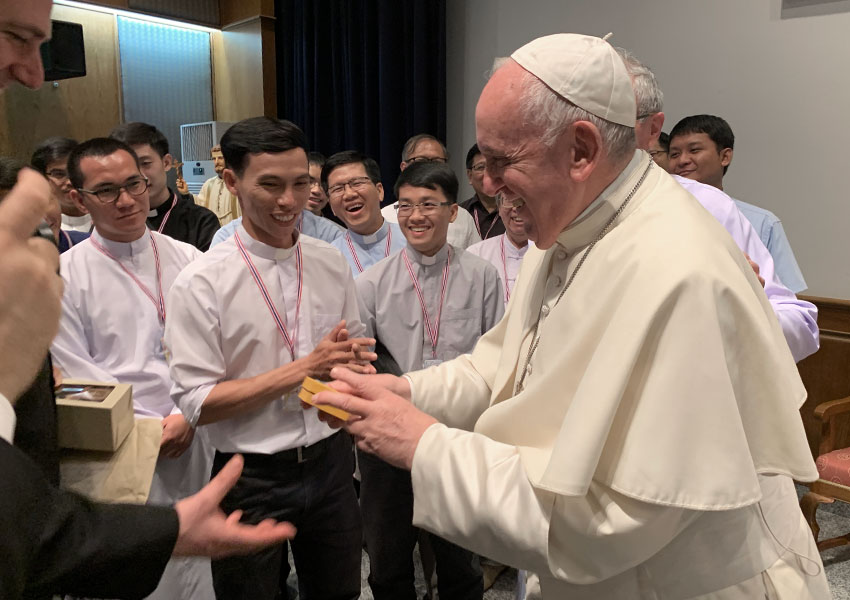
Whenever he entered a room full of Jesuits – I saw it in Kraków, Cartagena, Dublin, Bangkok, Budapest, everywhere in the world – he never took the chair as a lecturer. He would sit down, look each person in the eye, and wait. Sometimes he would prompt them himself: “Ask me questions – it’s better. Let’s put the ball at midfield.” It was a phrase I heard him repeat, in different forms, many times.
On one occasion, he became visibly irritated because the Jesuits had no questions to ask him and were expecting a speech to which they could respond with a prepared address. At that point, he broke the pattern and remained silent until the Jesuits began to ask him questions.
His way of speaking had its own grammar, which I learned to decipher trip after trip. Francis did not produce tidy, linear arguments fit for a press release. His words required something like a poetic reading: they moved by images, by stories, by sudden leaps from the particular to the universal. An episode from his time as provincial in Buenos Aires would connect, without warning, to the future of the Church in Asia. A Filipino girl in tears would become the key to understanding Christian compassion. This orality was his true doctrine. The philosopher Giovanni Reale, a scholar of Plato, once told me as much, speaking precisely of Francis and his “unwritten doctrines”. In his conversations with Jesuits, moreover, he communicated his very first impressions of the journey: what he had seen from the popemobile, the faces he had encountered on the street, the emotions still fresh from landing. These were conversations while the metal was still warm – unfiltered, immediate – and for that very reason uniquely valuable.
There was also a ritual that repeated itself at every arrival. When the plane landed and Francis descended the steps, the first speech he delivered before the country’s authorities was invariably an invitation to place Catholics at the service of the common good. He never spoke of the Church as a separate island. He insisted that everyone – believers and nonbelievers, Christians and followers of other faiths – must work together to build what he liked to call “social friendship”. It was a phrase that returned on every trip, from Brazil to Mongolia: the idea that faith is not a fence but a bridge, and that the task of Christians is above all to contribute to civic life, to justice, to a concrete fraternity among peoples.
But there was something else I noted in my travel diary: his capacity to be changed by events. On every journey, concrete situations reshaped the content of his message. I saw it in Tacloban, in the Philippines, where the Pope chose to stand in driving rain with people who had lost everything in Typhoon Yolanda. The wind was so strong that it brought down a scaffold, killing a twenty-seven-year-old volunteer just as the papal plane was taking off. The silence that followed that news – a silence agitated by the roar of the storm – has never left me. The Pope remembered her repeatedly in prayer; he met her father at the nunciature. It was not an institutional gesture. It was the grief of a man who had found himself inside the tragedy, not above it.
And then there was Bangui, in the Central African Republic, in the heart of a war. Journalists traveling with him asked whether it was prudent to go. Francis answered with jokes that concealed an absolute determination: “If you don’t want to come, get off – just give me a parachute!” Or: “I’m not afraid of bullets, but of mosquitoes.” Every meter he covered in that city was flanked by crowds, young people on motorbikes, three or four to a seat, dust rising from the unpaved roads as the convoy passed. There he chose to open the Holy Year of Mercy – not in Rome, but there – calling Bangui the “spiritual capital of the world”. The phrase was not rhetorical. It translated a physical decision: to place his own body at the most fragile point on the planet. And there, too, I saw him lean out from the popemobile, stretching his hands toward the children running alongside, searching their eyes, one by one.

I witnessed the same pattern in Ciudad Juárez, on the USA–Mexico border: the papal altar stood eighty meters from the frontier, with people gathered behind the dividing fence to hear the Mass. The wall became a bridge, symbolically crossed. In Mosul, amid the ruins. In Sarajevo, where walls still bear the marks of bullets. The Pope traveled to touch wounds – and this was no metaphor. I saw his hands rest on pockmarked walls, on marked faces, on children who had no words for what they had lived through. The sensations in Iraq were beyond description: Francis praying among the ruins of Mosul, once the stronghold of ISIS, and in Qaraqosh, in a church rebuilt after destruction at the hands of terrorists. The joy I saw there was irrepressible.
Before people, his gaze was always personal. He did not look upward, as one does when trying to embrace a crowd. He looked horizontally, because he wanted to see individuals – the faces, even if only a few, but never the mass. Once he told me: “It’s something that comes naturally to me.” And it did. You could see him physically lean toward people, reach out to touch a hand, caress a face, search for the gaze of the person in front of him. It was not a studied gesture. It was the reflex of a man for whom closeness was not a theological principle but an instinct.
In conversations with Jesuits, this physicality translated into a frankness untouched by diplomacy. In Poland, a newly ordained priest asked him for advice about the future. Francis replied: “The future belongs to God. The most we can do is the ‘futuribles.’ And the futuribles all belong to the bad spirit.” It was not cynicism; it was the realism of someone who knew that life is lived in the present, not in projections. In Colombia, when people spoke to him about moral crisis, he brought everything back to concreteness: Jesus’ theology began with a seed, a parable, an everyday fact. In Hungary, when asked about war, he said it was a mistake to think of it as a cowboy movie with good guys and bad guys.
One moment, in particular, has stayed with me. In the Philippines, during the meeting with young people in Manila, Glyzelle Iris Palomar, a twelve-year-old girl rescued from the streets, began to tell her story to the Pope and broke down in tears, unable to go on. Francis set aside his prepared remarks. “She has said the one thing that has no answer”, he said, “and that cannot even be expressed in words, only in tears. Let us learn to weep.” He added that the compassion that matters is not the worldly kind, the kind that at most leads you to reach for your wallet. True compassion was that of Christ, who understood our tragedies only when he was able to weep. In that moment Francis was not looking at the crowd; he was looking at her, only her, eye to eye.
Bergoglio, who had not liked to travel, reversed course once elected Pope. He said so himself: he had sensed that his ministry required him to set out into the world. But his was never a representational journey. Each time the plane landed, there was a man stepping off with a willingness to be changed by what he would encounter. That is what I tried to record in my travel diary, flight after flight, conversation after conversation: not so much the Pope’s words, as the way those words came into being – from an encounter with a face, from the silence after a tragedy, from the tears of a child, from the dust of a road. Francis never refused a question. In flight, he made himself available to journalists without knowing in advance what they would ask, and he answered off the cuff.
Above all, he never refused to be touched by reality. And perhaps this is the most intimate lesson of all those journeys: that faith, like travel, is not a destination but a way of moving through the world. Now that he is gone, those notes weigh differently in my hands. They trace the path of a man who crossed the world in order to encounter it, to let himself be wounded by it – and to heal its wounds.
[Original in Italian]
© Jesuit.media