Language protection: another aspect of integral ecology
By Colin Brady | Campion Hall, Oxford (British
Province)
[From “Jesuits 2024 - The Society of Jesus in the world”]
Protecting endangered language communities is another way of fighting for human rights and addressing the ecological challenge.
It is difficult to imagine two more different places than the University of Oxford, with its dreaming spires and community of academics and students, and the twenty-eight villages and two small towns in the foothills of the Himalayan mountains that is the home to the Hrusso Aka tribe. Yet a remarkable research project that focuses on the endangered language of this unique Northeast Indian tribe now connects them.
The Laudato
si’ Research Institute based at Campion Hall engaged in partnership with Fr
Vijay D’Souza, SJ, and others who work with endangered language communities.
When a community’s language is endangered, its people risk losing their unique
understanding of life and way of being human on our shared planet. Following in
a long tradition of Jesuit linguists, Fr Vijay D’Souza, SJ has therefore been
working with endangered indigenous languages in North East India for over
twenty years. His research led him to doctoral studies at Campion Hall in the
University of Oxford. Fr Vijay explains his motivation: “The loss of whole
languages is not just an academic concern; when we think about it, we soon
realise that we are talking about whole traditions that are at risk, and we can
see how ‘language rights are a social justice issue, and language rights are human
rights’”, he comments.
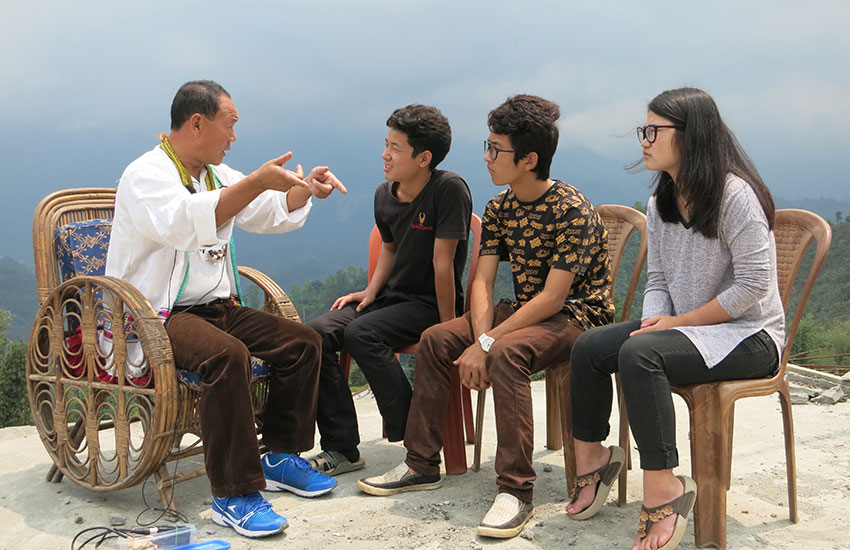
By delving into sacred mythology, word lists, oral history, and other local customs, Fr Vijay recorded the vocabularies of these endangered languages, enabling community groups to produce textbooks, stories, and even news channels in their own languages. Fr Vijay adds, “It’s a methodology that I call RIME, respectful intervention for mutual enrichment”. What is preserved is not just a language, but with it an entire culture and way of life.
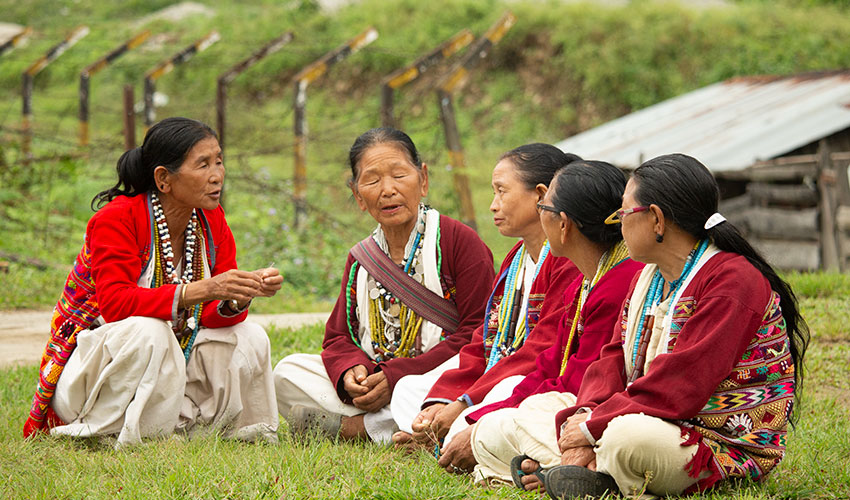
Fr Vijay’s interest in endangered languages was sparked in 1999 when he undertook a linguistic project in the Arunachal Pradesh state in North East India. Home to approximately a hundred small indigenous tribes and with ninety languages, this is one of the most linguistically and culturally diverse states in India. Fr Vijay focused on the Hrusso Aka tribe, with its population of seven thousand. The villagers had asked the Jesuits to open a school there and so began the Jesuit mission in 1988.
The three pioneers of the Jesuit mission took an immediate keen interest in the language, much to the surprise of the villagers. Fr Vijay initially arrived while still in studies for ordination, and was tasked with learning Aka, an endeavour which proved challenging. Firstly, Hrusso Aka was unscripted, and so Fr Vijay was compelled to find ways to learn it without the usual linguistic tools – grammar, dictionary, or other forms of printed materials. Secondly – and somewhat surprisingly – there was widespread pessimism about the future of the language among the native speakers themselves.
Dr Sarah Ogilvie, Senior Research Fellow in
Linguistics at Campion Hall, shares this concern, having worked on documenting
and revitalizing languages in Australia and America. “Over the past fifteen
years or so there has been a shift in how we do this work. The biggest change
within academic study of endangered languages is a new emphasis on
collaboration and capacity building. Heritage communities now invite the
linguist to come and work with them; they set the agenda and make the decisions
while the linguist is there to learn from them.”
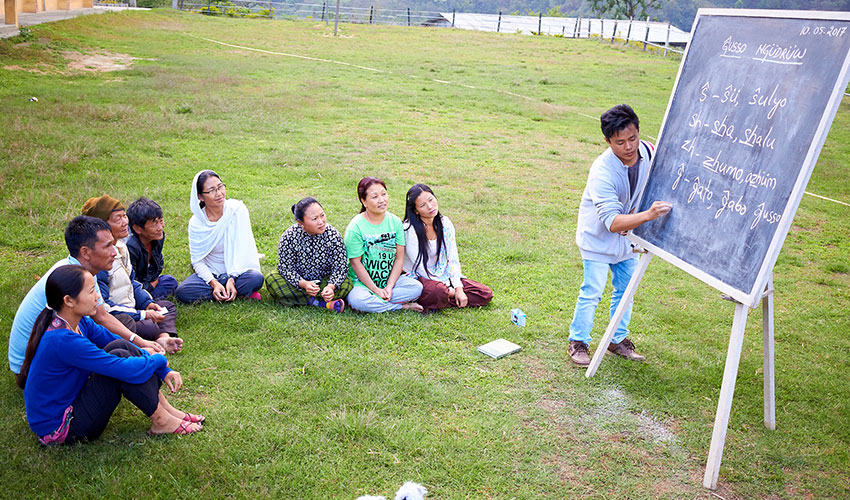
Fr Nick Austin, SJ, Master of Campion Hall has been pleased to see this work developing, “It’s an inspiring example of the sort of work we aim to do with colleagues here in Oxford, bringing world-class scholarship to bear on real-world concerns. Affirming and ensuring the survival of people’s languages and cultures is an essential part of this mission to walk with the excluded and to work with others in care from our common home.”
Endangered languages are not just a human rights issue, but an ecological one. With up to 90 % of the world’s languages are at risk of disappearing over the coming century; caring for languages will be key to protecting the world in a time of climate crisis, and to protecting communities against deepening poverty in a time of global economic turmoil. The partnership between the Laudato si’ Research Institute and the North Eastern Institute for Language and Culture in North East Asia founded by Fr Vijay, provides vital scholarly and practical support for this work.
Their resources on endangered languages are
available on the website of the Laudato
si’ Research Institute, along with other material including a free library
of key texts on integral ecology. Conversation about new research partnerships
are welcome and Campion Hall is always pleased to discuss opportunities for
postgraduate study at the University of Oxford.

Related Posts:
In an effort to strengthen global collaboration and advocacy across regions, the Global Ignatian Advocacy Network (GIAN) – an apostolic platform of collaboration animated and coordinated by the Social Justice and Ecology Secretariat of the Society of Jesus (SJES) – has launched...
The Caring for Community and Creation (CCC) project was initiated by the Jesuit Conference of Asia Pacific (JCAP) in 2022 to address poverty and ecology as identified in the JCAP apostolic plan. The project has three specific objectives, one of which is strengthening communities through...

Pope Francis raised climate change to global consciousness as the defining moral issue of our time. As a result, the Church has become a global voice urging political accountability and personal responsibility for healing the planet. Building on his legacy, Pope Leo vigorously calls for urgent climate action...

The annual meeting of Eco-Jesuit delegates in South Asia, held at Inigo Bhawan in Matigara, Darjeeling, became much more than a routine gathering. Set against the fragile ecology of the Eastern Himalayas, the meeting turned into a moment of discernment on the future...

The Social Justice and Ecology Secretariat (SJES) of the Society of Jesus has released its 2025 Annual Report, “The Promotion of Justice is Fueled by Hope”. The report details regional milestones at the conference level, the results of global advocacy, and its commitment to the mission of...

In the context of the First Conference on Transitioning Away from Fossil Fuels, which will be held in Santa Marta, Colombia, from 24 to 29 April 2026, the Jesuits for Climate Justice Campaign is presenting its Statement for COP31...