Cracking a more sustainable future through education
“According to my perspective, education is the way to crack a more sustainable and equitable future”, says Christa, from Sri Lanka.
Sri Lanka is known for its stunning, diverse landscapes and ancient sites. At the same time, its three decades of horrific civil war, the devastating 2004 tsunami, and the more recent political unrest, along with the strain of an economic crisis which deepens inequalities, also remain impressed in the hearts and minds of Sri Lankans, and the world.
Christa comes from Hatton, in the country’s central highlands (also known as ‘Upcountry’), an area characterised by its lush, rolling hills, and famous for its tea. But behind this lies a darker reality. The population of Hatton and the surrounding areas are of Indian Tamil origin, descendants of those brought to the country under British colonial rule, to work on the tea estates. They’ve since continuously struggled to overcome social and economic challenges, including inadequate wages, limited access to health and education, and few prospects for change. Those who do manage to find work in other sectors are mainly men, but these are in the capital or other parts of the country. Families are left behind, living in poverty, and women left to the back-breaking, ungratifying tending of the tea gardens, with little hope for anything else.

Christa. [© JWL]
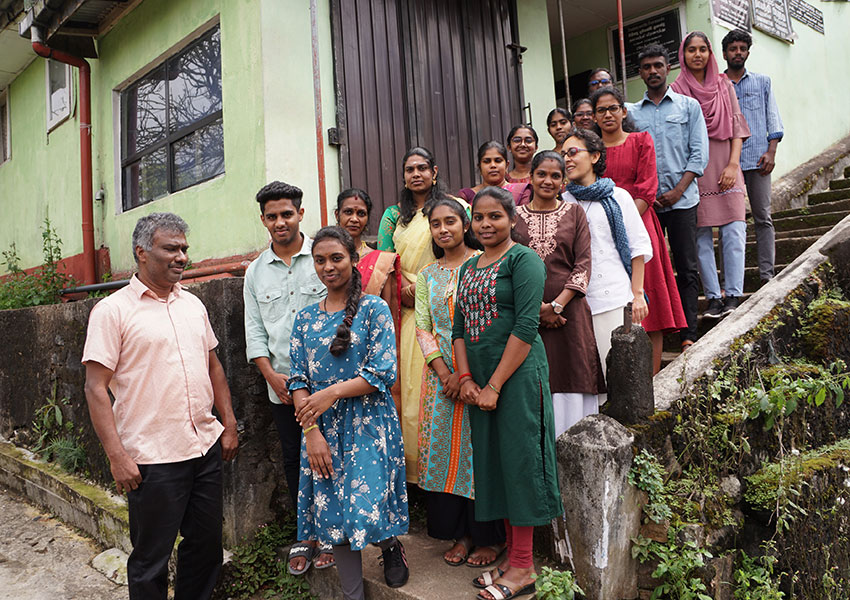
But there are youth, like Christa, who see hope for a better future through education. After her secondary studies, she enrolled in English and IT courses, and began to work as an accountant. However, she was unable to grow and obtain her Association of Accounting Technicians Level 3 qualification, due to a lack of qualified teachers in the area. Nonetheless, she continued to work and eventually joined Hatton’s Loyola Campus as an accountant – and that’s when she heard about Jesuit Worldwide Learning (JWL) and the BA in Sustainable Development (accredited by XIM University, India).
“This course gave essential knowledge about sustainable development and environmental and social issues, and also how we could solve these issues”, shared Christa. When faced with challenging topics or assignments, both onsite and online learning communities were helpful and eye-opening: “I learnt various experiences of the students from various cultures, religions, and countries”, she said, also highlighting how the discussions helped her gain “a better understanding about the social and environmental issues of the people who are living in different places”.
“Christa’s belief that education is the way to ‘crack a more sustainable future’ adds strength to JWL’s disruptive education model”, says Fr Peter Balleis, SJ, JWL Executive President. “Before cracking a more sustainable future through education,” he adds, “the centuries-old context and law of dependency of their mothers and grandmothers working in the tea gardens, this seemingly never-ending cycle, needs to be cracked.”
[© JWL]
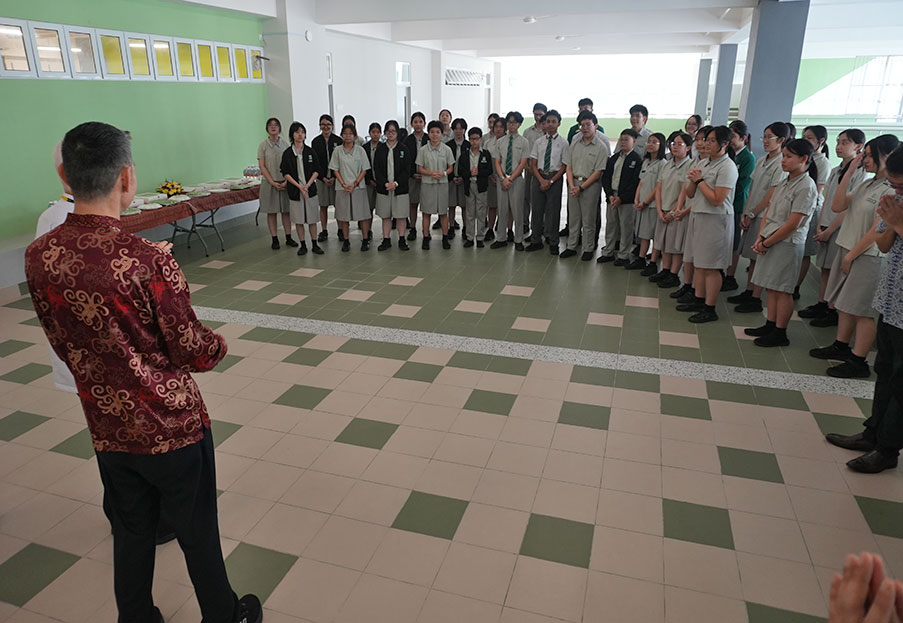
JWL has worked closely with the Jesuit Sri Lanka Province for a decade, in 11 Loyola Campus community learning centres across the country. Since 2020, almost 4,500 students enrolled in the Global English Language programme, 250 in short-cycle tertiary programmes, and 9 in the BA in Sustainable Development. Loyola Campus at Hatton Hall is one of the most prominent centres of this collaboration between the Sri Lankan Jesuit Province and JWL.
“Education is not only about gaining knowledge; it is about unlocking the potential of individuals and communities to shape their own futures”, says Fr Milroy Fernando, SJ, Country Director of Loyola Campus in Sri Lanka. “What we see in Hatton is a powerful example of how access to quality education can break cycles of inequality, empower young people – especially women – and create leaders who are committed to sustainable and inclusive development within their own communities.”
Christa is among the very first graduates of the BA in Sustainable Development. During her studies, she developed an interest in environmental issues, particularly waste management. She now works as a Management Service Officer at Hatton Dickoya Urban Council, which makes her feel like she’s playing a role in the development of her community as well as caring for the environment.

Sindhuja. [© JWL]
She was the first but not the last young woman from Hatton to seize the opportunity for tertiary studies and build a path of personal growth and service to the community. Sindhuja, too, sees the transformative potential of education: “I have a strong belief that by giving quality education, we can transform the world. Because when you give the quality education, people can think in a different way, and they can also think wider.”
Now in her final year of the degree programme, Sindhuja shares how transformative this experience has been for her both personally and professionally: “I’m so brave now. And I wasn’t that like before... It really made me strong and to be bold, and to be brave...” she said. “So actually, it really sustained my life. The sustainable development sustained my life”, she added, with a little giggle.
Although Sindhuja feels she can make a difference, she also expresses the need for her community to join her in these efforts: “Personally, I feel I can make some changes, so that’s my hope... but with one hand I can’t change anything. I need some group of people. I believe, the community people, the young people, if they come with good education... I can make some changes in my community. That’s my dream.”

Related Posts:
Launched at the 2018 IAJU Assembly, Magis Exchange offers students the chance to study across borders, cultures and academic contexts. It is more than an academic mobility program: it embodies a shared commitment to forming young people ready to engage thoughtfully...

Excitement is building for MAGIS Korea 2027, the international gathering that will bring young people from across the Ignatian family to Korea ahead of World Youth Day in Seoul. A recent online information session, led by Fr Hakjoon Lorenzo, SJ, General coordinator of MAGIS Korea...

“Since the third Universal Apostolic Preference was given to us, I have spent time discerning how the General Curia can help to move it forward. I didn’t want to set up a heavy structure. I didn’t think a Secretariat here in the Curia was needed. In the end, I opted for a light network structure...”

Pope Francis raised climate change to global consciousness as the defining moral issue of our time. As a result, the Church has become a global voice urging political accountability and personal responsibility for healing the planet. Building on his legacy, Pope Leo vigorously calls for urgent climate action...

Leading a retreat for young people should be easy. It’s usually just two or three days. But... where should I start? What should the theme be? Where do I get help? The good news is that help is at hand with a new platform called Magisresources.org...
For ten years, MAG+S Timor-Leste has been quietly accompanying young people. In our small community shaped by friendship, prayer, and service, many young people have encountered the richness of Ignatian spirituality and discovered a deeper relationship with God...