Mission Inter-Gentes: Jesuits Engaging with Muslims in Lucknow
By Joseph Victor Edwin, SJ
In November 2024, first-year Theology students from the Vidyajyoti Institute of Religious Studies, accompanied by Anil Almeida, SJ, and Joseph Victor Edwin, SJ, visited a prominent Muslim educational institution, Darul Uloom Nadwatul Ulema, an Islamic Seminary (Darul Uloom means abode of education). This institution is vital, as it trains Muslim scholars to adapt to the changing dynamics of modern society. The students also explored Firangi Mahal, recognized as Darul Uloom Nizamia Farangi Mahal, which claims to be the first madrasa (religious school) in the subcontinent. Firangrefers to Europeans and Mahal means palace inPersian. During the Mughal times, 16th Century to the early 18th Century, Europeans lived in this palace. Additionally, they visited Integral University, founded by Muslim intellectuals to promote inclusive education, as well as Unity College, which is managed by Shia Muslims.
At Nadwatul Ulema, we were warmly received by Faizan Nagarmi Nadwi Sahib and Maulana Mansoob Hasan Sahib, who led us on a tour of the institution. They introduced us to the library, which has numerous reading rooms for students, and contains around three hundred thousand books. The interaction during the tour was enriching for everyone involved, promoting learning for both hosts and guests. We also had the chance to explore the manuscript room, where we saw several ancient manuscripts in excellent condition. The visit ended with sincere gratitude and happiness, and the theology students left the Muslim seminary with prayers for the professors and students of this prestigious institution.
Later, the group arrived at Firangi Mahal to meet with Maulana Khalid Rasheed Firangi Mahli, the Shahi Imam (prayer leader) of Eid-Ghah (the place where Muslim offer prayers during the celebration of their major religious feasts) in Lucknow. The Imam highlighted that the Ulema from the Firangi Mahal lineage claim descent from the family of Prophet Muhammad. Their ancestors migrated to the Indian subcontinent in the 11th century, receiving support and protection from local rulers. The Mughal emperors later acknowledged the scholarly contributions of these Ulema. In 1695, the family moved to a location that had once belonged to a French merchant, which later became known as ‘Firangi Mahal’.
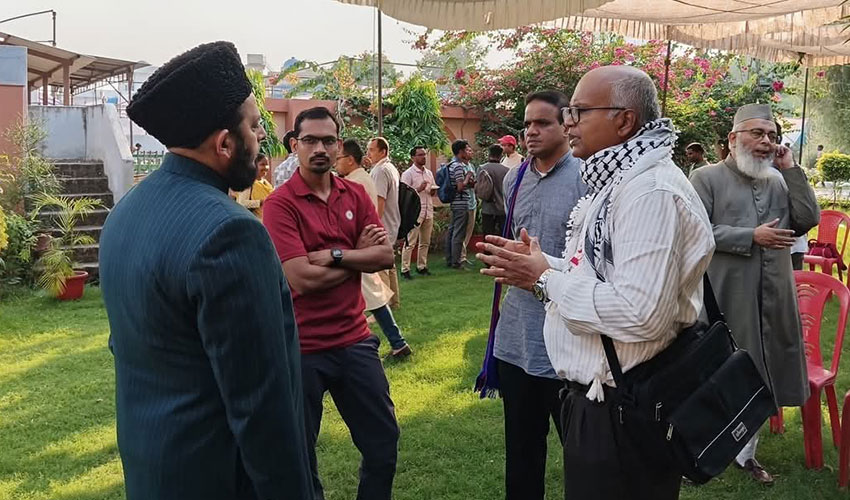
The Imam also provided a brief historical overview of Firangi Mahal. He mentioned that the Ulama-e-Farangi Mahal rose to prominence when Allama Nizam-ud-din Farangi Mahli created a curriculum for madrasas. This syllabus has been widely adopted by madrasas throughout the subcontinent and beyond for over three centuries, with some modifications. The madrasa established at Firangi Mahal attracted students from various countries, including China and Saudi Arabia.
The group had the chance to visit Integral University, founded by Muslim scholars to promote inclusive education. We were graciously welcomed by Mr Ghazali Sami, the liaison officer, and Mr Shariq Nafees, the Senior Manager at the Office of International Relations. They shared insights into the university’s vision and mission.
The vision of Integral University resonates deeply with many, especially because of its connections to both the Holy Bible and the Holy Qur’an. This vision reflects the institution’s dedication to steering young individuals away from ignorance and illiteracy, drawing on the biblical concept of “kindly Light” (Ex. 13:21) and the divine instruction to “read: thy Lord is most bounteous” (Q. 30:96). It emphasizes a commitment to educating youth through innovative and creative approaches, aiming to align their dynamic intellect and energy with values of decency, decorum, discipline, and dedication, all grounded in core principles.
The group acknowledged the significance of safeguarding and promoting “diversity”, which is essential for cultivating students’ openness to others while establishing a nation grounded in the secular principles outlined in the Constitution of India. Through discussions, we discovered that we unlock students’ potential by encouraging them to explore the unfamiliar, recognizing our interconnectedness, while also valuing the distinct talents and identities of each person.
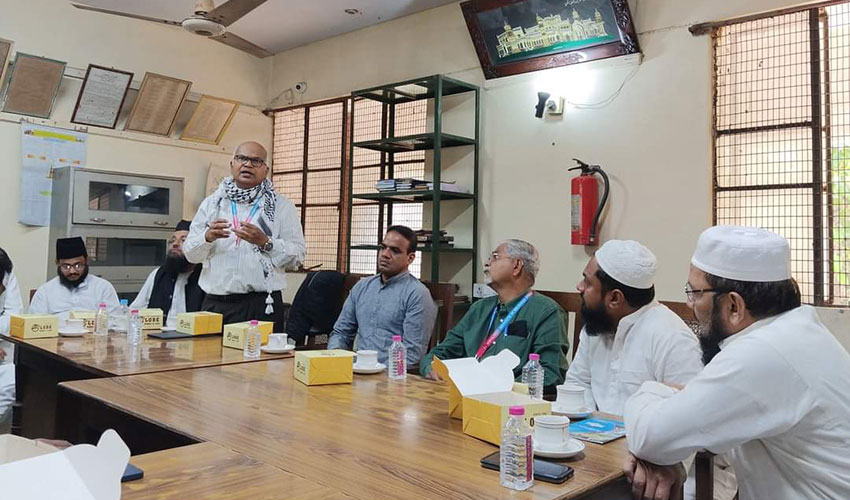
The next stop of the tour was Unity College, managed by Shia Muslims. Upon our arrival, we received a warm welcome from our friend Janab Najmul Hasan Rizvi, who highlighted that Shia Muslims believe that the Imams have a profound understanding of the Qur’an, guiding individuals along the righteous path. With the twelfth Imam currently in concealment, religious scholars take on the role of community leaders. He also highlighted that remembering the suffering and martyrdom of Imam Hussain and his companions at Karbala is crucial to the religious practices of Shia Muslims. Karbala remains one of the holiest shrines of Shia Muslims. They believe that Hussain, though innocent, bore the sins of all. By his suffering, all are saved.
Many Indian Christians are often influenced by negative stereotypes of Muslims. Paul Jackson, a noted scholar of Asian Sufism, offers a way to address this concern. He encourages them to reflect on their own experiences of observing Muslims in their daily lives, including their visible religious practices like the five daily prayers. Many Christians are moved by the devotion with which Muslims pray and the importance they attach to this ritual. During Ramadan, the dedication to strict fasting rules earns significant respect. By understanding Muslim beliefs and practices and building personal friendships with Muslims, Christians will be better prepared to handle difficult situations.

Related Posts:
A Croatian Jesuit who crossed half the world to serve the poorest communities of Bengal, Fr Ante Gabrić spent five extraordinary decades building up the Church in the Sundarbans – one school, one clinic, one family at a time. His cause for beatification is now before the Church...

The annual meeting of Eco-Jesuit delegates in South Asia, held at Inigo Bhawan in Matigara, Darjeeling, became much more than a routine gathering. Set against the fragile ecology of the Eastern Himalayas, the meeting turned into a moment of discernment on the future...

In April 2026, Pope Leo XIV made the first-ever papal visit to Algeria. Two weeks later, Father Arturo Sosa, SJ, Superior General of the Society of Jesus, travelled to Algeria to visit the small Jesuit community there for the first time since his election in 2016. The land of St Augustine, bishop of Hippo...

On the morning of 24 March 1964, Fr Herman Rasschaert celebrated Mass in his remote parish of Kutungia, 240 kilometres from Ranchi on the Orissa border. He knew what was happening in nearby Gerda village. Word had spread: a frenzied mob was attacking Muslims trapped...

What began as a simple encounter between urban students and forgotten hamlets has evolved into a profound Jesuit mission of accompaniment. For eight years, St. Xavier’s University Kolkata has answered the Society of Jesus’ call to “walk with the excluded” through its transformative...

Father Francis Pudhicherry, SJ, has been appointed Provincial of the Gujarat Province by Father General Arturo Sosa, SJ. Since 2021, he has been rector of De Nobili College in Pune, where Jesuit scholastics study philosophy and theology. He also teaches spiritual theology...