Strangers in their own land | Fr General meets Arab Christians in Israel
Reflection by David Neuhaus, SJ
David Neuhaus was the episcopal vicar for non-Arab Catholics in Israel from
2008 to 2017.
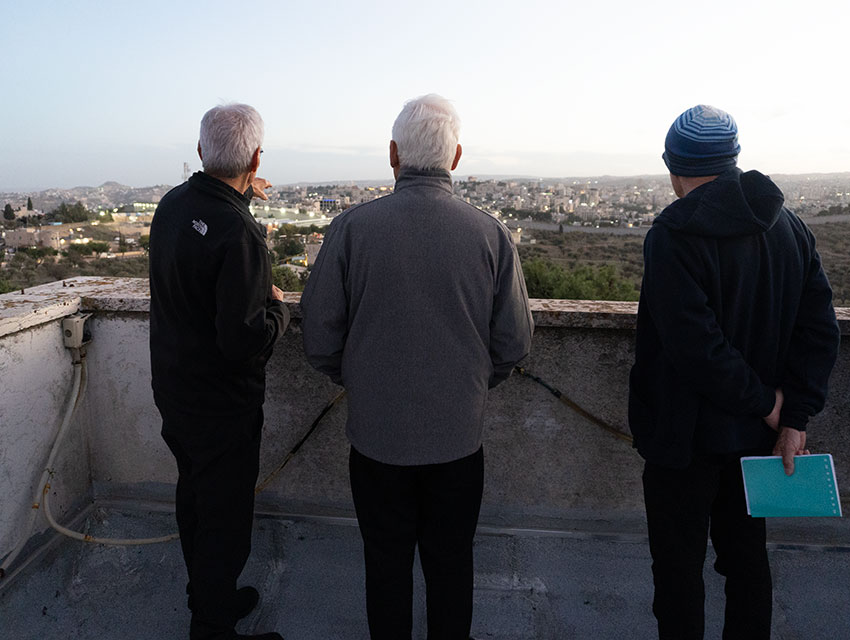
Father General Arturo Sosa, continuing his visitation of Jesuit works in the Holy Land, had a unique experience of the cultural and ministerial diversity of the region. Six Christian Palestinian Arab citizens of Israel – four men and two women from Jerusalem and the north of Israel – were invited to meet with Father General at the Pontifical Biblical Institute in Jerusalem and share their personal reflections on what it means to be not just Christians in the Holy Land, but Arabs in Israel. The group represented people from different walks of life, yet all committed to the mission of the Church. One member of the group was a female religious, the others were lay people ranging in age from their late twenties to their early sixties. Four of the participants are Catholic and two are of Orthodox backgrounds. The animator of the encounter, a Jesuit from the Jerusalem community, is a Christian Israeli citizen, formerly responsible for non-Arab Catholics in Israel (both Hebrew-speaking citizens and migrants).
The participants shared their personal stories with Father General, attempting to give him a portrait of the complexities of Christian life in Israel. They shared the challenges they have faced while living as Christians in a state that defines itself as being Jewish. They shared the state of the Christian population in Israel: the crises faced by and the resilience of the community. They also addressed the state of the Church within Israel: how Christians inside Israel see the conflict that has been playing out for decades between the Palestinians and the Israelis - detached and yet intimately intermingled. They shared with Father General their thoughts on what it means to be Christian Palestinian Arab citizens of Israel in the midst of the conflict and how that odd intersection challenges their identity and role. As the encounter continued, they offered their vision of the role of the Church in the conflict, set against their own experience of maintaining relationships with both Jews and Muslims, and their hopes for the future of the region.
One blessing that emerged from the encounter was a conversation on the possibilities for broadening the mission of the Society of Jesus inside Palestinian Arab society in Israel. The Society has focused, until now, on a presence in Bethlehem and the West Bank in Palestine. However, over the course of the conversation there was a clearly stated desire to contribute to deepening faith life and Christian formation inside Israel as well. The requests to do that have been made regularly for years, and Jesuits from Jerusalem and Bethlehem (including Peter du Brul, Hans Putman, myself, Garrett Gundlach, Hicham Chemali, Paul Saadé and others) have been making forays into Israel for just as long.
The history of the Society of Jesus in the region is filled with quiet successes that have stood the test of time. From Antoine Roussos, the “Jesuit Worker Priest” who ministered to Haifa, to my time as the episcopal vicar for non-Arab Catholics in Israel, there have been a steady stream of Jesuits who have worked tirelessly to strengthen the small Hebrew-speaking Catholic communities that were founded in the mid 1950s. These Jesuits have established the structures that serve the much larger but very fragile network of migrant Catholic communities in Israel, comprised predominantly of migrant workers from Asia and asylum seekers from Africa. The list of Jesuits who have taken upon the work of supporting the small Hebrew-speaking communities include José Espinoza, Juan Esquivias, Juan Manuel Martín-Moreno, Jean-Pierre Sonnet and so many others.
As the encounter with Father General ended, there was a hopeful feeling of the possible. This small community has shown its strength. In the midst of a so many challenges, it has survived, even thrived, in a place where it shouldn’t be possible. If they have done the impossible, perhaps it might be possible then to dream about establishing a Jesuit presence in Galilee, perhaps based in Nazareth? Is there another generation of Jesuits who are willing to take upon themselves this work? Can the Society of Jesus be as open to the future, as these Christian communities in the Holy Land?
Related Posts:
The Society of Jesus in Thailand is relatively small, with 37 Jesuits concentrated in three communities serving four cities, but the history of the Jesuits in Thailand goes back centuries, to the time of Saint Francis Xavier and the first missions of the Society of Jesus to what was then called...
On a sunny mid-week day in Kuching, Fr General Sosa visited St. Joseph’s Private Secondary School (SJPS) where the Jesuits of the Malaysia-Singapore Region work as teachers and administrators. Currently, Fr Stanley Goh is the Rector, while Fr Francis Lim served as the first...
Fr Arturo Sosa, SJ, arrived in Kuching, Malaysia to begin his 5th apostolic visitation of the Jesuit Conference of Asia Pacific (JCAP). With a full schedule of meetings and travel between different Jesuit ministries and communities in Malaysia, Thailand and Indonesia...
As Venezuela begins the difficult task of recovering after two strong earthquakes that claimed lives, left many missing and caused widespread destruction, Father General Arturo Sosa has sent a message of closeness and hope to the Venezuelan people.

As the Society of Jesus prepares for the II Congress JESEDU-Montreal 2027, a global process of review, discernment, and foresight is now underway. This initiative seeks to evaluate how the shared vision for Jesuit education has been implemented across the worldwide network of...

“Since the third Universal Apostolic Preference was given to us, I have spent time discerning how the General Curia can help to move it forward. I didn’t want to set up a heavy structure. I didn’t think a Secretariat here in the Curia was needed. In the end, I opted for a light network structure...”