Paraguay: The Noble Ruins of Paradise
By Wenceslao Soto, SJ
“I have just said to Your Excellency that the people of this reduction are very good, docile, and amenable, [...]. They attend Mass and sermons very well on Sundays and feast days. Easter, Corpus Christi, St John’s Day and the feasts of Our Lord are celebrated with great joy and happiness, but especially the feast of Our Holy Father and Patron Saint Ignatius.”
This is how the mission of San Ignacio Guazú was described in the letter of October 8, 1613, and this is the attitude that we observed in today’s Paraguayans, descendants of the interaction between the Spaniards and the native peoples.
I was on a trip to South America to fulfil various academic and cultural objectives, the first stage of which has been to accompany a pilot group of travellers on a route organized by the ‘Opera Romana Pellegrinaggi’and the Paraguayan Ministry of Tourism.

San Ignacio Guazú Diocesan Museum.
We were welcomed at the diocesan museum of San Ignacio Guazú by its director, Fr David Hernández Correa, a Spanish Jesuit, who accompanied us on the visit to what used to be the mission schools, the only preserved part of the reduction, which contains the imagery of the church that collapsed in the 20th century. It is one of the oldest missions, started by Marcial de Lorenzana in 1609. The word “reducción” comes from the Latin word “re-duco”, since the idea was to bring the indigenous people back from dispersion to a common life in small villages, for their evangelization, protection and socialization.
We also visited the mission of Santísima Trinidad de Paraná, founded in 1706. It is the largest and most spectacular group of reductions in Paraguay and its majestic ruins were declared a World Heritage Site by UNESCO in 1993. We arrived on September 28, on a magical night. The enclosure was dimly illuminated and the recorded sounds of animals and environment took us back to some centuries ago, for example, to 1728 when it had a population of 3,000 Guarani Indians. We were received by a group from an indigenous community that sang a sober welcome melody with ancestral instruments, after which the Cacique (tribal chieftain) addressed us with some moving words of welcome. We then took a tour, which we repeated the next day, in daylight. The guide highlighted the work of the Jesuits with the natives to whom they provided evangelization, education and socio-economic development.
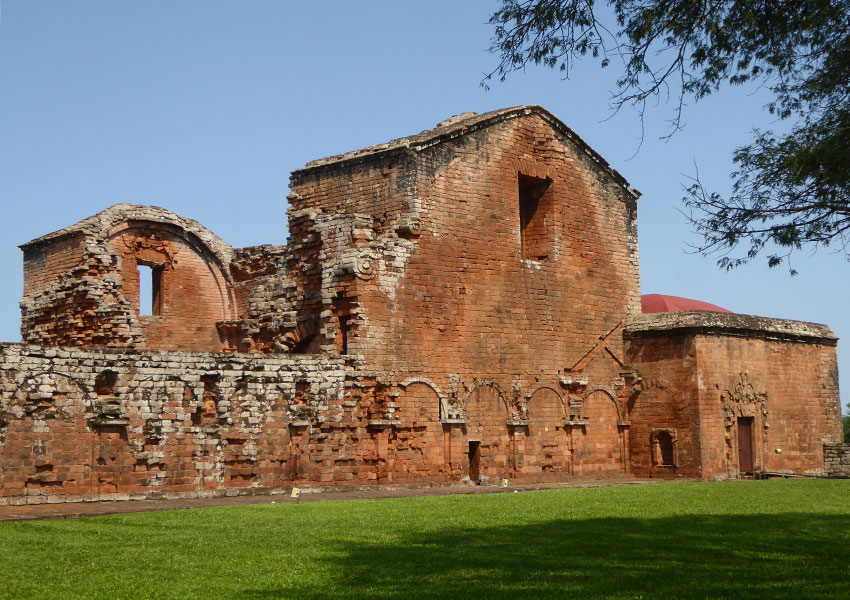
Remains of the Trinidad del Paraná reduction.
We also visited the mission of Jesús de Tavarangüé, founded in 1685 on the banks of the Paraguay River by Jesuits Francisco García and Jerónimo Tiburón. It was intended to be one of the largest churches of its time, but it has remained unfinished (this is what “Tavarangüé” means in Guaraní) due to the expulsion of the Jesuits from the Spanish domain in 1767. It was also declared a World Heritage Site by UNESCO in 1999.
The film “The Mission” (1986) is clearly linked to the Jesuit reductions with the Yguazú Falls (“big water” in Guaraní). It is a national park with 274 waterfalls that was chosen as one of the seven natural wonders of the world. A breathtaking spectacle is the so-called Garganta del Diablo (Devil’s Throat), which one can almost touch while walking along some footbridges, as it is only 50 m away. It shows the pure and powerful essence of nature, before which one is overwhelmed, and one cannot help but be transported to another dimension and experience the creator.
Nearby is the Itaipú hydroelectric power plant (“sounding stone” in Guaraní), a bi-national enterprise of Paraguay and Brazil, built in 1984. It is the largest producer of electricity in the world, which is shared equally between both countries. However, Paraguay, after covering 90% of its energy needs, sells the rest to Brazil. If before we were impressed by the work of God, now we are overwhelmed by the work of the “work of God” – man.

Remains of the Jesús de Tavarangüé reduction.
The tour also took us to the Paraguayan Chaco, whose area covers 60% of Paraguay but is home to only 2.8% of its 7 million population, including various groups of native peoples with the difficult challenge of maintaining their culture without their original environment and in contact with the city. Another key group is the Mennonites, a branch of the Anabaptist movement. After living in different countries, some of them took advantage of the Paraguayan government’s offer of land in this region in 1930. It is a minority with a strong identity and a tenacity that has enabled them to turn this rather inhospitable area into an economic empire.
Our long journeys have evoked many reflections: the glorious past of the Jesuit reductions and their possible replicability today; the uncertain future of the native peoples; the harmful exploitation of the natural resources that threatens drastic changes... We hope that among the good people, suitable solutions can be found.
Related Posts:
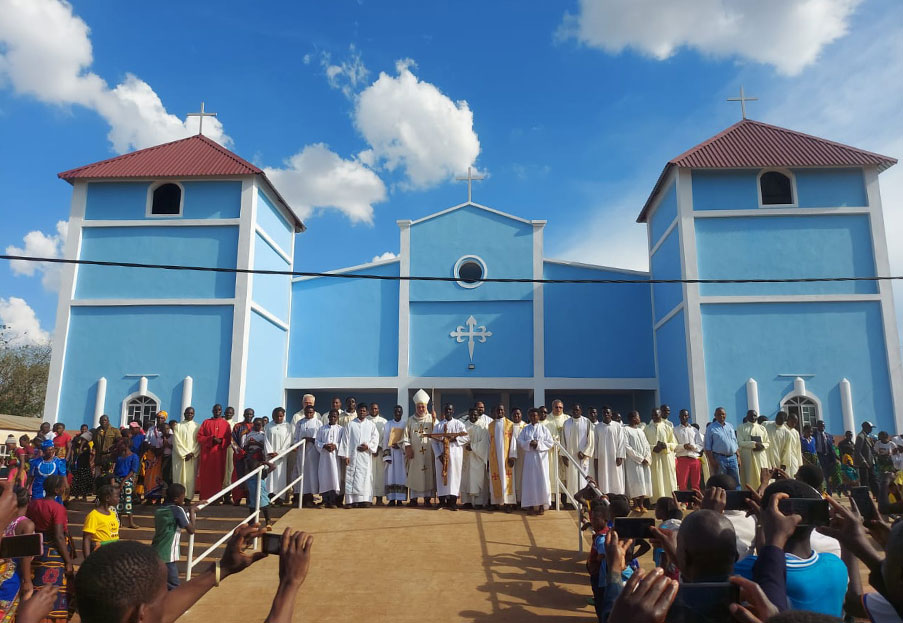
The Jesuit Southern Africa Province (SAP) has, between 2021 and 2026, celebrated a series of significant milestones that reflect its vibrant growth, deep missionary heritage, and expanding regional presence. From its establishment to major anniversaries, historic visits...
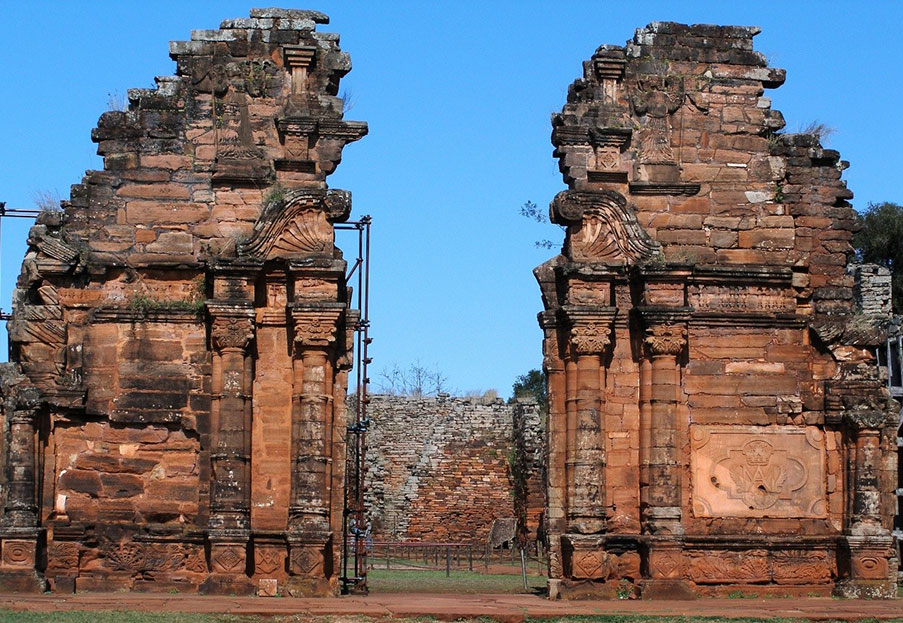
The Paraquarensis Province was separated from that of Peru in 1604. It comprised the territories of the present-day states of Paraguay, Argentina, Uruguay, part of Bolivia, and, temporarily, Chile. One of the most notable ministries in this Province was the Guaraní reductions...
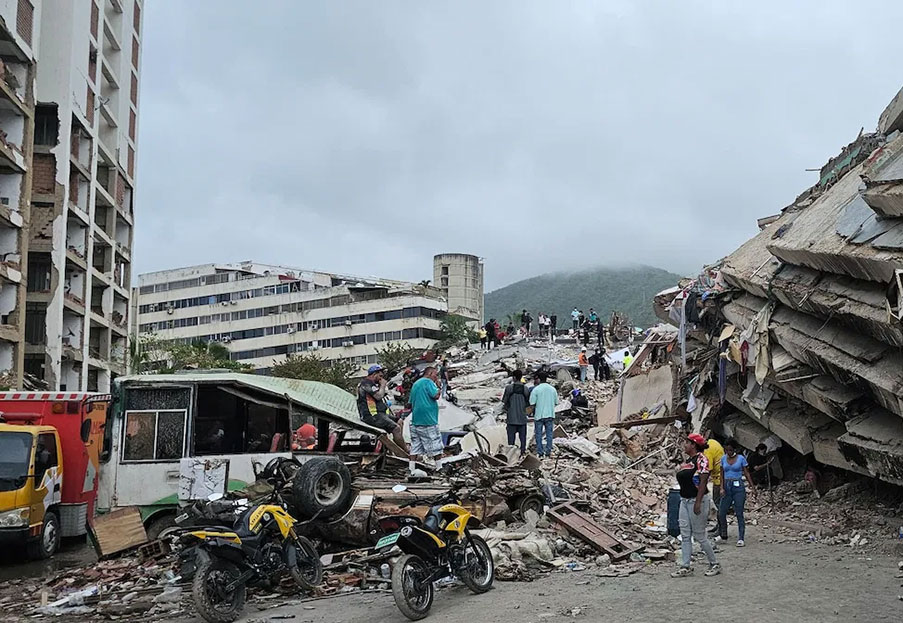
A series of powerful earthquakes have struck Venezuela on 24 June, causing widespread destruction across affected communities and leaving thousands of people in urgent need of assistance...
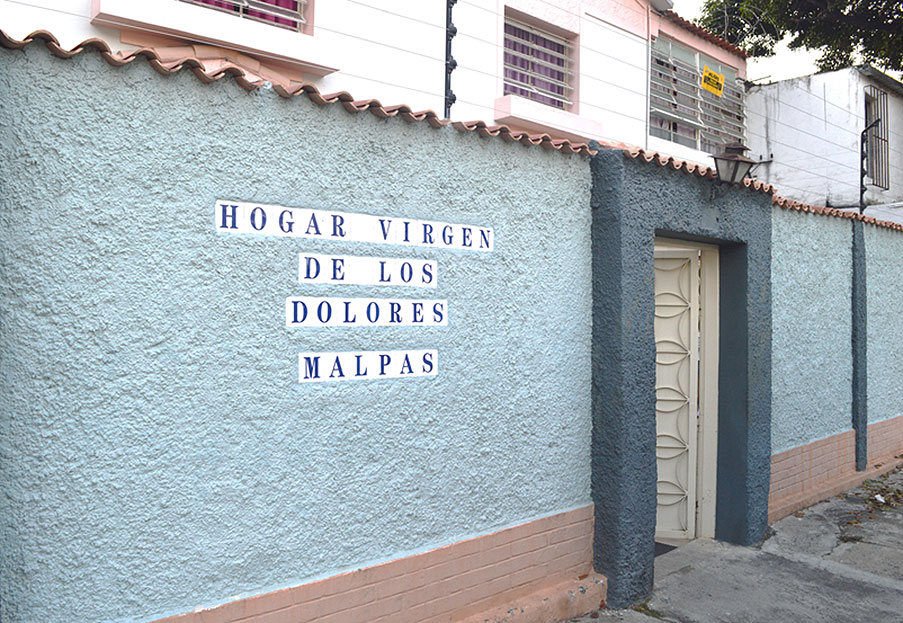
For eight decades, the Hogar Virgen de los Dolores (HVD) has served Venezuela’s most vulnerable children, building a legacy rooted in the Jesuit commitment to education and social justice. What began as an apostolic initiative has now evolved into a model of education...

One of the Universal Apostolic Preferences promulgated by Father General in 2019 invites the Apostolic Body of the Society of Jesus to “Walk with the poor, the outcasts of the world, those whose dignity has been violated, in a mission of reconciliation and justice”...

Superior General Arturo Sosa, SJ, has appointed Father Jorge William Hernández Díaz, SJ, as Provincial of the Caribbean Province. He currently serves as superior of the San Ignacio Residence–Provincial Curia, as vicar of the Santísima Trinidad University Parish...