Relations between the Church and Fascism. Father Enrico Rosa and the seizure of La Civiltà Cattolica on 23 July 1929
By Sergio Palagiano | Archivum Romanum Societatis Iesu (ARSI)
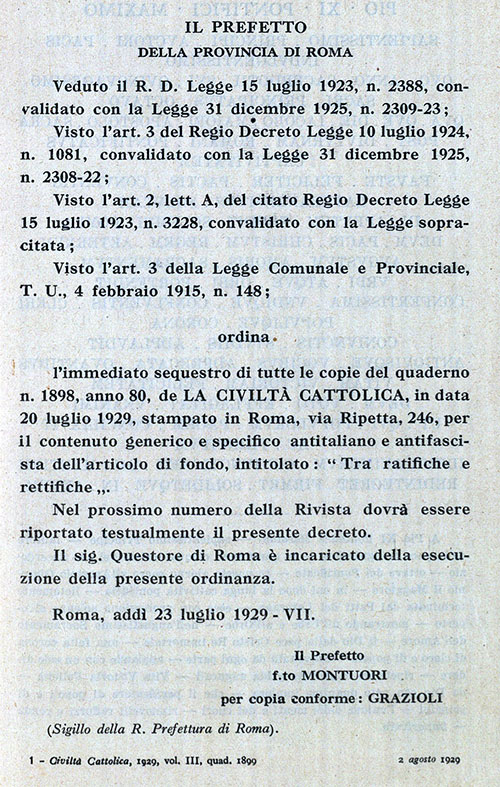
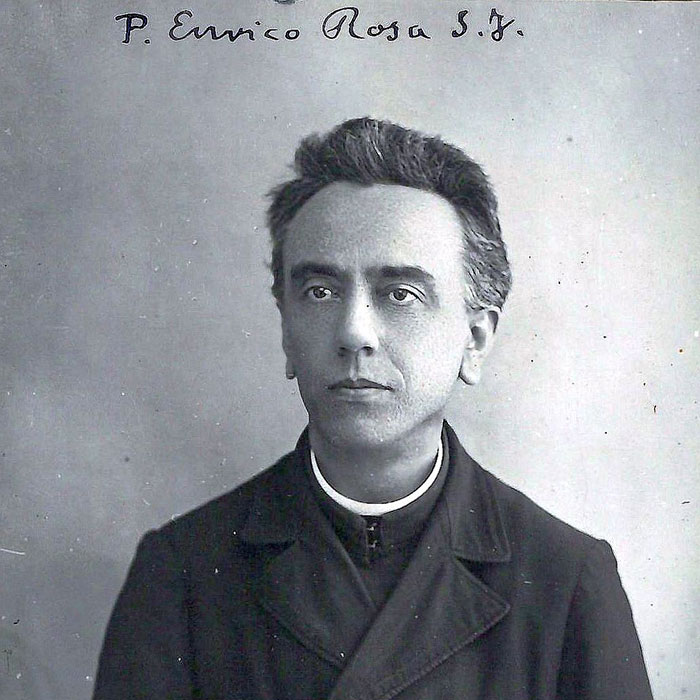
On 23 July 1929, the Prefect of Rome ordered the seizure of all copies of issue no. 1898 of La Civiltà Cattolica, dated 20 July, due to the “general and specific anti-Italian and anti-fascist content” of the anonymous article entitled Tra ratifiche e rettifiche. La parola del Papa (Between Ratifications and Rectifications. The Pope’s words). The author was Father Enrico Rosa, SJ, editor of the journal from 1915 until 1931.
In the article, Father Rosa, reflecting on the relationship between history and the present, argues that Nihil sub sole novum: contemporary events can only be understood in the light of the past, because they tend to repeat themselves according to patterns already seen. Starting from this premise, Father Rosa draws a parallel between the pontificates of Pius XI and Pius VII, based on the political and social crises that both had to face.
Shortly after his election as Pope in Venice in 1800, the cardinal Chiaramonti (Pius VII) had made a heartfelt appeal to the European sovereigns and peoples to direct their efforts towards the Christian education of young people, the promotion of the good press “...as an essential part of the educational endeavour itself...” and the recognition of the Church’s freedom. These were the indispensable tools for countering the effects of the revolutionary ideas that were transforming Europe. The 1801 Concordat with Napoleon initially seemed to have restored peace between Church and State in France, as the Pope had secured recognition of Catholicism as the religion practised by the majority of the French people.
But these expectations were soon dashed by the unilateral addition of the Organic Articlesto the Concordat in April 1802, which served to restrict the freedom granted to the Church and subordinate its decisions to civil authority. Pius VII intervened on several occasions with corrections and protests, and although he lacked military power, Father Rosa points out, the Pope reigned until 1823, whilst the Emperor, once defeated, was exiled to St Helena in 1815: military force could be overcome by the moral force of law and faith.
Father Rosa draws an analogy between the signing of the Concordat of 1801 and the signing of the Lateran Pacts on 11 February 1929. The agreement between the Holy See and the Italian State, which brought the Roman Question to a close, was an extraordinary historical event, celebrated with numerous civil and religious ceremonies. But once again, as in 1801, the initial enthusiasm soon gave way to difficulties and obstacles that gradually came to light. Shortly before ratification, in May 1929, the Head of Government, Benito Mussolini, delivered a number of speeches in Parliament containing statements denigrating the Catholic religion, and which, above all, sought to downplay the role of the Church and the very substance of the Pacts.
Like Pius VII in his day, Pius XI intervened to respond indirectly to the ‘Duce’ by threatening to annul the Concordat and the Treaty. He did so in his address of 14 May during the audience granted to the pupils of the Collegio Mondragone and in his letter of 30 May to Cardinal Secretary of State Pietro Gasparri. In the former, he asserted the Church’s educational mission and its sound doctrine “...contrary to certain recent statements...”; in the letter, he rejected other “...erroneous assertions and serious prejudices...”, reaffirming the principles of Catholic doctrine and the authentic meaning of the Lateran Pacts (Papal Statements on the Lateran Pacts. Immediately after the signing; To the Diplomatic Corps; Following the parliamentary speeches and debates, Rome 1929).
The Pope’s speeches, Father Rosa continues, were intended to be genuine clarifications, necessary to set out the content of the agreements and correct political interpretations deemed inaccurate. The Papal Statements demonstrated the perfect coherence of his thinking in his role as father and spiritual guide, teacher of Catholic doctrine and independent sovereign recognised under international law. They were indispensable for correctly understanding the meaning of the Lateran Pacts and defending the Church’s educational and spiritual mission against misleading interpretations.
The article was regarded by the Fascist authorities as a criticism of the government’s positions and an assertion of ecclesiastical autonomy vis-à-vis the regime’s stance, and it was therefore ordered to be seized. The measure carried an explicit political message: the regime was not prepared to tolerate public statements that called its line into question.
The ratification of the Lateran Pacts had not eliminated the tensions between the regime and the Church; on the contrary, these tensions were destined to intensify over the vital issues of the education of young people, the role of Catholic associations and the limits of state control over religious life. These tensions were to reach breaking point in May 1931, when the regime decreed the dissolution of the youth groups of Italian Catholic Action, followed by the promulgation of Pius XI’s encyclical letter Non abbiamo bisogno on 29 June, written in defence of Italian Catholic Action. This subsequently led, on 2 September, to an agreement between the Holy See and the government which recognised the existence of Catholic youth groups but restricted their activities to the spiritual sphere.
Related Posts:

The Paraquarensis Province was separated from that of Peru in 1604. It comprised the territories of the present-day states of Paraguay, Argentina, Uruguay, part of Bolivia, and, temporarily, Chile. One of the most notable ministries in this Province was the Guaraní reductions...
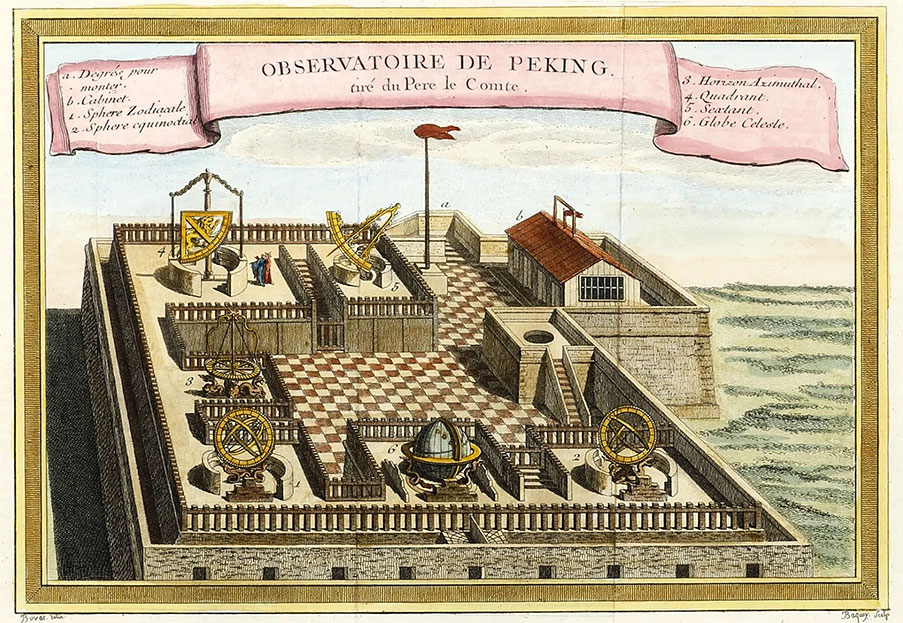
On 21 June 1629, the sky above Beijing darkened for a few moments. To astronomers, it was a partial solar eclipse. To the Chinese imperial court, however, the phenomenon had a much deeper significance. For centuries in China, eclipses had been interpreted as messages from Heaven...
On 5 June 1546, Paul III signed the brief “Exponi nobis”, which addressed how men who did not belong to the original group of highly qualified priests of the Society could nonetheless belong to it and serve its mission. The brief did so by establishing the grade of coadjutor...

On 22 May 1622, Pedro Páez died in Gorgora (Gondar, Ethiopia). He was born in Olmeda de las Fuentes (Madrid, Spain) in 1564 and entered the Society at the age of 20 at the novitiate in Villarejo de Fuentes (Cuenca, Spain), although older biographies state that he entered in Coimbra...

Four hundred and eighty-four years ago, the Apostle of Asia stepped ashore in Portuguese India – marking both the end of a long formation and the beginning of a ministry that would span a continent. The arrival of St Francis Xavier (1506–1552) in Goa, India, on 6 May 1542 was at once a...