Sacred Art and Spiritual Legacy: Exploring the Cappella Borgia
The Borgia Chapel is the central focus of a research project grounded in extensive archival work conducted by Jimena Abáigar de Villegas. While she collaborates with ARSI (Archivum Romanum Societatis Iesu), she is finishing her MA in Art History at John Cabot University in Rome to explore the chapel’s historical and artistic significance, laying the foundation for her future Ph. D.
By Jimena Abáigar de Villegas
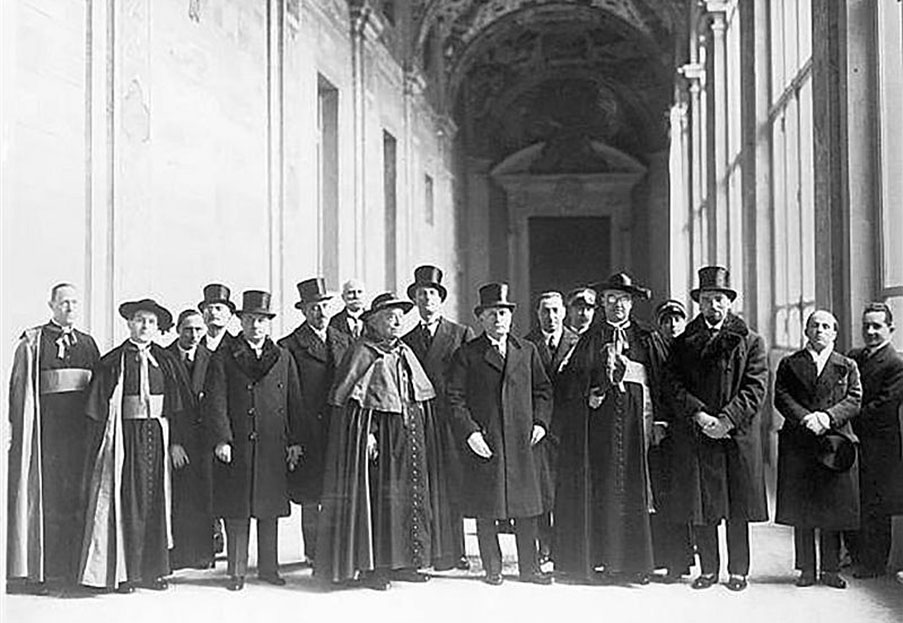
The Borgia Chapel is a true Jesuit gem in Rome, located just five minutes from Saint Peter’s Basilica, within the General Curia of the Society of Jesus. Originally known as the Oratorio Borgia, it was built alongside the Curia between 1921 and 1927 under the government of Father General Wladimir Ledóchowski (1866-1942). However, its decoration did not begin until after 1930 and was officially inaugurated in 1933.
Unlike what one might expect from a Roman Jesuit sacred space, the Cappella Borgia stands apart from the dramatic aesthetics of the late Jesuit Renaissance and Baroque, as seen in churches like Il Gesù or Sant’Ignazio in Campo Marzio, developed during the Counter-Reformation to reaffirm and expand Catholic authority. Instead, its artistic language is deeply rooted in Medieval Byzantine and Romanesque Revival traditions, drawing inspiration from Byzantium, Ravenna, and the Roman Medieval and early Christian imagery of the catacombs.
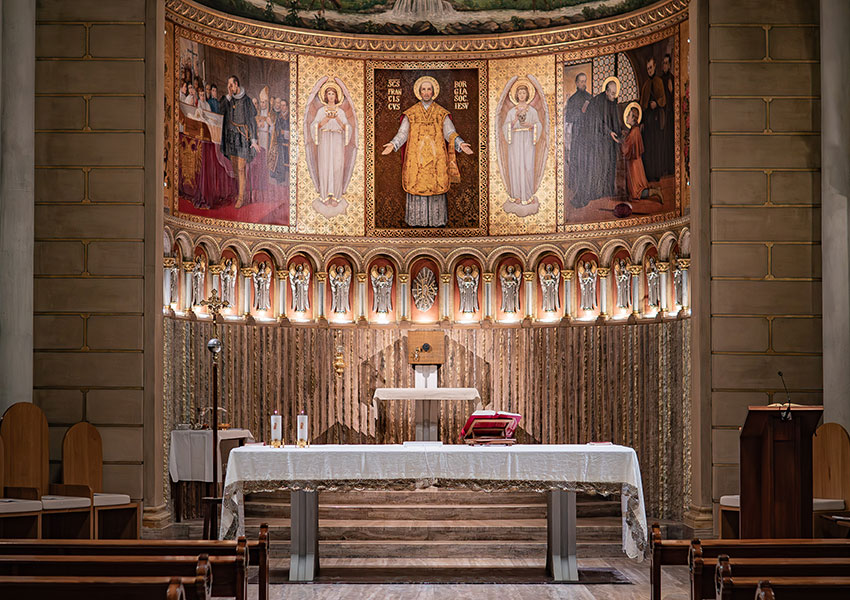
While nowadays the Borgia Chapel is used occasionally, usually when the community celebrates Mass with the presence of people from outside of the Curia community, 90 years ago it did not use to be like that. In fact, it was quite the opposite, as it was not built as a private chapel for the Jesuit community living in the Curia, but instead a very open oratory, accessible for every faithful who wanted to attend Eucharistic ceremonies, pray, or adore the Lord. This is confirmed by Archival documents preserved at the Archivum Romanum Societatis Iesu (ARSI), also located within the Curia.
The oratory was consecrated to the Spanish Saint Francis Borgia (1510-1572), an archetype of the saintly General of the Society of Jesus, for the Jesuit General Curia. He was the third General Superior of the order, from 1565 to 1572. As Father Augustus Coemans aptly remarked, “In the same way that the Borgia approach was open to all, our chapel could also be called a church”. In alignment with this vision, the oratory was consecrated in 1929 as an intentionally open space of worship by Archbishop of Toledo Pedro Segura y Sáenz.
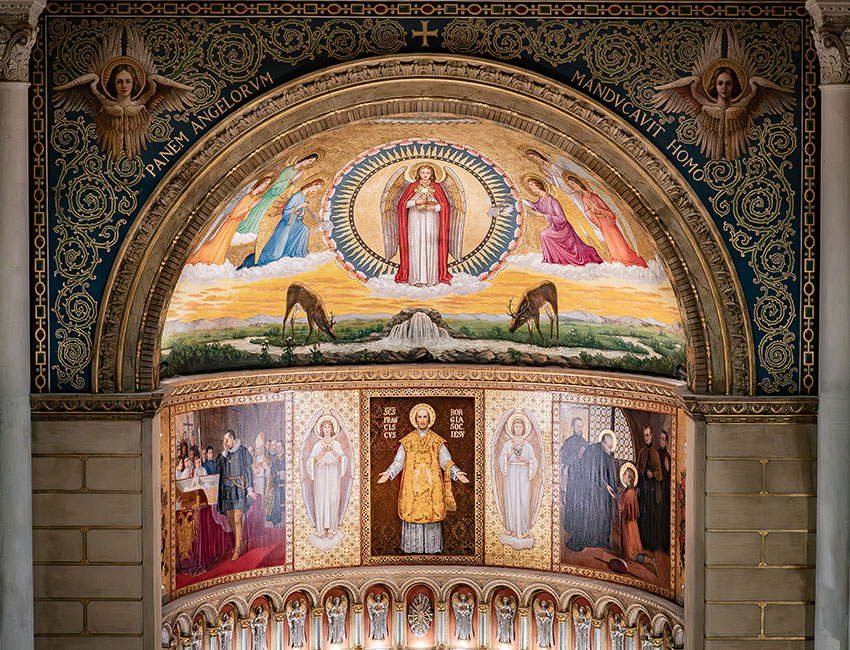
Saint Francis Borgia is prominently honoured in the apse, depicted alongside his two most significant iconographic attributes: the crown and the skull, alluding to one of the most emblematic and widely represented episodes of his life. Frequently recounted by the Jesuit historians Pedro de Ribadeneira (1526-1611) and Álvaro Cienfuegos (1657-1739), it is the encounter with the decomposed body of consort Empress Isabella of Portugal in Granada in 1539, an event that profoundly influenced his spiritual transformation. Mirroring this scene is Saint Francis Borgia’s meeting with Saint Stanislaus Kostka (1550-1568), which underscores the universality of the Jesuit and Ignatian mission from its beginning to contemporary times, and the continuity of sainthood within the Society.
Connections to Borgia, however, extend beyond iconographic attributes and biographical episodes. The design of the main apse also reflects a central aspect of his spirituality – his profound devotion to the Eucharist as the true source of spiritual life, a Sacrament that unites Christ with the believer, granting them strength during the path of faith and, ultimately, Salvation. This is visually expressed through the depiction of two deer drinking from a spring, symbolising the Water of Life, while six angels in adoration surround the Eucharist. Two Psalms, therefore, are directly referenced: 78:25: “A person ate bread of angels. He sent provision for them in abundance”; and 42:1: “As the deer pants for streams of water, so my soul pants for you, my God”. In conveying this message, the artistic program draws upon historical motifs, concepts, and even stylistic elements Early Christian, Romanesque, and Byzantine traditions, yet reinterpreted within a contemporary Jesuit context. The spiritual significance is further deepened through direct references to Eucharistic and salvific imagery found in the Roman catacombs, such as olive branches, peacock feathers, anchors, and the Eucharist fish carrying baskets of loaves, therefore reinforcing the continuity of Christian devotion across centuries.
The principal architect overseeing the construction of the Curia, and therefore the Borgia Chapel, was Giuseppe Gualandi (1866-1944). However, in accordance with Jesuit tradition, part of the works was entrusted to two coadjutor brothers, personally summoned to Rome by Father Wladimir Ledóchowski, to conclude the mural illumination. The primary artist was the Spanish Brother Antonio Arribas (1888-1973), a disciple of the esteemed brother Martín Coronas (1862-1928), who had decorated the Cueva de San Ignacio, in Manresa, and the Palau Ducal dels Borja, in Gandia, among many other works. Although Brother Arribas was the leading figure in the artistic execution, he did not complete the work alone. Several years after he began, Polish brother Théodor Podobienski (1898-1939) arrived in Rome, where he assisted with the final stages of the project preceding the oratory’s final inauguration, which took place in the summer of 1933.
Related Posts:
The General Curia of the Society of Jesus launches its brand-new Webinars’ Calendar. After being in pilot mode for the last two years, these meetings have proved to be incredibly useful, with sometimes up to 600 people taking part from all around the globe. The idea is to provide ongoing formation...
The General Curia concluded its social year with a gathering in the Aula on 19 June that brought together the Jesuit members of the Curia community and the lay collaborators that jointly sustain its administrative operations...

The Enlarged Council brought together the Secretaries of the Apostolic Sectors, General Counsellors, General Treasurer, Presidents of Conferences, and other officials at the Curia to examine a central question: How to increase and deepen collaboration across apostolic...
On 5 June 1546, Paul III signed the brief “Exponi nobis”, which addressed how men who did not belong to the original group of highly qualified priests of the Society could nonetheless belong to it and serve its mission. The brief did so by establishing the grade of coadjutor...

Four hundred and eighty-four years ago, the Apostle of Asia stepped ashore in Portuguese India – marking both the end of a long formation and the beginning of a ministry that would span a continent. The arrival of St Francis Xavier (1506–1552) in Goa, India, on 6 May 1542 was at once a...

Superior General Arturo Sosa has convoked the 72nd Congregation of Procurators, bringing representatives from across the Society of Jesus to Indonesia in October 2027. The gathering will examine how the Society’s structures must be reshaped to carry its mission forward...