Jesuits in Quebec City: Arrived in 1625 – still there in 2025!
By Pierre Bélanger, SJ
Quebec City! Renowned for its beauty, perched on a cliff overlooking the majestic St Lawrence River. Quebec City! Known for its history, a meeting place between Europeans and Indigenous peoples in the 16th and 17th centuries. Quebec City! Honored by UNESCO as part of the World Heritage of Humanity. And Quebec City... at the origins of the Jesuit presence in North America and the development of the Church in the vast New France of the time.
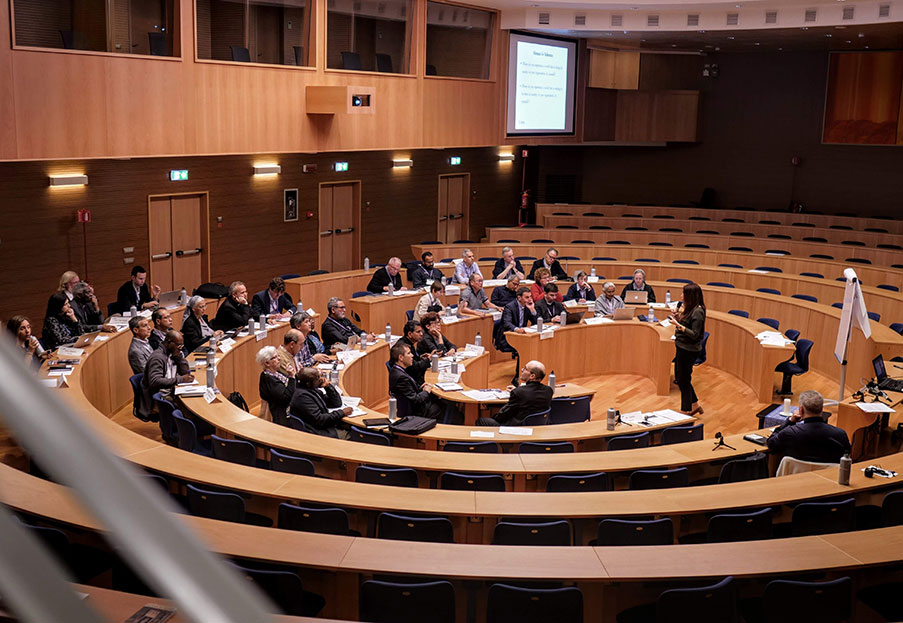
Yet for today’s Jesuits, it is simplicity and humility that characterize the anniversary they are celebrating this year. On September 26, the feast day of the Canadian Martyrs (according to the Canadian liturgical calendar), the Jesuit community of Quebec City, in union with the Catholic Church of Quebec City and at the invitation of its pastor, Cardinal Gérald Lacroix, will commemorate the first arrival of the Jesuits in Quebec City in 1625.
That year, Jesuit fathers Jean de Brébeuf, Charles Lalemant, and Ennemond Massé, along with two coadjutor brothers, landed on the banks of the Saint-Charles River. Their missionary work consisted of providing spiritual guidance to the settlers and evangelizing the indigenous peoples.

This anniversary is celebrated with thanksgiving and in a spirit of hope that marks the ongoing Jubilee Year. Along with the Ursuline and Augustinian nuns and Saint François de Laval – the first bishop of Quebec City – the Jesuits are rightly considered among the founders of the Church in North America. Their presence has taken many forms over the centuries. It was marked above all by their commitment to education, when in 1635 they founded the first classical college north of Mexico. It then developed through the dissemination of the Spiritual Exercises of St Ignatius, which is now carried out by the Manrèse Spirituality Center, which has been involved in the formation of Ignatian spiritual guides for 50 years.
Surely, while there are reasons for the Jesuits, heirs to a rich history, to feel a certain pride, humility is appropriate for these celebrations because it has marked this entire journey. Consider the living conditions of Father Brébeuf and his companions, who were very modest in the face of the challenges of inculturation they faced. They were forced to learn indigenous languages “like little children” – languages so different from those they knew. Let us also note the humility evident in the writings of these early Jesuits, who struggled to understand the spiritual ties that bound Native Americans to nature. Humility was required to live or survive during the long canoe trips to Huronia: these learned and wise Europeans were quite helpless in the heart of the wild forests.

We might add that it took a great deal of humility and detachment when, after the suppression of the Society of Jesus in 1773, the Jesuits here saw their confreres die, to the very last one, in 1800, thus interrupting a diverse and vigorous apostolate. And if providence allowed the Jesuits to return to Quebec City in 1847, it was with discretion and simply to provide spiritual guidance to the young people of the Congregation of Notre Dame, which was the origin of the Christian Life Communities (CLC). They did so from the “Chapelle des Jésuites” on Dauphine Street, where they have remained ever since.
Thus, today, the 400th anniversary is similarly marked by sobriety – not prestige or fanfare. The program will include a Bach concert in the historic chapel. On September 26, friends of the Society will gather at the Cathedral of Quebec to give thanks and support through prayers for the presence and apostolates of the small community of Quebec and its partners. The following day, there will be a conference entitled “400 Years of Jesuit Mission in Quebec City: Faith, Knowledge, and Networking since the Beginnings of New France”.

Related Posts:

There is an ostensibly simple sign that hangs in the entryway of The Loyola School. It greets students and visitors alike as they step from the streets of Baltimore into what once was a string of rowhomes but now is a center for early learning and childhood development...

The USA Midwest Province’s use of solar energy began with schools and now reaches to the rooftops of a Jesuit residence and the Province office itself. About half of the Province office’s electricity comes from the 152 panels on the roof of the Chicago building...
On a cool Advent morning, nine members of the Jesuit Media Lab community – an initiative sponsored by the Jesuit Conference of Canada and the United States to gather and support creators inspired by the Ignatian tradition – met at Georgetown University in Washington, D.C., the oldest...
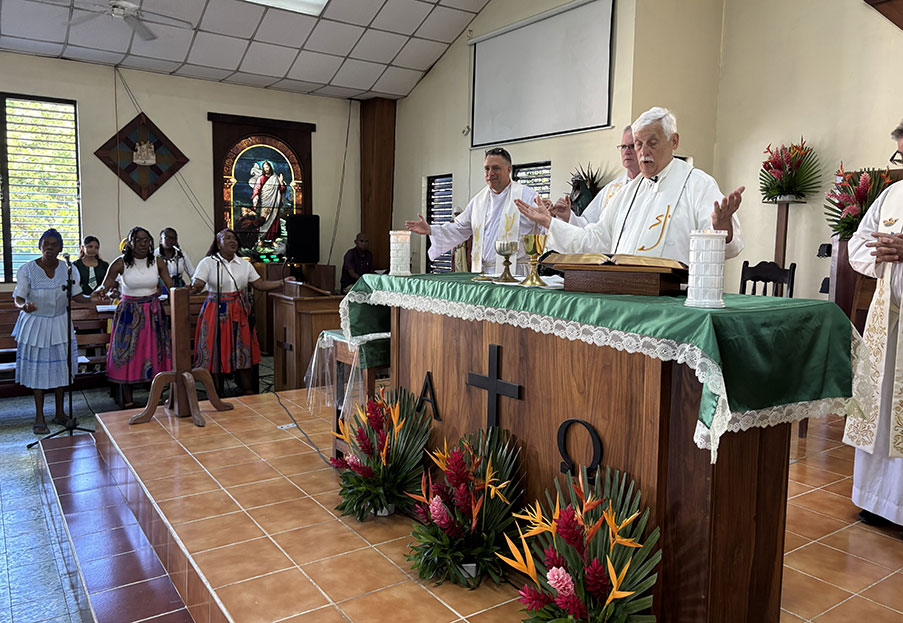
Fr Aric Serrano, SJ, is a Jesuit of the US Central and Southern Province. Born in Pecos, Texas, he was missioned to St. Peter Claver Parish in Punta Gorda, Belize after his ordination in 2023. He shares his reflection on the visit of Father General Arturo Sosa to the indigenous communities of southern Belize.
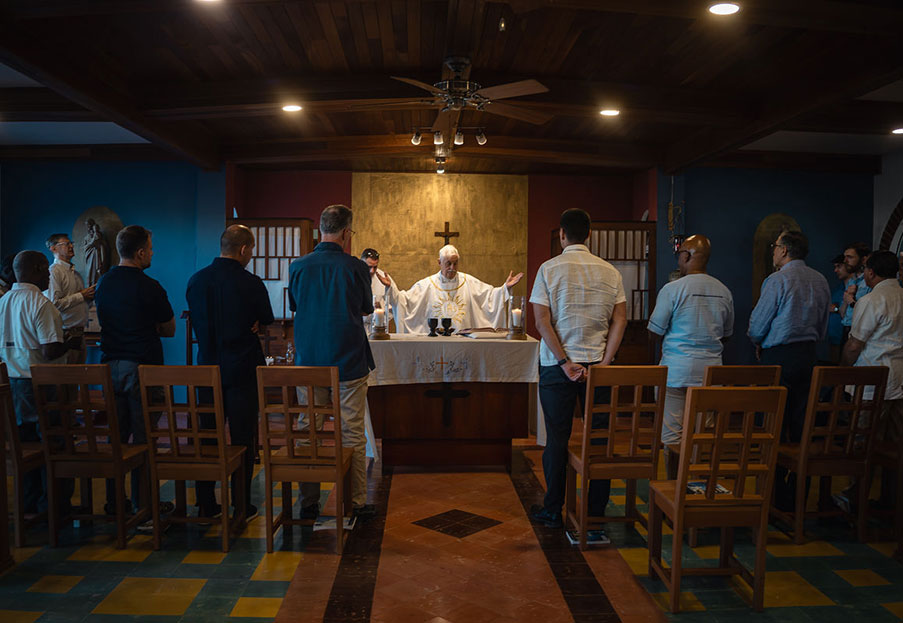
Fr General’s travels through the USA Central and Southern Province (UCS) continued with a visitation of Jesuit ministries in Belize. For 175 years, the Society of Jesus has been ministering to the people of the Central American country. The following is an excerpt of a brief history of the Society of Jesus in Belize...
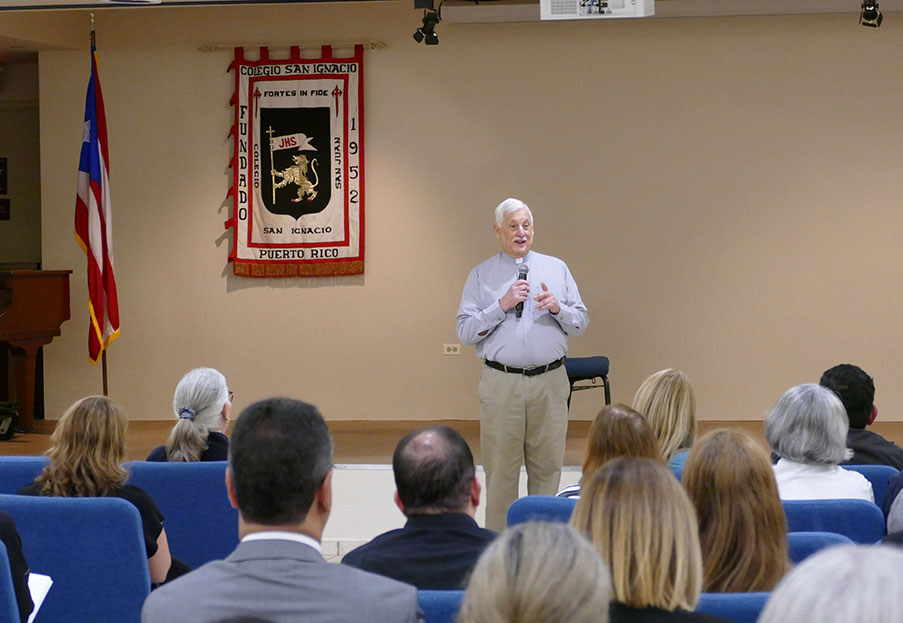
After touring Jesuit works in Denver, St. Louis, Houston, and New Orleans, Fr General Arturo Sosa landed in San Juan, Puerto Rico, to continue his official visitation of the Jesuit USA Central and Southern Province (UCS). His first stop was at the Centro Universitario Católico (CUC}...