Solar Power Innovation Expands in the USA Midwest Province
By Michael Austin, managing editor of Jesuits magazine for the USA Midwest Province (UMI)
The USA Midwest Province’s use of solar energy began with schools and now reaches to the rooftops of a Jesuit residence and the Province office itself.
About half of the Province office’s electricity comes from the 152 panels on the roof of the Chicago building. The panels, installed in 2025, produce 109,000 kWh of electricity and will save the Province about $15,000 per year. Solar panels atop Milwaukee’s Arrupe House, the first Jesuit community in the United States to go 100% solar, produce about 56,000 kWh of electricity and are expected to pay for themselves in less than eight years.
Naturally, these projects align with one of the four Universal Apostolic Preferences (UAPs) of the Society of Jesus, “Caring for Our Common Home”, and with the message of Pope Francis’ 2015 encyclical, Laudato si’. But they make sense for another important reason, too, says James Erler, provincial assistant for justice, ecology and reconciliation for the UMI Province. “This isn’t just the ethical thing to do”, Erler says. “It’s also fiscally smart and will save us a lot of money in the long run.”
Solar innovation in the UMI Province began at Gesu Jesuit Catholic Church and School in Detroit, where Sisters of the Immaculate Heart of Mary (IHM) have long been teachers, administrators, and pastoral ministers. The renovation of their Motherhouse, which achieved LEED certification, provided the important first step in making sustainability a moral mandate for the 21st century.
That project clearly served as inspiration because when a lay teacher at Gesu learned about the “My Solar School Contest”, students and faculty were instantly interested. After forming a Solar Energy Club in their historic 1925 building, they toured solar facilities and spoke to experts in the field. With the help of Gesu alumni, they created a solar power-themed video and entered the contest. Their video won third place and $500 in prize money.
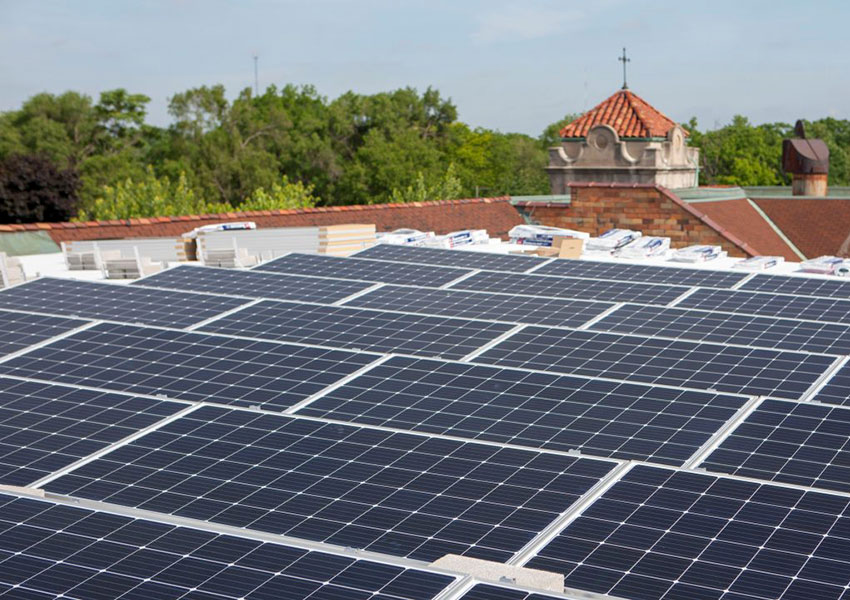
The ingenuity did not stop there. Drawing on the resources of their hometown – Detroit, the epicentre of the American automobile industry – Gesu students showed their video to the vice presidents of the UAW-Ford National Programs Center and requested funds to pay for solar panels at the school. The organization approved the request and granted Gesu $55,000. The school also received $5,000 from the My Solar School Contest’s sponsor,the Ecology Center in nearby Ann Arbor. A third grant came from Michigan Interfaith Power & Light, and in 2018, Gesu installed a 24-kilowatt solar system on its gymnasium roof. In 2021, Gesu won the national Cool Congregations Renewable Role Model award.
Through it all, Gesu students were able to research the benefits of solar energy and other sustainability issues. In doing so they learned about grant-seeking, advocacy, the health benefits of clean energy and their roles in protecting the environment. Air pollution is the third-leading cause of asthma, and solar energy reduces the air pollution that causes asthma. Gesu students learned that asthma afflicts 8% of all Americans, 20% of Michigan citizens, 27% of Detroiters. Since January 2019, Gesu has reduced its emissions by an average of 21 tons per year. The solar panels produce 17% of school’s energy during the academic year, and completely power both the school and the church over the summer.
More recently, Chicago’s Christ the King Jesuit College Prep (CTK) and Chicago Jesuit Academy (CJA) have implemented extensive solar power programs. Since January 2025, CJA’s 322 rooftop solar panels have supplied the tuition-free primary and middle school with more than 110,000 kWh of electricity. As of late 2025, savings had totalled more than $3,000. Since late October 2024, CTK, a co-educational high school in the Cristo Rey Network, has generated more than 401,778 kWh of electricity from its 719 rooftop solar panels, resulting in savings of nearly $44,000 by the end of December 2025.
All three school projects were paid for with federal, state and utility incentives along with the support of John and Susan Dewan, co-founders of Dewan Solar and The John & Susan Dewan Foundation in Chicago.
“Having solar panels installed at CTK is moving us further into a future we can all be proud of”, says Maggie Deady, a CTK social studies teacher. “Environmental sustainability is a key feature of our Catholic social teaching. It’s important for our students to see that we don’t just talk the talk, we also walk the walk when it comes to helping our environment and the climate change crisis.”

Related Posts:

Pope Francis raised climate change to global consciousness as the defining moral issue of our time. As a result, the Church has become a global voice urging political accountability and personal responsibility for healing the planet. Building on his legacy, Pope Leo vigorously calls for urgent climate action...

The annual meeting of Eco-Jesuit delegates in South Asia, held at Inigo Bhawan in Matigara, Darjeeling, became much more than a routine gathering. Set against the fragile ecology of the Eastern Himalayas, the meeting turned into a moment of discernment on the future...

The Social Justice and Ecology Secretariat (SJES) of the Society of Jesus has released its 2025 Annual Report, “The Promotion of Justice is Fueled by Hope”. The report details regional milestones at the conference level, the results of global advocacy, and its commitment to the mission of...

There is an ostensibly simple sign that hangs in the entryway of The Loyola School. It greets students and visitors alike as they step from the streets of Baltimore into what once was a string of rowhomes but now is a center for early learning and childhood development...

In the context of the First Conference on Transitioning Away from Fossil Fuels, which will be held in Santa Marta, Colombia, from 24 to 29 April 2026, the Jesuits for Climate Justice Campaign is presenting its Statement for COP31...
On a cool Advent morning, nine members of the Jesuit Media Lab community – an initiative sponsored by the Jesuit Conference of Canada and the United States to gather and support creators inspired by the Ignatian tradition – met at Georgetown University in Washington, D.C., the oldest...