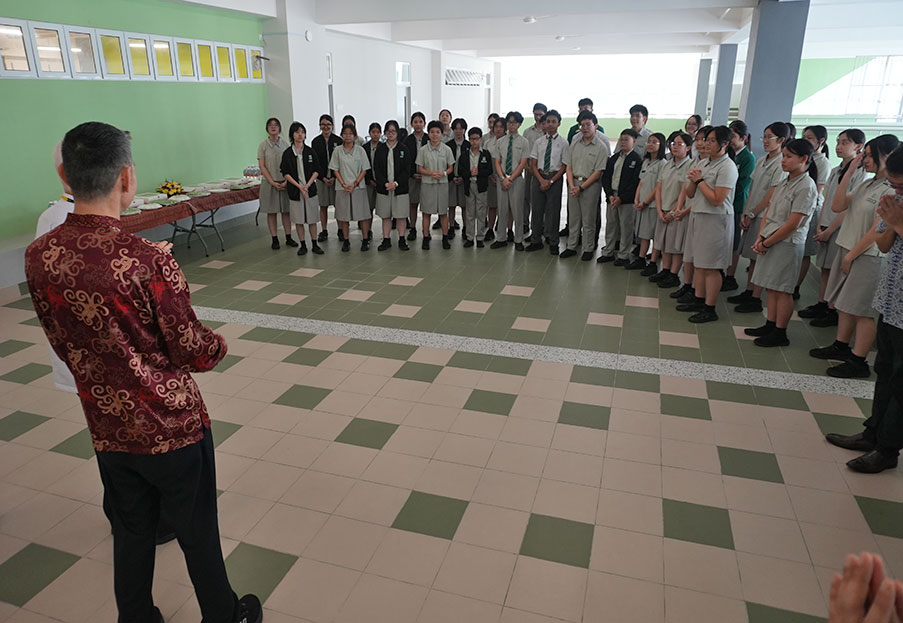
A Literary Pilgrimage: A Survey of Rare Jesuit Texts
By Rebecca Moon Ruark
On a cool Advent morning, nine members of the Jesuit Media Lab community – an initiative sponsored by the Jesuit Conference of Canada and the United States to gather and support creators inspired by the Ignatian tradition – met at Georgetown University in Washington, D.C., the oldest Catholic and Jesuit institution of higher learning in the United States. At the historic Hilltop Campus’ Lauinger Library we writers and poets, teachers and thinkers made our day’s pilgrimage to a special sort of shrine: one of rare books and archival materials that together sustain the unbroken heritage of Ignatian history, theology and creativity – nearly 500 years after its beginnings in a cave in Manresa, Spain.
Housed in the Booth Family Center for Special Collections, the library’s vast body of Jesuitica is “unparalleled”, according to the Library of Congress. Numbering in the many thousands, it includes the Woodstock Collection started by the shuttered seminary of the same name, the Maryland Province Archives, personal Jesuit papers and books by and about Jesuits – with more than 17,500 rare books housed there. Woodstock Librarian Adrian Vaagenes, along with Aleksandra Kinlen, Processor of the Jesuit Collections, and Mary Beth Corrigan, Librarian for Collections on Slavery, Memory, and Reconciliation, curated the volumes viewed by us modern-day, bookish pilgrims.
Vaagenes notes that there is “a bit of a sacramental quality to these material objects – both texts and archival pieces including correspondence, notebooks, diaries and scrapbooks – as an expression of individual life.” A steward of embodied history, Vaagenes collects and cares for the collection both as “historical witness” and for “love of neighbour” – today and for future generations.
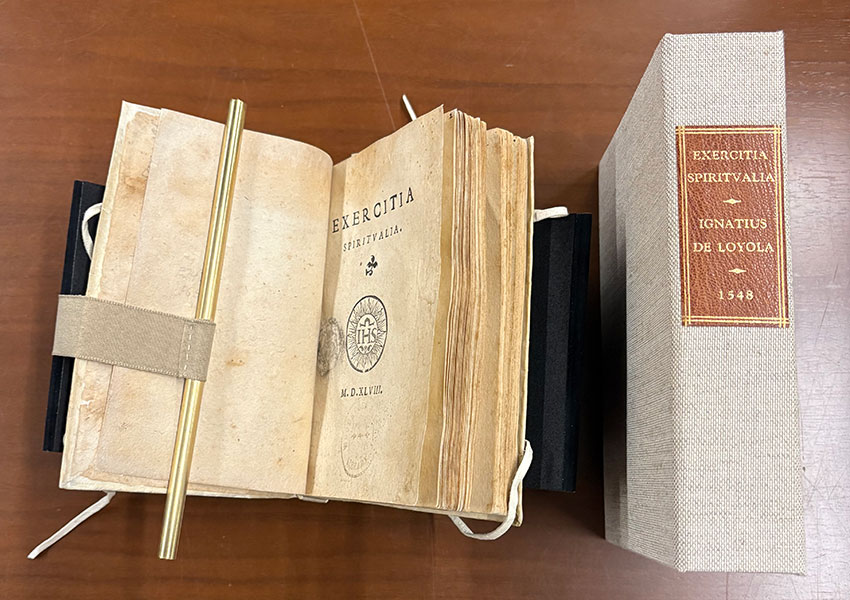
With five tables of materials before us, we searchers began at the beginning, with St Ignatius of Loyola’s founding call to contemplation, discernment and service: the 1548 first edition Exercitia spiritualia (Latin for “Spiritual Exercises”), with ownership stamps that chart the rare book’s journey from Old World to New World, library to library, over nearly half a millennium. With this text of fragile paper and vellum, we held in our hands the seed of the Ignatian charism, which has taken root the world over – and animated our creative selves and communities.
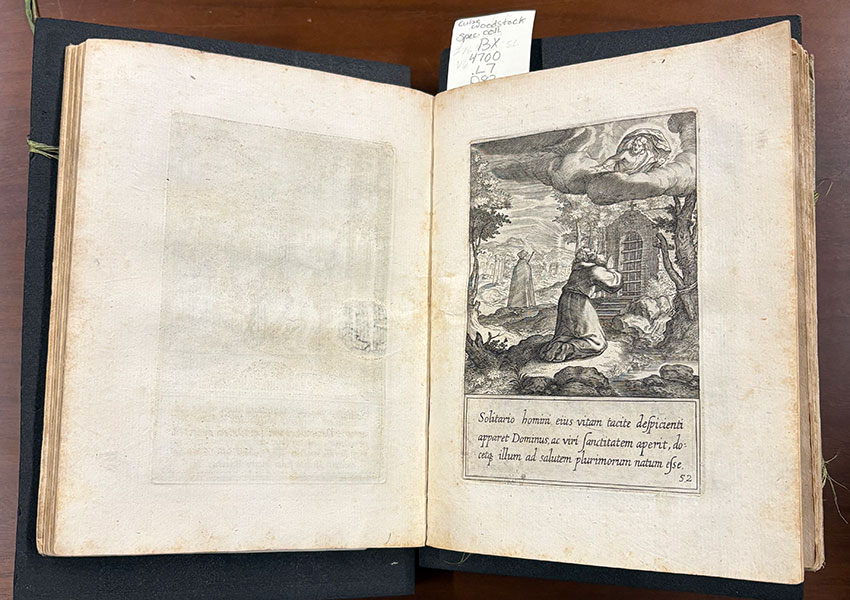
From early sources of Jesuit identity, including the 1583 Constitutions, which codified the mission for the Society of Jesus, the curators presented the Society’s turn to pedagogy with its 1598 Ratio Studiorum (“Plan of Studies”) and 1787 Proposal for Establishing an Academy, John Carroll’s plan to establish Georgetown College, founded in 1789. Rounding out the 18th century, we viewed the 1790 John Carroll sermon taking possession of the see of Baltimore, preached atSt. Peter’s Church, the seat of America’s first bishop John Carroll, an historic site, gone now, just an hour from Georgetown’s campus.
God in All Things
Much more than a theological, pedagogical, or geographical history lesson, the literary treasures set before us illuminated the early Jesuits’ wide-ranging interests in science, nature and the arts. The 1671 Ars Magna Lucis et Umbrae (“The Great Art of Light and Shadow”) by German Jesuit polymath Athanasius Kircher provides the first depiction of a “magic lantern”, an early projector and herald of modern cinema, an art form near and dear to us Jesuit Media Lab creators and cultural critics.
Then there was the large-scale 1874 Gospel of John written in English and hand-painted by a woman artist with flowers, leaves, vines, and insects – a beautiful example of the late 19th century’s Romantic movement. The highly decorative Bible stands as an accomplished artistic creation and a potent reminder of beauty as a powerful means of expressing one’s individual and collective transcendent faith.
A 1918 first edition volume of Gerard Manley Hopkins’ Poems was paired by the curators with an 1866 edition of Christina Rossetti’s The Prince’s Progress and other Poems. The Rossetti volume was inscribed and given to Hopkins (a convert who joined the Society in 1867 and was ordained in 1877) by his sister Kate, a devout Anglican who, after her brother’s death, helped bring his first edition to publication. Generations of poets and writers since have the siblings to thank for his poems of wildness like “God’s Grandeur” and lines like “Glory be to God for dappled things” that remind us creators to glorify even the imperfect – the messiness – of our God-made world.
Go to the world
An ancient theology can feel stagnant or, at best, static. An active collecting effort, the Jesuit collection tells an incarnate history, a story of America’s Maryland Province – for many years the centre of Jesuit training – and its national and global influences, impressions and people. Vaagenes notes the importance of taking both “inspiration and caution” from these embodied materials.
Among the cultural and vernacular artefacts depicting Jesuit evangelization in the American Colonies, the 1610 Manuale sacerdotum (a sacramental manual for priests) includes handwritten notes made by Andrew White, SJ, the “Apostle of Maryland” who helped found the colony for Catholics, celebrated the first Catholic Mass in what would become the United States in 1634, and developed linguistic tools for converting and educating the Native American population.
This catechism’s yellowed pages include a handwritten prayer translated into the dialect of the Piscataway people, the only place the original language survives; digitized for accessibility, the document continues to be used in partnership with the Piscataway Conoy Tribe and in teaching efforts at Georgetown University and beyond. Likewise, the collection’s documents that speak to the Jesuits’ owning of enslaved people in the United States are also openly available and are often used to teach – and aid in the work of reconciliation.
Fast-forward more than 300 years, and we find in the 1943 missionary guide, Vademecum for Catholic Chaplains, a manual to help chaplains navigate the spiritual needs of Catholic servicemen during World War II. The striking first line of the introduction feels instructional for all vocations in the business of prayer, justice and peace: “The mission entrusted to you is supernatural.”
As creators aspiring to live out the Ignatian charism during a time of unrest, injustice, and violence, our mission is also supernatural: to learn from living memory and allow it to guide the good fruits of our creative and spiritual endeavours.
Related Posts:

There is an ostensibly simple sign that hangs in the entryway of The Loyola School. It greets students and visitors alike as they step from the streets of Baltimore into what once was a string of rowhomes but now is a center for early learning and childhood development...

The USA Midwest Province’s use of solar energy began with schools and now reaches to the rooftops of a Jesuit residence and the Province office itself. About half of the Province office’s electricity comes from the 152 panels on the roof of the Chicago building...
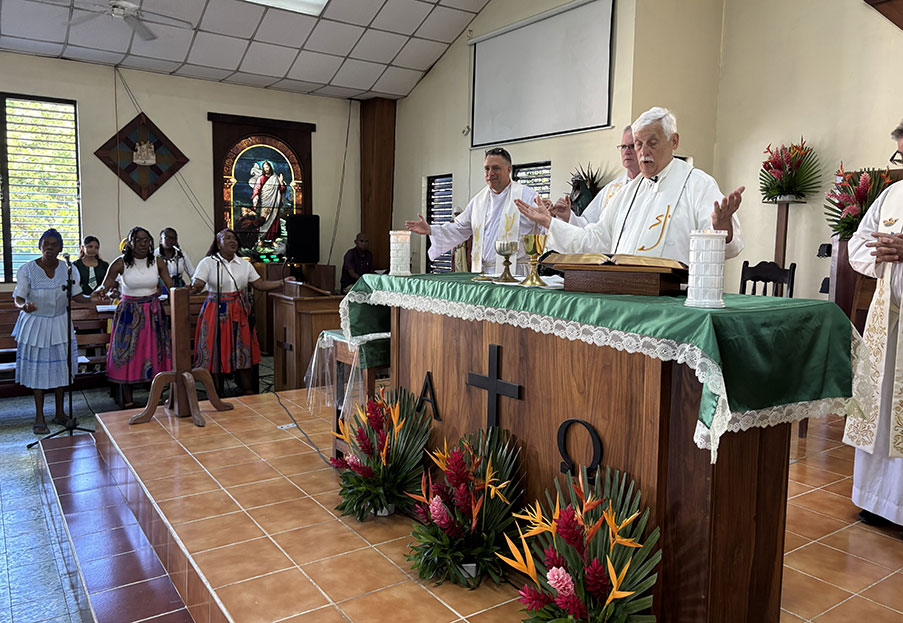
Fr Aric Serrano, SJ, is a Jesuit of the US Central and Southern Province. Born in Pecos, Texas, he was missioned to St. Peter Claver Parish in Punta Gorda, Belize after his ordination in 2023. He shares his reflection on the visit of Father General Arturo Sosa to the indigenous communities of southern Belize.
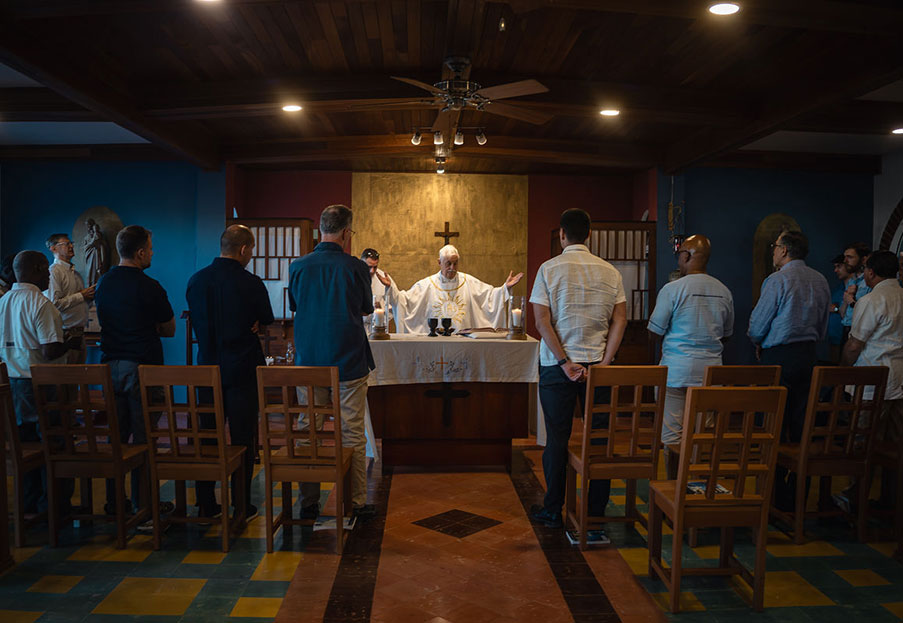
Fr General’s travels through the USA Central and Southern Province (UCS) continued with a visitation of Jesuit ministries in Belize. For 175 years, the Society of Jesus has been ministering to the people of the Central American country. The following is an excerpt of a brief history of the Society of Jesus in Belize...
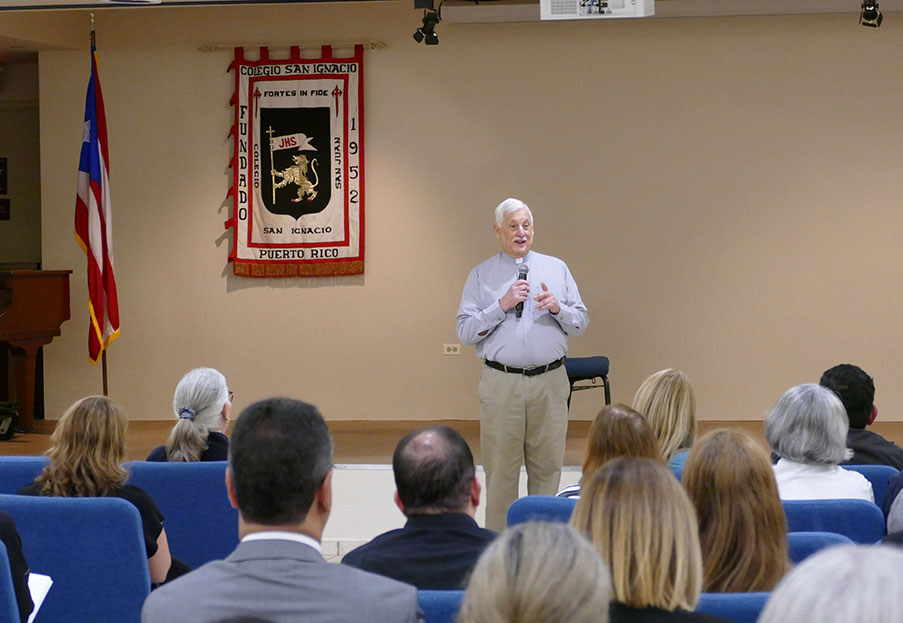
After touring Jesuit works in Denver, St. Louis, Houston, and New Orleans, Fr General Arturo Sosa landed in San Juan, Puerto Rico, to continue his official visitation of the Jesuit USA Central and Southern Province (UCS). His first stop was at the Centro Universitario Católico (CUC}...
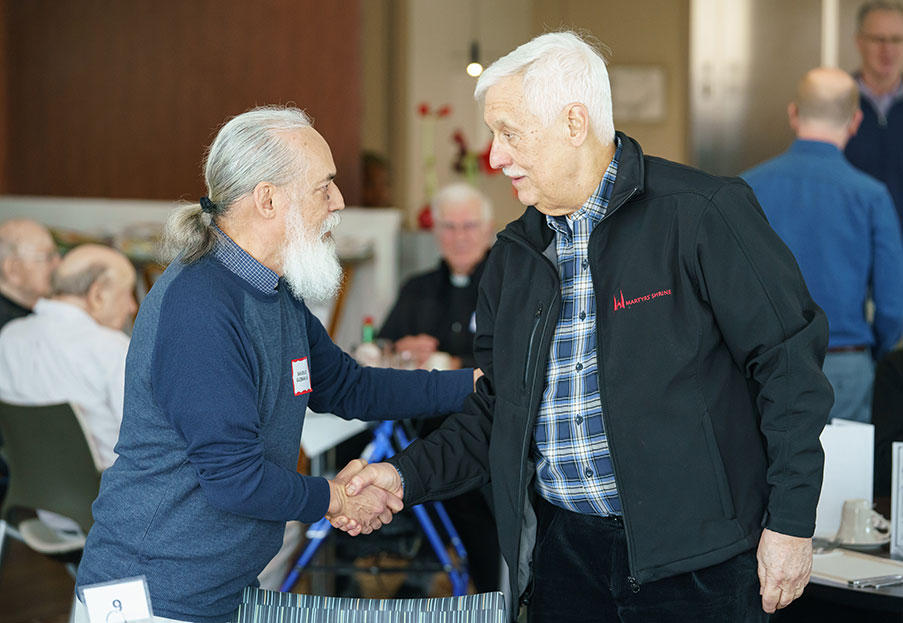
After visiting the novices of the Jesuit USA Central and Southern (UCS) Province in Denver, Superior General Arturo Sosa spent two days in St. Louis to observe the myriad Jesuit ministries in the area. The seat of the UCS Province, St. Louis is also home to the largest number of Jesuits and Jesuit works...