From Boston 2012 to Montreal 2027: A Global Survey of Jesuit Schools and Education Delegates in Review and Foresight
By Jimmy Bartolo, SJ | Secretary for Secondary and Presecondary Education
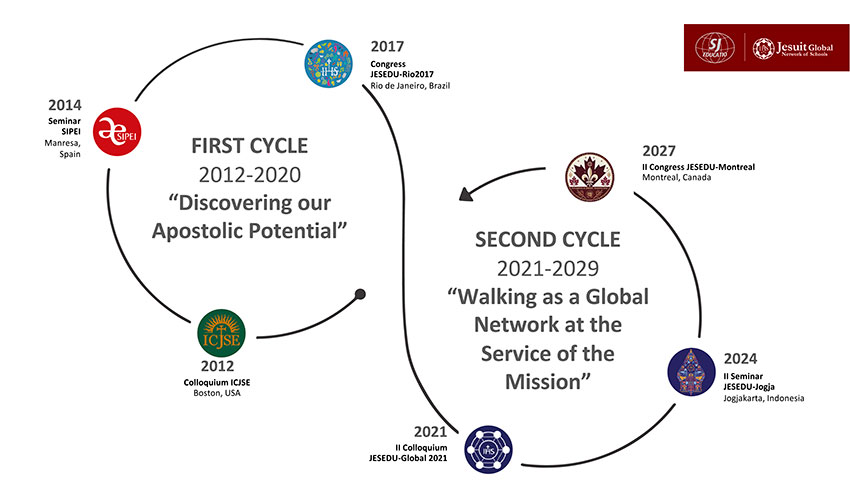
As the Society of Jesus prepares for the Second Congress JESEDU-Montréal 2027, which will bring together Provincial Delegates for Education from across the world, a significant moment of reflection and discernment lies ahead. This gathering will mark the conclusion of the second global cycle of collaboration among Jesuit and Companion Schools – a journey that began with the landmark Boston Colloquium in 2012 and has since fostered a dynamic and interconnected international educational network.
Over the past decade, this global process – structured through Colloquia, Seminars, and Congresses – has generated a coherent vision for Jesuit education. Each stage has contributed meaningfully: vision statements have guided direction, seminars have clarified priorities, and the first Congress JESEDU-Rio2017 articulated concrete actions. The publication of Jesuit Schools: A Living Tradition of Jesuit Education in the 21st Century in 2019 further deepened this shared mission by identifying ten global identifiers of Jesuit schools in the 21st century.
This body of work represents a strong and fruitful foundation. Yet, as the second cycle draws to a close, the question arises: how effectively have these insights been implemented across our diverse global contexts? More importantly, how can this accumulated experience guide Jesuit education into an uncertain and rapidly changing future?
The Need for Evaluation
A rigorous and honest evaluation is essential at this juncture. Such an evaluation is not merely retrospective; it is a vital instrument for renewal. By examining what has been achieved, where challenges persist, and which initiatives have borne fruit, the Society can move forward with clarity and purpose.
This process seeks to avoid two common pitfalls: repeating ineffective strategies and failing to recognise and expand successful ones. Instead, it aims to provide a grounded, evidence-based understanding of the current state of Jesuit education worldwide.
Importantly, the entire process will be carried out using a synodal methodology – marked by listening, participation, shared responsibility, and communal discernment. This ensures that the evaluation is not imposed from above but emerges from the lived experience and voices of those engaged in the mission.
Aims of the Evaluation
The evaluation, conducted in preparation for the II Congress JESEDU-Montreal 2027, will pursue several interrelated objectives:
• To assess the
extent to which action plans, vision statements, and the ten global identifiers
have been implemented across regional networks.
• To identify achievements that can be celebrated and shared more broadly.
• To analyse obstacles that have hindered implementation in different contexts.
• To offer an Ignatian reading of the present reality – attentive, discerning,
and oriented towards mission.
• To gather the insights of education delegates regarding the most pressing
challenges facing Jesuit education in the years ahead.
• To reflect on the role of the education delegate in the different Jesuit
Provinces.
• To explore what helps and hinders effective networking at a local, regional
and global levels.
• To formulate recommendations that will inform the action statement to be
discerned at the Montreal Congress.
• To strengthen responsibility and ownership among delegates and regional
leaders for the ongoing implementation of shared priorities.
The JESEDU Review and Foresight Group
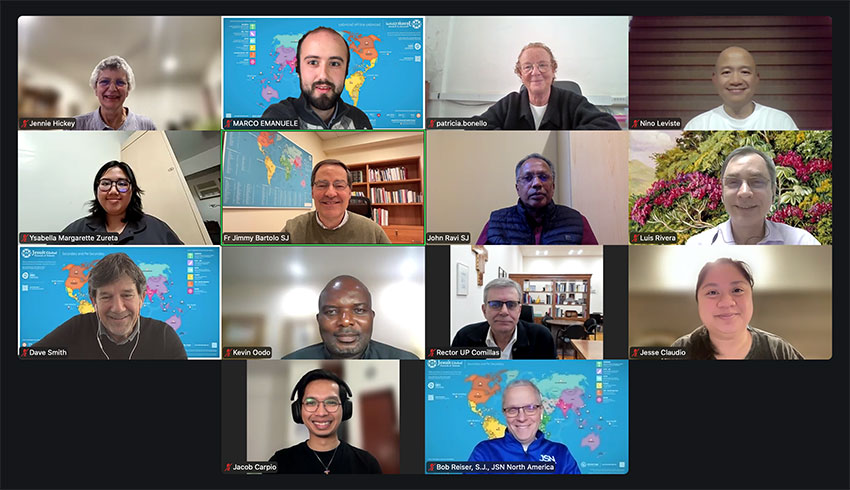
To guide and enrich this process, the Secretariat for Secondary and Presecondary Education has established a “JESEDU Review and Foresight Group”. This group is composed of experts in the field of Jesuit education representing the six Conferences of the Society of Jesus, ensuring a truly global perspective.
The role of this group will be twofold. First, it will accompany and critically engage with the evaluation process, helping to interpret findings with depth and coherence. Secondly, and crucially, it will contribute a foresight dimension – identifying emerging trends, challenges, and opportunities that will shape Jesuit education in the coming years.
By bringing together diverse expertise and regional insights, the group will help ensure that the outcomes of the evaluation are not only analytically sound but also strategically forward-looking.
Methodology: A Mixed-Methods Approach
The evaluation will adopt a robust mixed-methods design, combining quantitative and qualitative research.
• Quantitative analysis will be conducted through semi-structured questionnaires addressed to all heads of JESEDU educational institutions. This will provide a broad statistical overview of implementation across the global network.
• Qualitative analysis will be reserved for education delegates of the Society of Jesus. Through confidential, in-depth interviews, this phase will explore experiences, challenges, and insights that cannot be captured through numerical data alone.
The research will be carried out by a team of expert researchers and conducted in English, Spanish, and French to ensure inclusivity and depth of engagement. This dual approach will allow for both measurable data and nuanced understanding, respecting the diversity of cultural and regional realities. Throughout, the synodal approach will guide the methodology, privileging attentive listening and shared discernment.
The schedule of this process will ensure that delegates will have sufficient time to reflect on the findings prior to the Congress, enabling more meaningful and informed discernment.
A Forward-Looking Perspective
While grounded in evaluation, this initiative is fundamentally oriented towards the future. Jesuit education today operates within a complex and evolving global landscape marked by rapid technological change, shifting cultural dynamics, ecological crises, and increasing social inequalities. These realities demand not only reflection but foresight.
The evaluation, enriched by the work of the JESEDU Review and Foresight Group, will therefore intentionally include a forward-looking dimension. By listening carefully to education delegates and analysing emerging trends, it will seek to identify the key challenges and opportunities that Jesuit education must address in the coming years. Among these are likely to be:
• The integration of digital transformation with humanistic and spiritual formation
• The strengthening of global citizenship and intercultural dialogue
• The promotion of ecological responsibility in line with the Universal Apostolic Preferences
• The deepening of faith formation in increasingly pluralistic societies
• The formation and support of educators as mission-driven leaders
In this sense, the evaluation becomes an instrument of apostolic planning – helping the Society not only to understand where it stands, but to discern where it is called to go.
Conclusion
The preparation for II Congress JESEDU-Montreal 2027 represents a decisive moment for Jesuit education worldwide. By undertaking a comprehensive, synodal, and forward-looking evaluation, the Society of Jesus reaffirms its commitment to excellence, accountability, and mission.
This process is ultimately an investment in the future. It seeks to ensure that the next phase of Jesuit education is shaped not only by past achievements, but by a clear-eyed understanding of present realities and a courageous openness to what lies ahead.
Grounded in evidence, enriched by global expertise, inspired by tradition, and guided by discernment, the Montreal Congress has the potential to chart a renewed and hopeful course for Jesuit education in the years to come.

Related Posts:
École Fondamentale Saint Louis de Gonzague was built to give every child space to be included, to live and learn alongside others, and to recognize their dignity as human beings. When the Jesuits founded the school in September 2004, in a region greatly affected by...
As the Society of Jesus prepares for the II Congress JESEDU-Montreal 2027, a global process of review, discernment, and foresight is now underway. This initiative seeks to evaluate how the shared vision for Jesuit education has been implemented across the worldwide network of...

The Secretary for Secondary and Pre-secondary Education, with great joy and gratitude, announces that Fr Hugo Gómez Sevilla, SJ, a Jesuit leader with a wealth of valuable international leadership experience building networks, pastoral sensitivity, and a deep commitment to Jesuit education...
The ICAJE (International Commission on the Apostolate of Jesuit Education) and JGNS (Jesuit Global Network of Schools) Board meeting took place from 26 May to 29 May 2026, bringing together leaders of the global Jesuit educational apostolate to reflect on shared priorities...

After three years of being ad experimentum with the Jesuit Conference of Asia Pacific (JCAP), the Pakistan Jesuit Mission pauses to reflect on what it means to live and serve in this land. These years have not been easy. Pakistan is often described as an “arduous” place...
The International Commission on the Apostolate of Jesuit Education (ICAJE) supports the Secretariat for Secondary and Pre-Secondary Education in animating, coordinating, and renewing Jesuit education worldwide. Since its establishment in 1980, ICAJE has fostered collaboration...